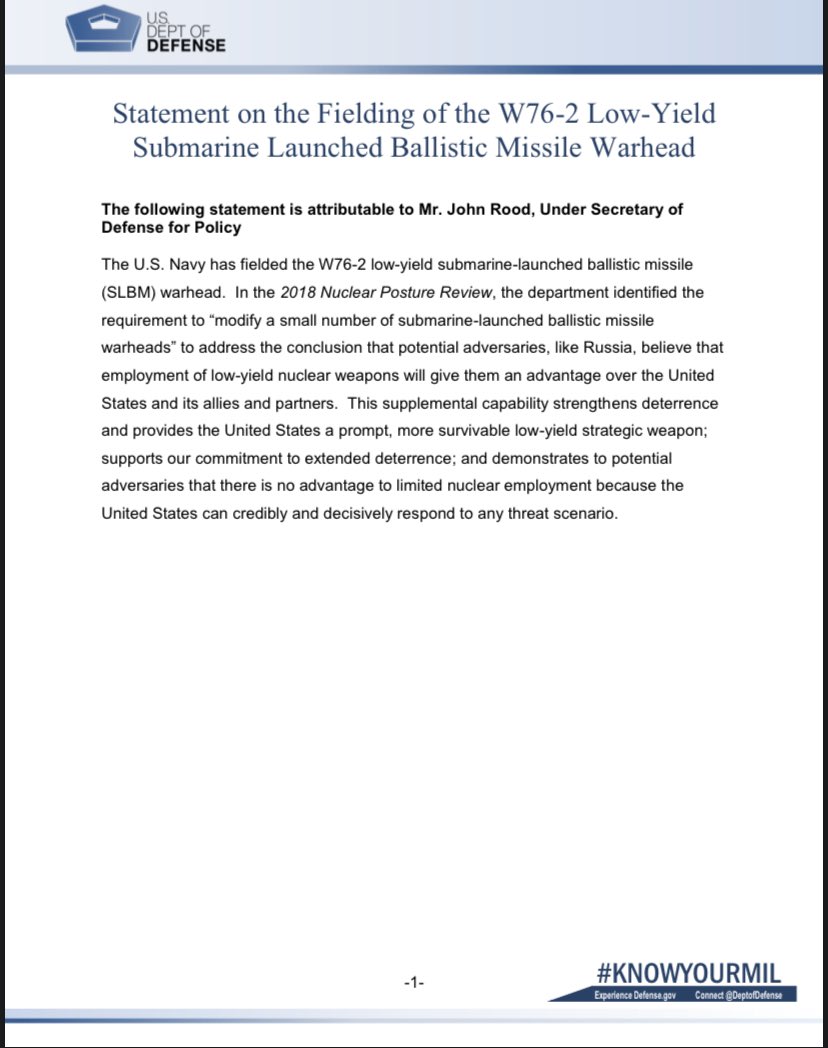
The U.S. Department of Defense has officially confirmed that U.S. Navy has fielded the new W76-2 low-yield submarine-launched ballistic missile (SLBM) warhead.
The warhead is a modification of the existing W76, which is used to arm submarine-launched Trident II missiles.
The advanced W76-2 warhead was first announced in the Trump administration’s Nuclear Posture Review (NPR) unveiled in February 2018. There, it was described as a capability to “help counter any mistaken perception of an exploitable ‘gap’ in U.S. regional deterrence capabilities,” a reference to Russia. The justification voiced by the administration was that the United States did not have a “prompt” and useable nuclear capability that could counter – and thus deter – Russian use of its own tactical nuclear capabilities.
The deployment of a new nuclear weapon aboard a submarine was first reported by Jan. 29 by the Federation of American Scientists.
Last week, The Federation of American Scientists published a report detailing their belief Ohio-class ballistic missile submarine USS Tennessee (SSBN-734) left the Kings Bay Submarine Base, Ga., for a strategic deterrent patrol at the end of 2019 carrying at least one W76-2 low yield warhead on a Trident submarine-launched ballistic missile (SLBM).
“We estimate that one or two of the 20 missiles on the USS Tennessee and subsequent subs will be armed with the W76-2, either singly or carrying multiple warheads. Each W76-2 is estimated to have an explosive yield of about five kilotons. The remaining 18 missiles on each submarine like the Tennessee carry either the 90-kiloton W76-1 or the 455-kiloton W88,” wrote Hans Kristensen, the director of the Nuclear Information Project at the Federation of American Scientists.
The Defense News reported that the warhead design is a modification of the W76-1 warhead for the Navy’s Trident ballistic missile, which has allowed NNSA to quickly turn around the design since it was ordered in last year’s Nuclear Posture Review. The warhead is designed to be smaller than the weapon detonated at Hiroshima, Japan, during World War II.