

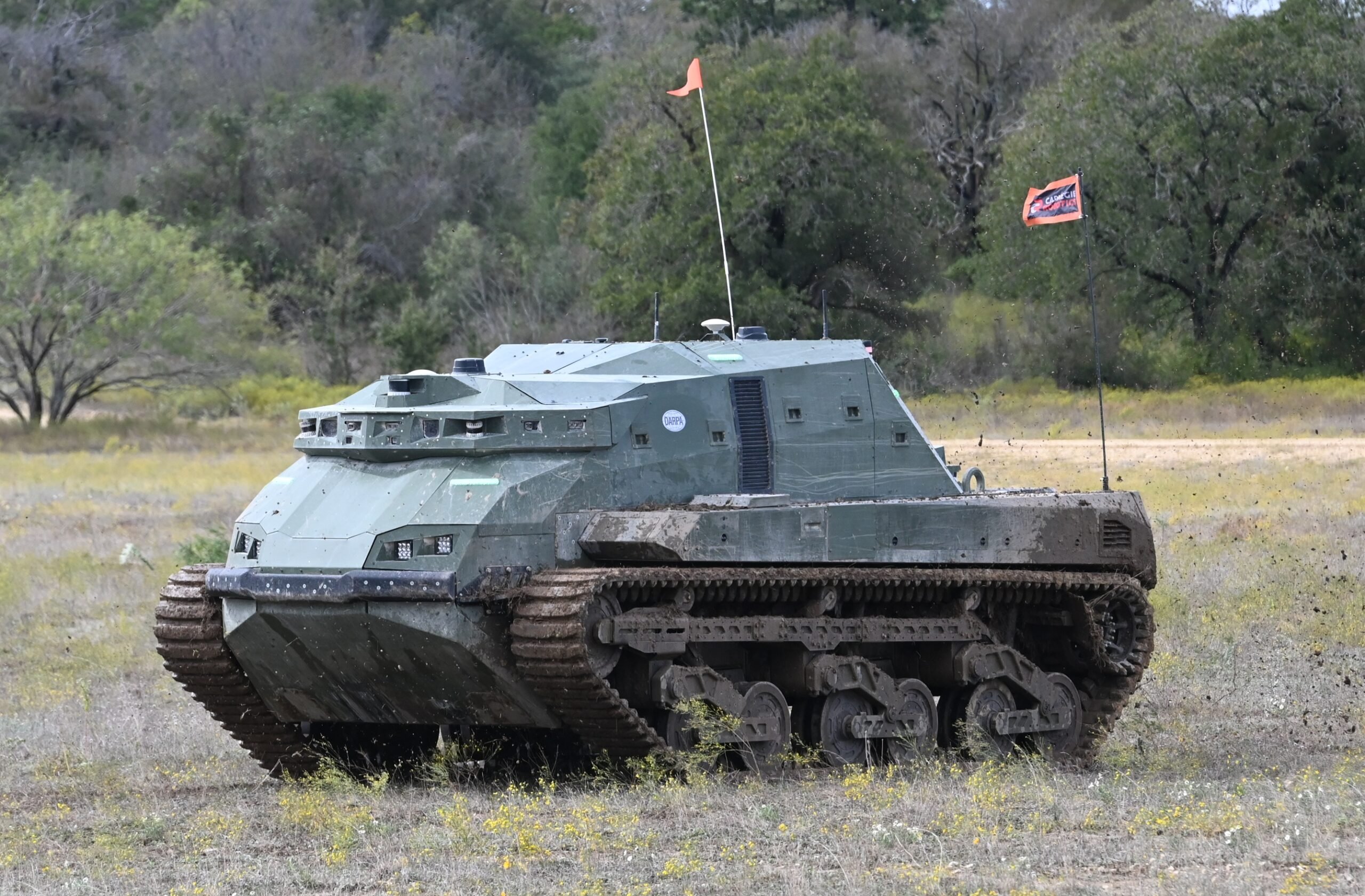
DARPA, the U.S. military’s research department, announced that it has tested fully unmanned robotic fighting vehicles.
The DARPA Robotics Autonomy Complex Environment Recognition (RACER) Experiment 4 (E4) unfolded across military training areas in Texas, showcasing significant advancements in autonomous military maneuvers.
Using fully unmanned robotic fighting vehicles (RFVs), the RACER initiative demonstrated autonomous movement within a 15-square-mile terrain encompassing diverse ground cover typical of complex Texas landscapes, including vegetation, trees, rocks, slopes, and water crossings.
Despite no prior exposure to the area’s sensor data sets, the RACER teams executed over 30 autonomous runs covering distances ranging from 3 to 10 miles, totaling more than 150 autonomous miles. These successful runs, conducted at speeds up to 30 miles per hour, underscored the adaptability and resilience of autonomy stacks, proving their efficacy in real-world scenarios.
Moreover, the RACER program commissioned the RACER Hardware Platform (RHP) to traverse over 30 miles autonomously, evaluating low-level autonomous control, gathering sensor data, and refining operational tactics. Additionally, software development commenced for global planning with tactics, with input from focus groups comprising uniformed subject matter experts stationed at the military base.
The RHP, built on the Textron M5 base platform and supported by Carnegie Robotics, serves as a crucial element for integrating autonomy hardware and software stacks. Collaborating institutions include the University of Washington, Overland AI, NASA’s Jet Propulsion Laboratory, Offroad Autonomy, Georgia Institute of Technology, and Duality Robotics.
The RACER E4 event follows previous experiments in 2022 and 2023, maintaining a biannual cadence to continually enhance robotic capabilities. DARPA’s commitment to advancing autonomy, inspired by the Grand Challenge’s legacy, persists, driving innovation in off-road military applications.
The spring of 2024 marks the 20th anniversary of DARPA’s Grand Challenge, a milestone in fostering American ingenuity in autonomous vehicle technologies. RACER’s progress represents a significant stride towards revolutionary autonomy, particularly in challenging off-road environments crucial for military operations.