

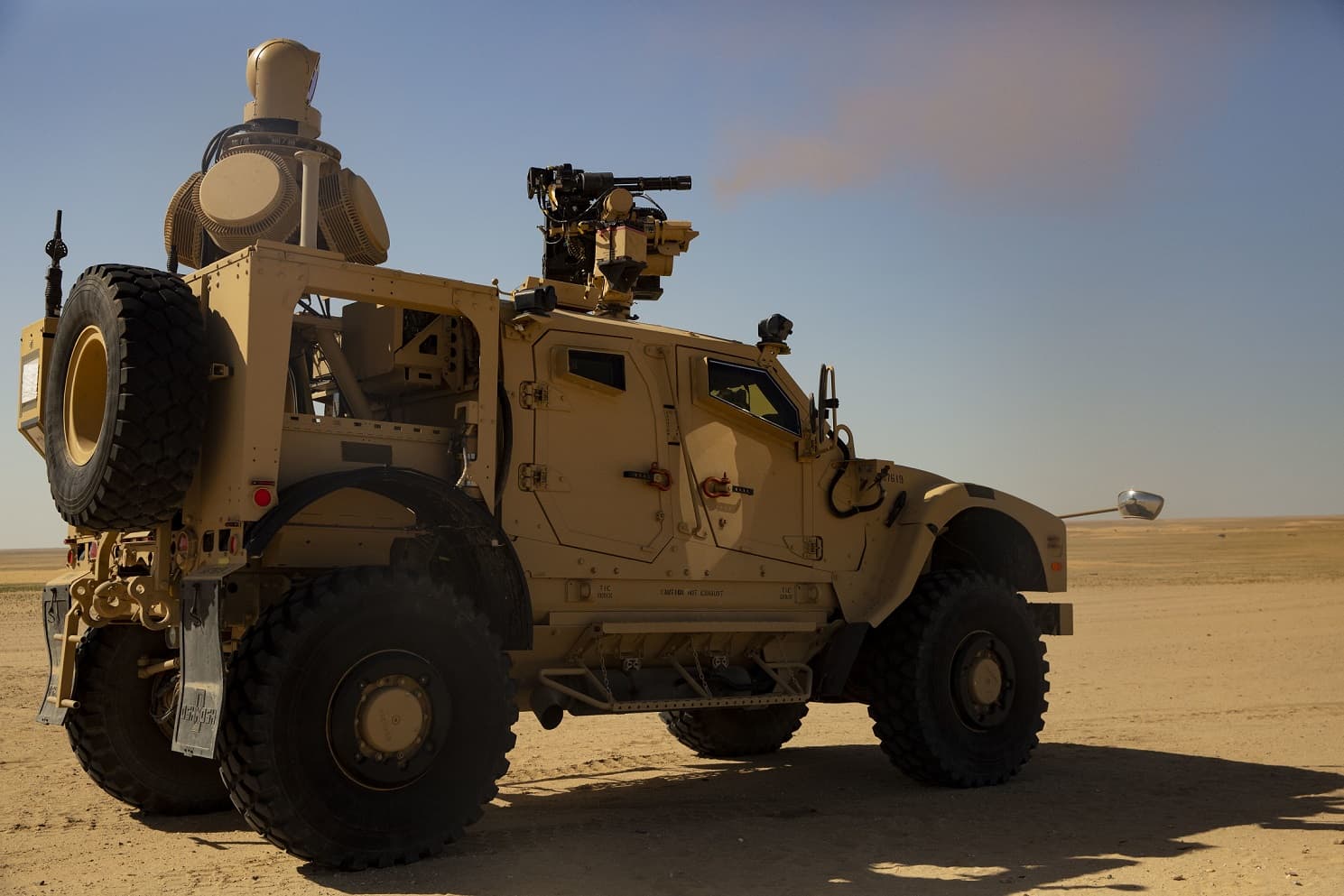
U.S. Army wants a new 360-degree counter-drone system

The U.S. Army is looking for information on a 360-degree counter-drone system capable to detect unmanned aircraft systems weighing less than 20 pounds.

The recently published post on the federal business opportunities website is asking industry for information for market research purposes to understand industry capability to provide a vehicle-based cueing sensor capable of providing real-time alerts to an existing on-board precision fire control radar (PFCR).

The Army Contracting Command disclosed request for a new cueing sensor that can be configured to operate on Army Ground Combat vehicles including HMMWV, Bradley, Stryker, Abrams, Joint Light Tactical Vehicle [JLTV], and next-generation combat vehicles.

- ADVERTISEMENT - CONTINUE READING BELOW -

The request stresses that new sensors should be small, lightweight, affordable, and be suitable for stationary and on-the-move operations.

The new counter-drone system should detect a group of an unmanned aerial system, with approximately 20 lbs takeoff weight, in 360 degrees of coverage from a stationary vehicle.

Also noted that cues must be provided/updated on no less than 10 simultaneous targets. No more than one false cue can be declared for every 100 nuisance targets detected.

The new system would be mounted to an Army’s combat vehicles that will detect, identify and defeat “ballistic low altitude drone” during stationary and on-the-move operations.

As a result of issuing this request for information, the U.S. Government expects to receive white papers describing proposed concepts and technologies. The request responses should identify sensor designs that will support the Armaments Center system concept and include a credible development path, with rough order magnitude estimates provided on costs and timeline.

Readers who wish to follow our weekly coverage can subscribe to the Weekly Defense Roundup.

If you wish to report a grammatical or factual error in this article, please let us know by using the online form.

Executive Editor
  • In this story
  • USA

Support The Defence Blog

Independent reporting takes resources. Join us on Patreon.

Become a patron

More Like This

Pentagon calls on Johns Hopkins for its Sentinel missile program

Johns Hopkins University's Applied Physics Laboratory in Laurel, Maryland, won a contract worth $199 million to provide research and development engineering support for the...

U.S. Air Force expands its arsenal of small combat drones

The U.S. Air Force has handed a Georgia drone maker a contract worth up to $90 million to build small, expendable aircraft designed to...

U.S. Marines test drove their future reconnaissance vehicle

The U.S. Marine Corps' Program Manager Light Armored Vehicles held what the service calls a Marine Touchpoint event last month for the Advanced Reconnaissance...

Sikorsky and BETA team up on unmanned supply aircraft

A helicopter maker and an electric aircraft startup just proved they can bolt cutting-edge autonomy software onto a brand-new aircraft in under two weeks,...

Lockheed’s new drone killer packs a microwave weapon

Lockheed Martin unveiled MORFIUS X-Rotor at the Farnborough International Airshow, an airborne counter-drone system built around a high-power microwave weapon that the company says...

IAI turns a business jet into a multi-mission spy plane

Israel Aerospace Industries introduced ELLYON, a multi-mission aircraft that combines electronic attack capabilities with advanced intelligence-gathering sensors into what the company calls a single,...