

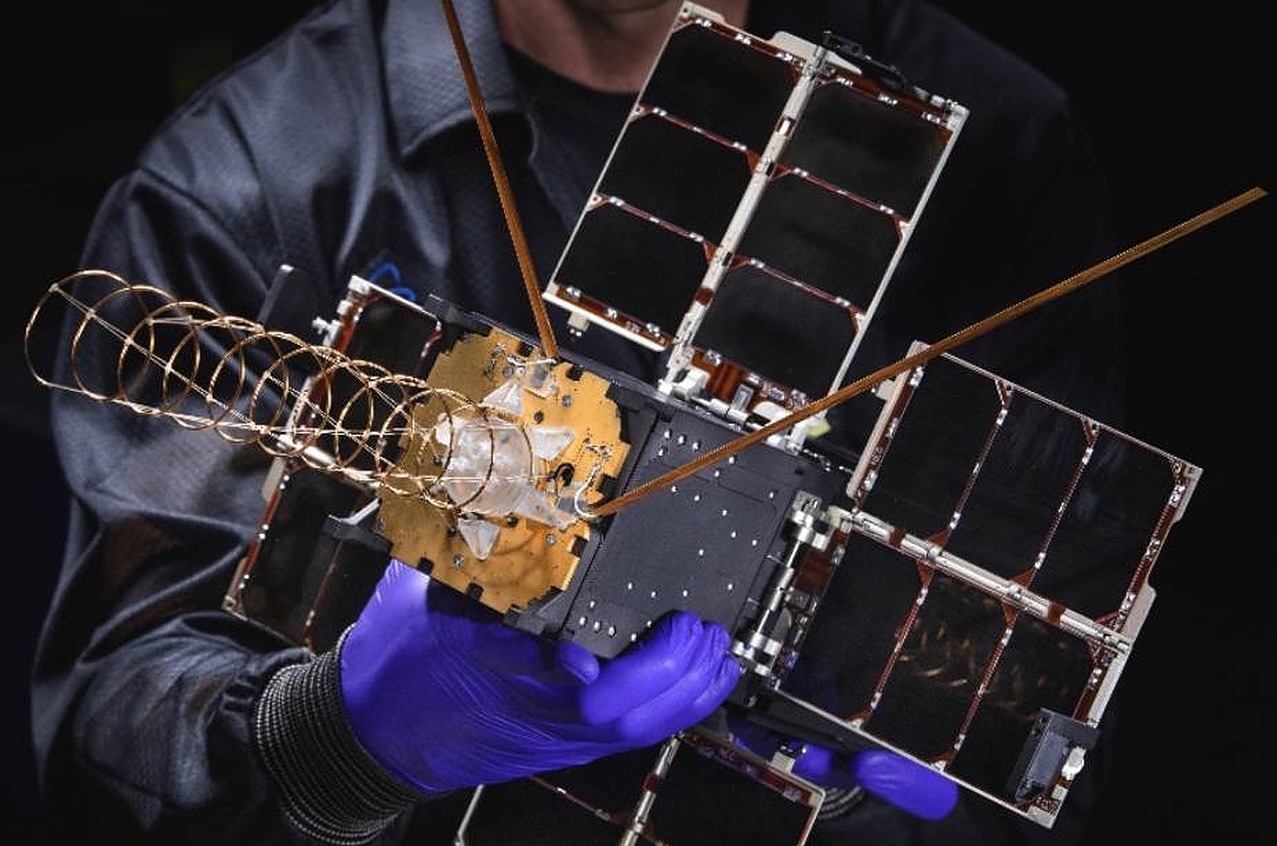
The U.S. Army releases additional details on its plan to build a constellation of bread loaf-size satellites into orbit to deliver new capabilities across the battlefield.
The Army has worked to develop a new type of tiny satellite that will carry next-generation tactical space support payloads designed to operate in low earth orbit. As part of this initiative was developed the 3U CubeSat Gunsmoke-J technology fostering innovations for tactical ground forces.
The Army Space and Missile Defense Command’s first and third Gunsmoke-J satellites, a joint capability technology demonstration by the USASMDC Technical Center and Assured Position Navigation and Timing/Space Cross Functional Team, were placed into orbit, June 30, by two very different paths.
The first CubeSat was deployed from the Cygnus cargo vessel S.S. Katherine Johnson as a secondary mission shortly after it undocked from the International Space Station.
“We were very lucky to have this unique opportunity to place our satellite into orbit, and we extend our gratitude to those involved for making this a reality,” said Rebecca Nagurney, Gunsmoke deputy program manager. “What this group and our Gunsmoke-J team has accomplished over the past few months is amazing and is a testament to what true teamwork can achieve.”
“We were very lucky to have this unique opportunity to place our satellite into orbit, and we extend our gratitude to those involved for making this a reality,” said Rebecca Nagurney, Gunsmoke deputy program manager. “What this group and our Gunsmoke-J team has accomplished over the past few months is amazing and is a testament to what true teamwork can achieve.”
The third CubeSat was air-launched into orbit by a 747 carrier aircraft from Mojave Air and Space Port in Mojave, California. It was flown out to a launch site over the Pacific Ocean, about 50 miles south of the Channel Islands. After a smooth release from the aircraft, the LauncherOne rocket ignited and propelled itself toward space, ultimately deploying its payload into an orbit approximately 500 km above the Earth’s surface.
“This deployment and same day launch of two separate Gunsmoke-J satellites is a major step toward demonstrating what we believe will be enabling tactical warfighter capability,” said Wheeler “Chip” Hardy, division chief, USASMDC Technical Center Space Directorate’s Space Applications Division. “We are excited to be at this point after five years of development. This is the culmination of a lot of hard work by a lot of people to get to this point. We look forward to the verifying demonstrations and a possible future transition of the technology to the tactical forces.”
The Gunsmoke-J science and technology effort will provide new and advanced capabilities to tactical warfighters in a satellite about the size of a loaf of bread. Its experiments will show how its sensors can provide critical data and information key in multi-domain operations. The effort will also help inform future acquisition decisions.
“We are very excited because now we can begin our checkout and mission operations as our work is part of a science and technology demonstration effort,” Nagurney said. “If the Gunsmoke experiments are successful, then this work could lead to future systems, which would enhance long-range precision fires in support of the warfighter.”
Gunsmoke and potential follow-on small satellite systems are designed to provide information or sufficient data relative to tactical decision-making that is delivered in a timely manner.
“The team has worked extremely hard on this effort so it was thrilling to watch a successful launch,” Nagurney said. “It is very rewarding to work on a program like Gunsmoke where our work is going to impact future technology and Army acquisition decisions to help support the warfighter.”