

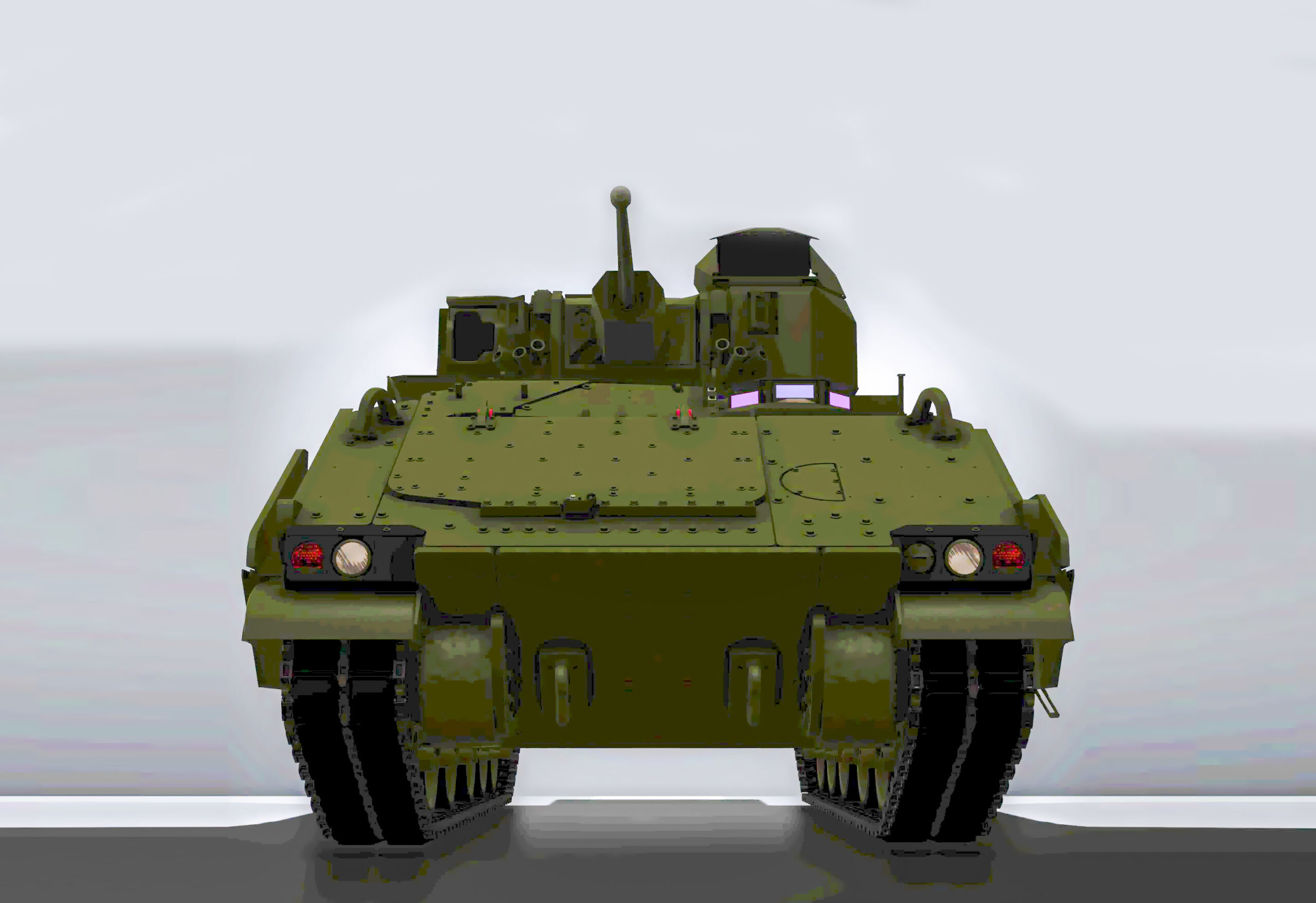
U.K. aerospace giant BAE Systems released more details about its concept of the U.S. Army’s Optionally Manned Fighting Vehicle (OMFV).
The OMFV project is a key element of the U.S. Army’s Next-Generation Combat Vehicle modernization effort aims to ultimately replace the decades-old Bradley.
According to a company news release, BAE Systems was awarded a contract from the Army for the OMFV program.
During this phase, BAE Systems will further develop a design that will meet – with ample growth and adaptability – the Army’s needs for lethality, mobility and survivability on future battlefields.
BAE Systems, along with teammate Elbit Systems of America, will explore crew automation, active protection, and other transformational combat vehicle technologies and turret solutions that will deliver the advanced warfighting capabilities the Army needs for the future.
“Our Soldiers on the future battlefield should set the pace of the fight and dominate in lethality, survivability, and mobility through technology,” Jim Miller, director of business development at BAE Systems, said. “The conceptual design phase allows us to demonstrate how we marry future technology with our integration and production experience to deliver a new level of capability to our troops on an ever-changing, interconnected, multi-domain, joint battlefield.”
BAE Systems’ OMFV design will provide a highly maneuverable and survivable solution for the Army’s Armored Brigade Combat Team (ABCT) to engage in close combat and deliver decisive lethality. BAE Systems’ solution will accommodate a host of targeting systems that will share threat and target data across the ABCT team, and will help protect soldiers as they get to the fight.
BAE Systems’ OMFV concept is an integrated system of systems based on a Modular Open Systems Approach (MOSA), which allows for rapid upgrades and technology refresh for quick insertion of new innovations or to counter emerging threats. MOSA solutions also help lower lifecycle sustainment costs and enable commonality across platforms.
Preliminary design work on the contract will take place in York, Pennsylvania; Sterling Heights, Michigan; Minneapolis, Minnesota; and San Jose, California.