

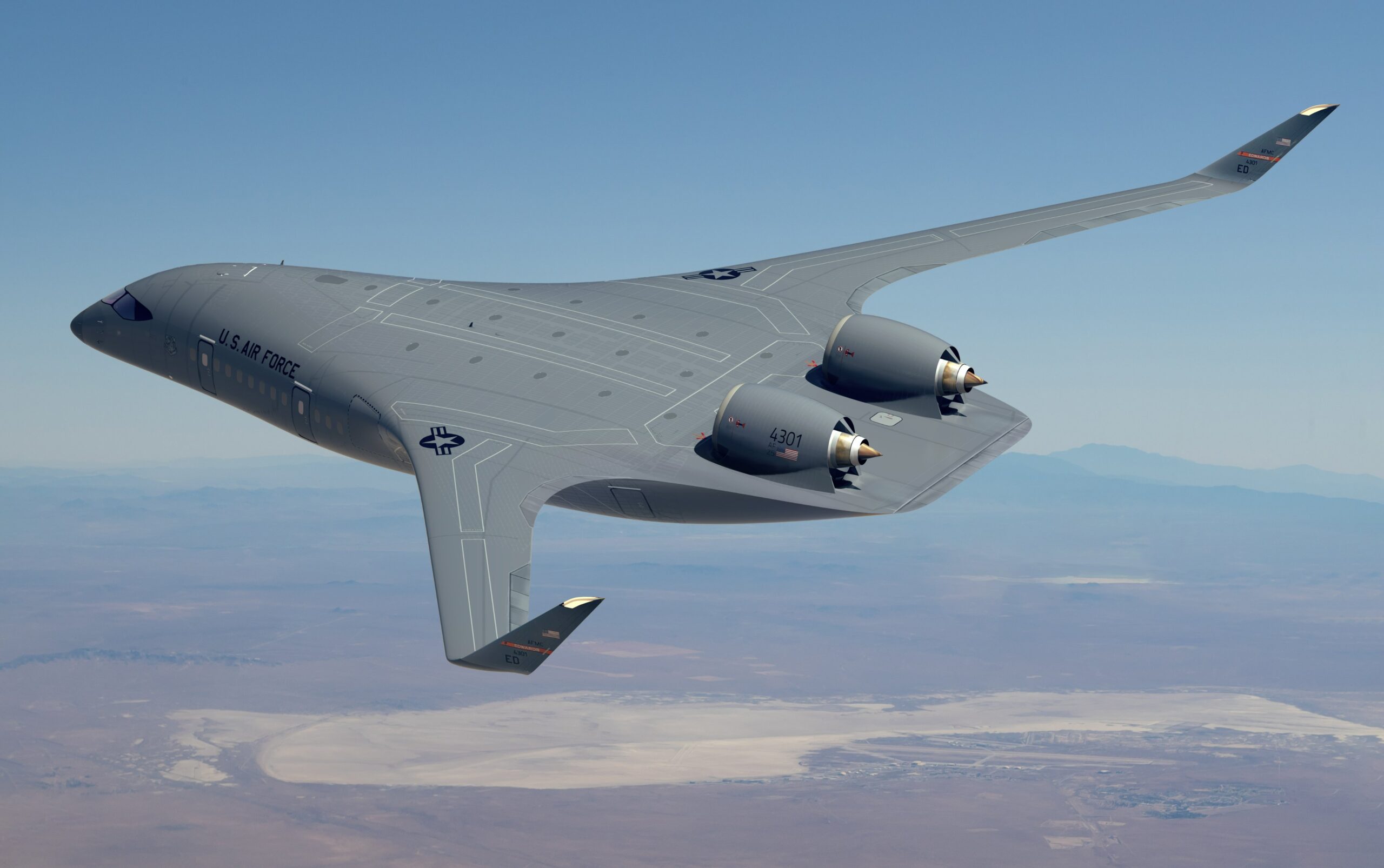
Defense giant Northrop Grumman Corp. has officially joined the U.S. Air Force’s highly-efficient blended wing program.
“We joined JetZero and Air Force officials for the Blended Wing Body Aircraft Prototype Project Announcement and panel discussion,” the company said in a Twitter post.
The Air Force is investing in JetZero’s aircraft design that will reduce fuel consumption, cut emissions and noise, and provide an improved airline passenger experience. The company will build a full-scale demonstrator to validate BWB performance.
As air traffic grows at a projected rate of 3.6 percent annually, decarbonizing the industry becomes even more challenging. The global airline fleet is projected to nearly double to 47,700 aircraft by 2041, according to Cirium, an aviation analytics firm. JetZero aircraft can play an essential role in reducing the industry’s carbon
footprint.
JetZero’s demonstrator, the first in a proposed family of BWB aircraft, uses current engines and systems. The blended wing body aircraft, a design that has been under study by NASA and others for three decades, lends itself to conversion in the future to hydrogen propulsion, which would produce zero carbon emissions.
Under the terms of the award from DoD’s Defense Innovation Unit, JetZero will receive $235 million over a four-year period, culminating in first flight of the full-scale demonstrator by the first quarter of 2027. The DIU was founded in 2015 to help the U.S. military make faster use of emerging commercial technologies.
JetZero is collaborating with Northrop Grumman and Scaled Composites, who bring extensive experience in advanced aircraft design, manufacturing, and mission systems integration to build and test the full-scale demonstrator. And Jet Zero has selected Pratt & Whitney GTF™ engines to power the demonstrator, with Pratt & Whitney GATORWORKS supporting JetZero with design and integration of the propulsion system within the demonstrator.
“The BWB is the best first step on the path to zero carbon emissions. It offers 50% lower fuel burn using today’s engines and the airframe efficiency needed to support a transition to zero carbon emissions propulsion in the future,” said JetZero CEO Tom O’Leary, “No other proposed aircraft comes close in terms of
efficiency.”
JetZero is leading efforts to expand BWB technology and demonstrate its capabilities for the future of aviation and the climate for both military and commercial markets.