

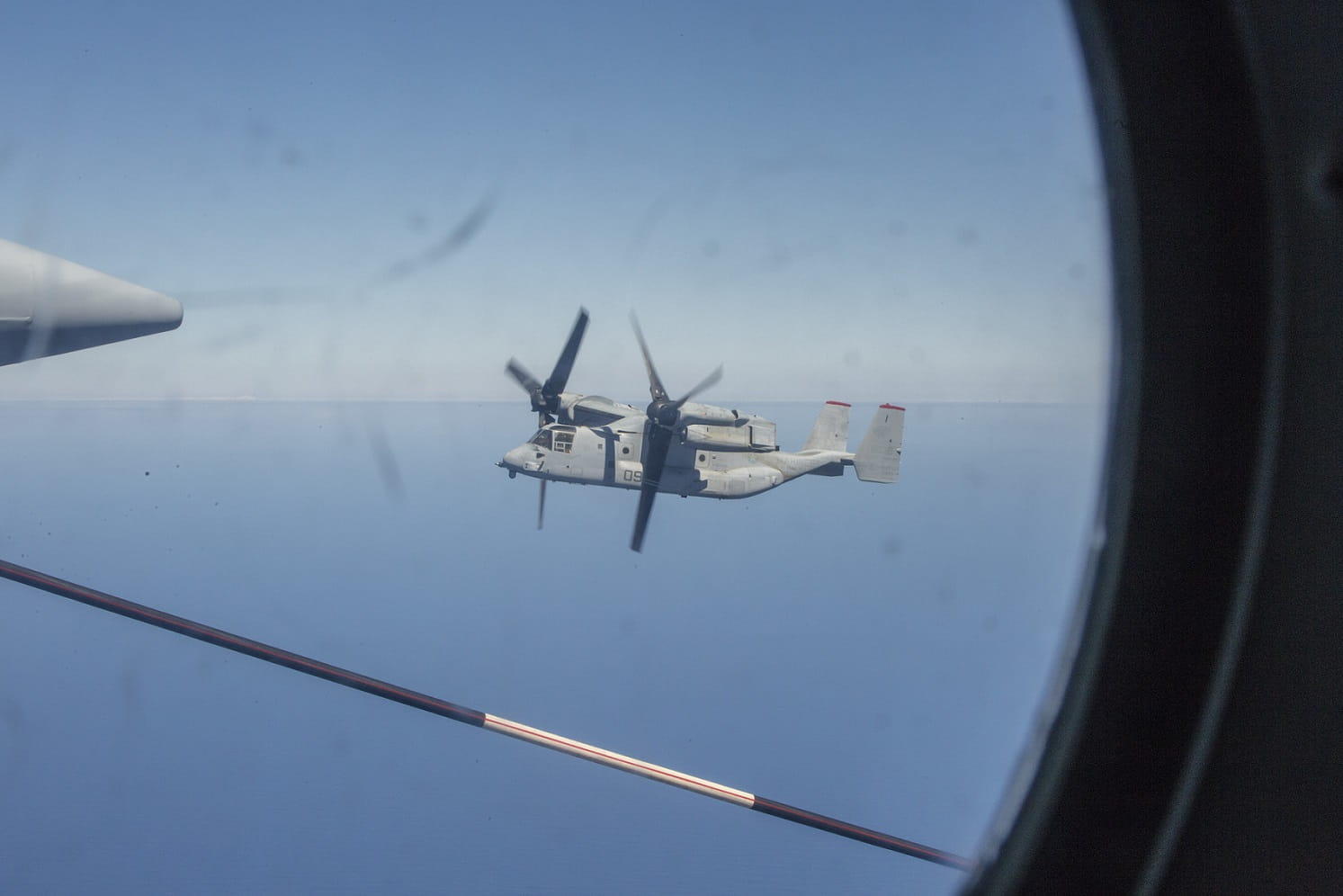
U.S. Marines with Marine Rotational Force – Darwin completed a trans-Pacific flight in MV-22 Osprey tilt-rotor aircraft for the fourth time, transiting from Darwin, Australia to their home station on Marine Corps Base Hawaii on September 19, according to a recent service news release.
The flight consisted of four MV-22 Ospreys from Marine Medium Tiltrotor Squadron 363, Reinforced, supported by two KC-130J Hercules from Marine Aerial Refueler Transport Squadron 152, and was conducted to improve upon the Osprey trans-Pacific concept that had been developed and refined over the past three MRF-D iterations.
“Being able to fly our aircraft from Australia to Hawaii is a great example of the flexibility and options that the Ospreys create for a commander,” said U.S. Marine Maj. Kyle Ladwig, operations officer for Marine Medium Tiltrotor Squadron 363, Reinforced.
For an aircraft that is accustomed to getting combat-loaded Marines in and out of landing zones, the trans-Pacific flight demonstrated the tremendous breadth of capability the Osprey brings to the table, according to Ladwig.
The KC-130J Hercules escorted the Osprey on each leg of the trans-Pacific journey, stopping at islands along the route where the aircrews could rest and refit and aircraft could be topped-off with fuel. The Hercules increased the range of the Ospreys by conducting air-to-air refueling, allowing the aircraft to make longer trips without landing.
“We are responsible for managing the fuel state of all aircraft in their flight during tactical ferries of assets from location to another with minimal or no viable diverts,” said U.S. Marine Capt. Anthony Walters, the KC-130J strategic area refueling commander for the trans-Pacific mission. “On this trip, we pioneered a southerly island hopping route with plentiful diverts to safely employ the MV-22s to or from MRF-D and Hawaii,” he continued.
A part of the Marine Rotational Force – Darwin aviation combat element, the Ospreys that flew this mission were in Australia for the previous six months supporting the robust MRF-D training schedule, which comprised of more than a dozen exercises across the continent.
The MV-22 Osprey is a highly capable aircraft, combining the vertical capability of a helicopter with the speed and the range of a fixed-wing aircraft.