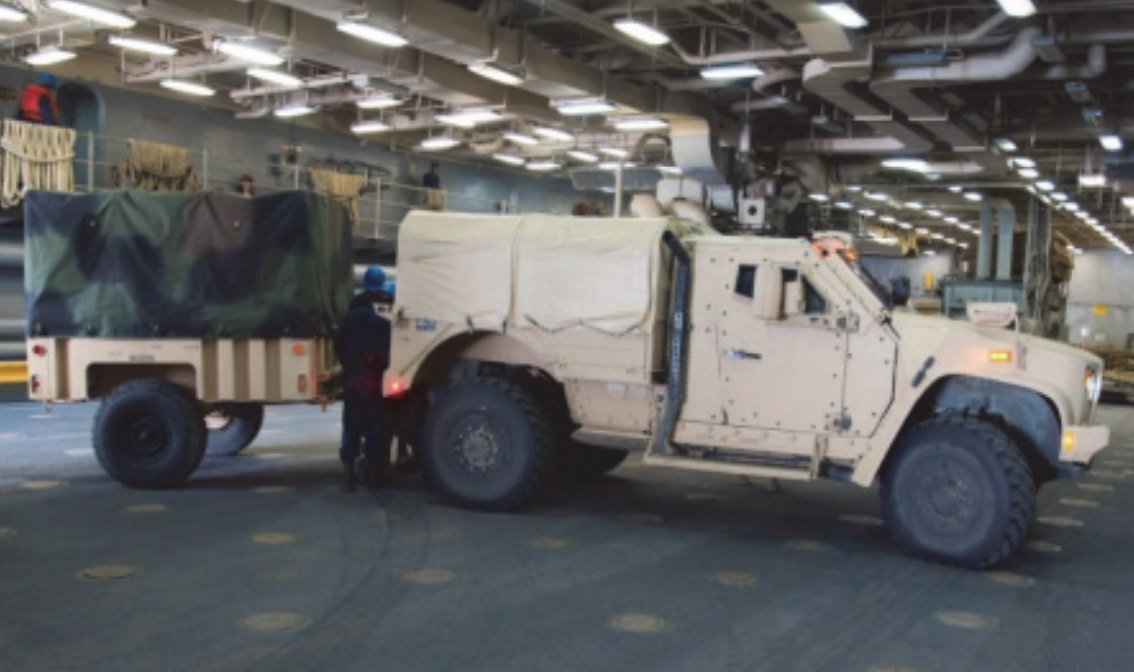
The U.S. Army is seeking information from industry for the production of the Joint Light Tactical Vehicles (JLTV) Family of Vehicles – Trailers (T), or JLTV-T.
On June. 28, the U.S. Army Contracting Command posted a notice on the U.S. government’s main contracting website, asking for information from contractors about their ability to produce companion trailer (JLTV-T), towable by all JLTV variants.
The JLTV family of vehicles is a material solution intended to provide ground transport to mounted Infantry, Combat Arms, and Combat Service Support Forces.
The intent of the JLTV program is to provide a mobile, lightweight tactical vehicle that fills capability gaps, regains transportability, and restores balance in the “iron triangle” of protection, payload, and performance. The JLTV provides protected, sustained, networked light tactical mobility to enhance the effectiveness of ground combat and supporting forces. It is also capable of moving over long distances within a theater of operations using a variety of lift assets, including sealift, amphibious ships and airlift capabilities both fixed and rotary wing.
The JLTV’s family is comprised of two variants, a four-seat and a two-seat variant, a companion trailer (JLTV-T), and associated kits. The four-seat variant has two Base Vehicle Platforms: the General Purpose (GP) and the Close Combat Weapons Carrier (CCWC). The GP platform has two Mission Package Configurations, the GP and the Heavy Guns Carrier (HGC). The CCWC platform has only the CCWC Mission Package Configuration. The two-seat variant has one Base Vehicle Platform: the Utility (UTL). Each base vehicle platform will be configured as a Mission Package Configuration through the installation of various kits.
According to media reports in recent weeks, Dr. Bruce Jette, Assistant Secretary of the Army for Acquisition, Logistics and Technology, approved the Joint Light Tactical Vehicle (JLTV) program’s transition into Full-Rate Production.
According to a statement released by the Program Executive Office for Combat Support & Combat Service Support, the approval follows an Army decision in December 2018 to begin fielding the new platform with the Army’s 1st Brigade, 3rd Infantry Division, Fort Stewart, Georgia, in April. The 1-3 ID became the Army’s first unit equipped with JLTVs in April 2019, after receiving more than 300 vehicles.