

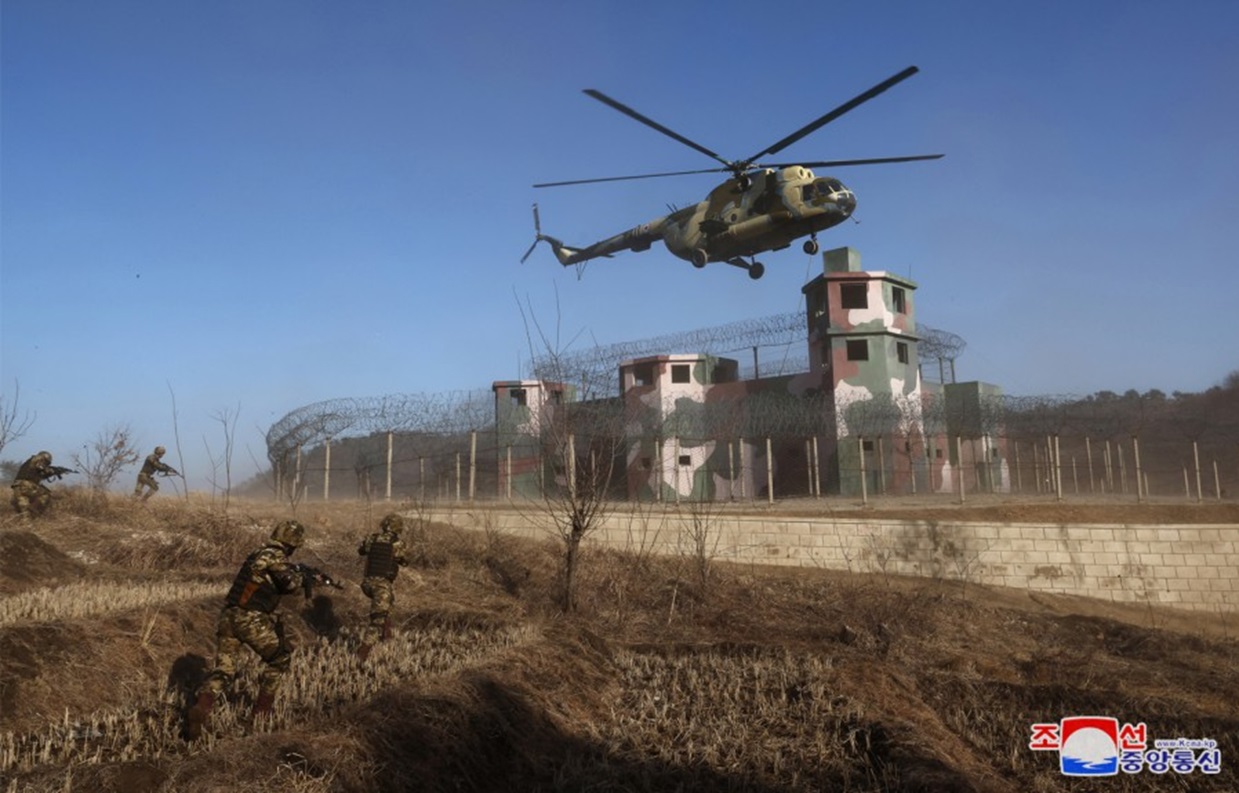
The North Korean military has simulated attacks on South Korean guard posts and equipment along the demilitarized zone (DMZ) during recent military exercises.
According to reports from the state-run Korean Central News Agency (KCNA), North Korean leader Kim Jong Un visited a crucial combat training base in the western region of the country to oversee and guide the military exercises. Emphasizing the need to bolster combat readiness and preparedness, Kim directed efforts towards enhancing practical training to counter perceived threats from the South and its ally, the United States.
The timing of these exercises coincides with the commencement of the annual spring military drills conducted by Seoul and Washington, known as “Freedom Shield”. These joint exercises typically involve a series of field maneuvers, missile interception drills, and live firing exercises, further exacerbating tensions on the Korean Peninsula.
Pyongyang has vehemently denounced the joint military exercises, labeling them as “reckless” and warning of severe repercussions. The North Korean regime has consistently condemned such maneuvers as provocative acts of aggression, viewing them as a direct threat to its sovereignty and security interests.
Kim Jong Un inspection of North Korea training base indicates mock assaults on simulated South Korea DMZ guard outposts. pic.twitter.com/xs9EMGwIQp
— Joseph Dempsey (@JosephHDempsey) March 6, 2024
The simulated assaults on South Korean guard outposts represent a calculated display of military reaction by North Korea, aimed at asserting its dominance and deterring any perceived aggression from its adversaries. The strategic significance of these exercises lies in their ability to convey a message of strength and resolve, signaling North Korea’s readiness to attack their neighbor.
Amidst a more than problematic international context for Washington, already grappling with mounting challenges on multiple fronts, North Korea’s simulated assaults on South Korean DMZ outposts add another layer of complexity to global security dynamics. The United States finds itself under significant pressure on the European front, as it navigates direct threats to Ukraine emanating from Moscow’s aggressive actions. Additionally, tensions in the Middle East have intensified.