

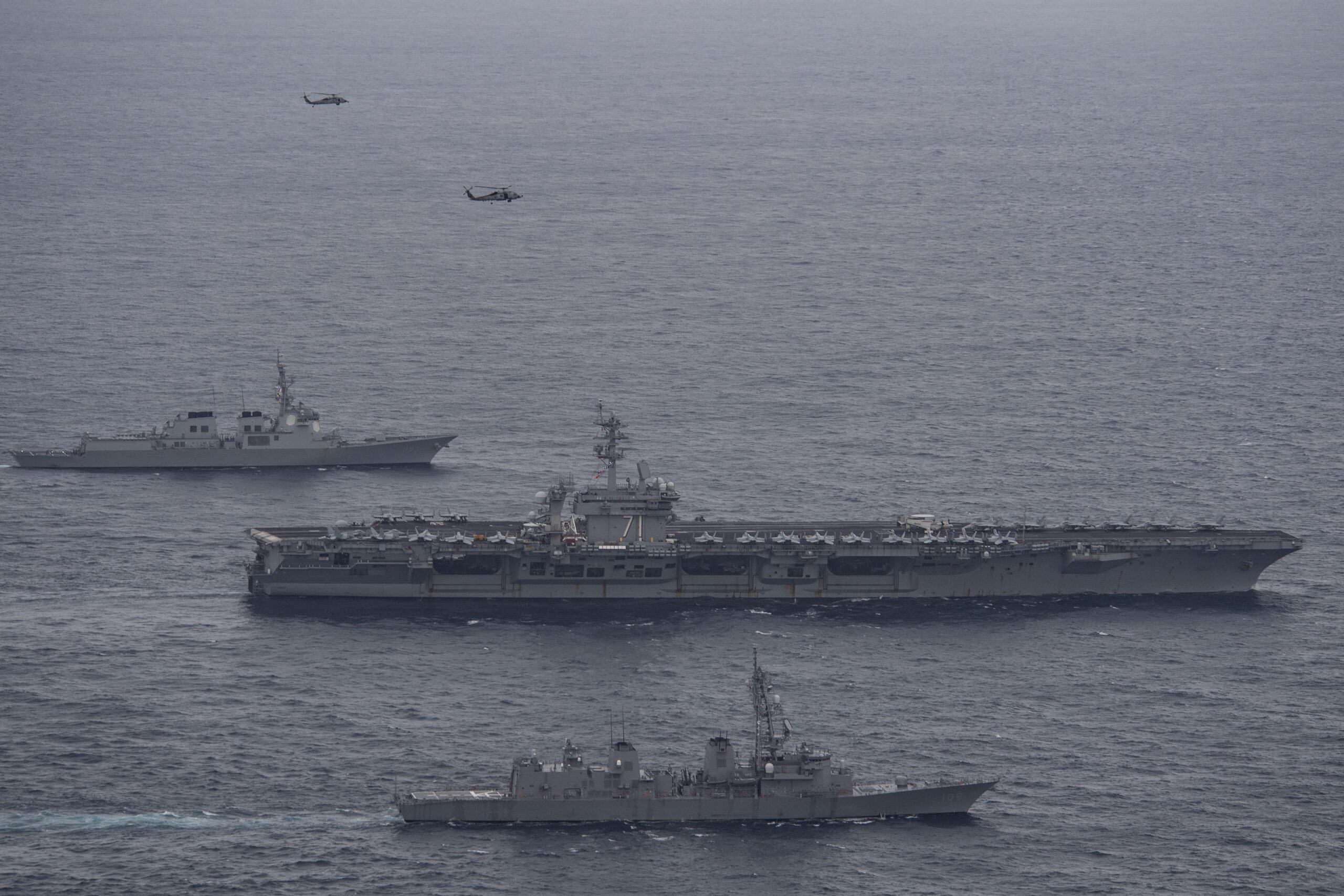
The U.S. Navy, Japan Maritime Self-Defense Force (JMSDF), and Republic of Korea Navy (ROKN) recently concluded a trilateral maritime exercise aimed at enhancing regional security and stability in the Indo-Pacific.
The exercise, held on April 11, involved the participation of several ships from each navy, including the USS Theodore Roosevelt and guided-missile destroyers from the U.S., Murasame-class destroyer JS Ariake from Japan, and Sejong the Great-class guided-missile destroyer ROKS Seoae Ryu Seong-ryong from South Korea.
Over the course of two days, the three maritime forces engaged in various activities such as advanced maritime communication operations, maritime interdiction operations training, air warfare exercises, staff exchanges, and integration exercises. Rear Adm. Christopher Alexander, commander of CSG-9, emphasized the importance of such exercises in demonstrating the ability of the allied forces to integrate and operate together effectively in responding to any contingency.
The trilateral exercise also served as an opportunity to enhance capabilities in responding to security threats, including those posed by the Democratic People’s Republic of Korea (DPRK), and to strengthen cooperation in providing humanitarian support during maritime emergencies. Captain Baek Jun-cheol, Commanding Officer of ROKS Seoae Ryu Seong-ryong, highlighted the exercise’s significance in addressing security challenges in the Indo-Pacific region.
The exercise, conducted in accordance with international law in international waters, underscores the commitment of the U.S., Japan, and South Korea to promoting peace and stability in the region. It builds upon the agreements made at the Camp David Summit in August 2023 to conduct multi-domain trilateral exercises regularly, enhance ballistic missile defense cooperation, and deepen security partnerships.
As the U.S. marks over 70 years of partnership with South Korea and Japan, the trilateral exercise reflects the longstanding commitment of the three nations to safeguarding common security interests and maintaining a rule-based international order. Capt. Brian Shrum emphasized that the exercise contributes to maintaining deterrence and ensuring the freedom and openness of the seas, achieved through cooperation and the strength of combined allied forces.