

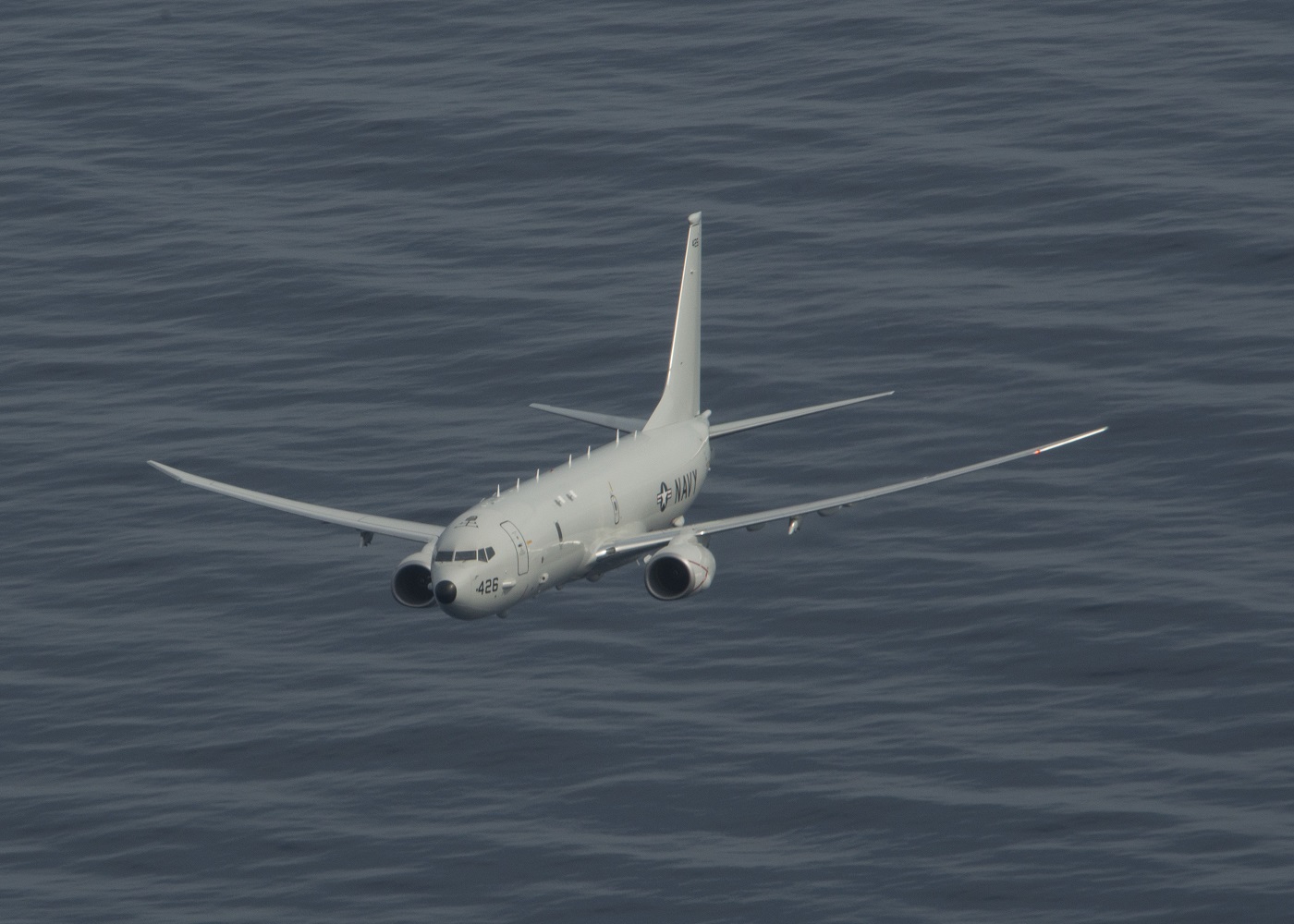
U.S. aerospace giant Boeing marked a milestone with the delivery of its 100th P-8A maritime patrol aircraft to the U.S. Navy.
“This countdown to 100 includes some of the original test aircraft that helped pave the way for this advanced tech the U.S. Navy uses to guard the seas worldwide,” said in the company.
The P-8A Poseidon, a militarized version of the Boeing 737, is primarily designed to conduct Anti-Submarine Warfare (ASW) missions, but is outfitted with additional equipment that allows it to perform a variety of other missions.
The P-8 can fly higher (up to 41,000 ft) and get to the fight faster (490 knots).
The U.S. Navy received its 100th P-8A aircraft from Boeing on 14 May as the global fleet, which also includes the Indian navy and the Australian and U.K. air forces, approaches 300,000 flight hours of hunting submarines and providing aerial reconnaissance capabilities around the world.
“We’re honored by the Navy’s faith and confidence in our employees and the P-8 system,” said Stu Voboril, vice president and program manager. “Our focus has been, and will be, on delivering the world’s best maritime patrol aircraft, bar none.”
This is the 94th mission-capable airplane to enter the U.S. Navy fleet, with six additional jets used as Engineering Manufacturing Development test aircraft.
The 100th fully-operational delivery is scheduled for later this year. Boeing has also delivered 12 jets to the Royal Australian Air Force, two to the U.K.’s Royal Air Force and eight P-8Is to the Indian Navy. Multiple U.S. Navy squadrons have deployed with the P-8A Poseidon, and the Indian Navy and Royal Australian Air Force are conducting missions with the P-8 as well.
There goes the 100th #P8A for the @USNavy lifting off from Boeing field. This countdown to 100 includes some of the original test aircraft that helped pave the way for this advanced tech the U.S. Navy uses to guard the seas worldwide. pic.twitter.com/APKDfFt9od
— Boeing Defense (@BoeingDefense) May 14, 2020
Earlier this year, Boeing was awarded a $1,5 billion contract modification to build the 18 Lot 11 P-8A maritime aircraft for the Navy; the government of New Zealand; and the Republic of Korea.
The contract modification covers procure eight P-8A for the U.S Navy; four aircraft for the government of New Zealand and six for the Republic of Korea.
The procurement also includes a segregable effort consisting of unknown obsolescence for Lot 11, Class 1 change assessment and obsolescence monitoring as well as non-recurring engineering for the Republic of Korea.