

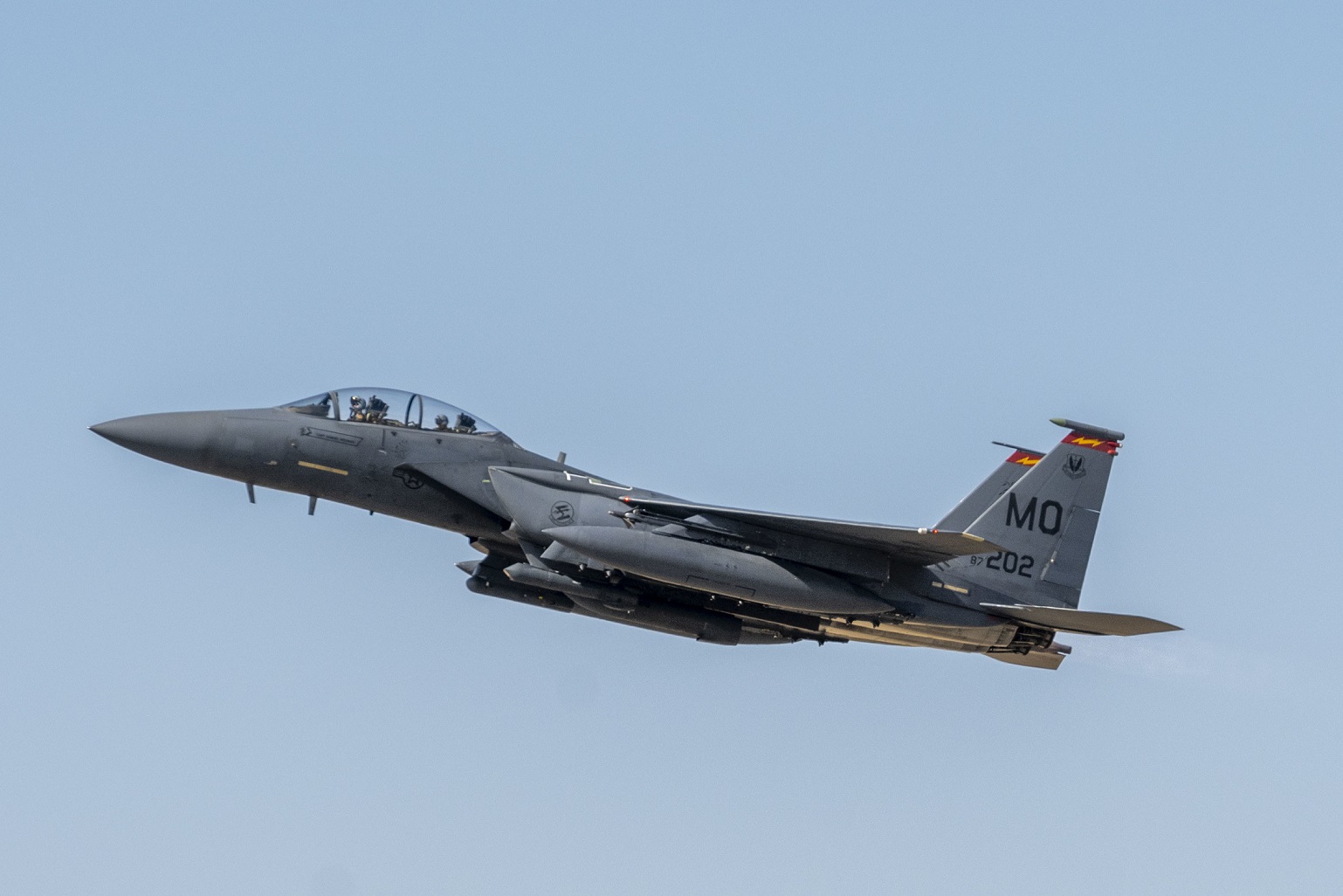
Two weeks earlier, BAE Systems announced that it had received a $13 million contract for advanced Global Positioning System (GPS) technology to protect U.S. F-15E aircraft from GPS signal jamming and spoofing.
The company’s Digital GPS Anti-jam Receiver (DIGAR) will ensure the reliability of military GPS systems for aircraft operating in challenging signal environments.
DIGAR uses advanced antenna electronics, high-performance signal-processing, and digital beamforming – a capability that combines 16 steered beams – for better GPS signal reception and superior jamming immunity. These capabilities are critical for high-speed aircraft as they maneuver through the battlespace. The F-15 Eagle is the second U.S. Air Force fighter platform to receive DIGAR GPS upgrades, following the F-16 Fighting Falcon. DIGAR also provides advanced GPS capabilities for intelligence, surveillance, and reconnaissance aircraft as well as multiple unmanned aerial vehicles.
“Modern airborne missions require accurate positioning and navigation data, and GPS systems must be able to withstand adversaries’ best disruption efforts,” said Greg Wild, Navigation and Sensor Systems product line director at BAE Systems. “Our DIGAR antenna electronics are trusted to protect these platforms in contested environments.”
BAE Systems’ family of military GPS products offer size, weight, and power characteristics suitable for a variety of applications, including handheld electronics, vehicles, unmanned aerial vehicles, aircraft, and precision-guided munitions. In addition to GPS Anti-Jam products, the company is currently delivering advanced GPS products compatible with the next-generation M-Code satellite signal, and is developing the next generation of receivers to ensure dependable GPS for warfighters across land, air, and sea domains.
BAE Systems work on military GPS technology takes place in Cedar Rapids, where the company is investing more than $100 million to build a 278,000-square-foot, state-of-the-art research and manufacturing center.