

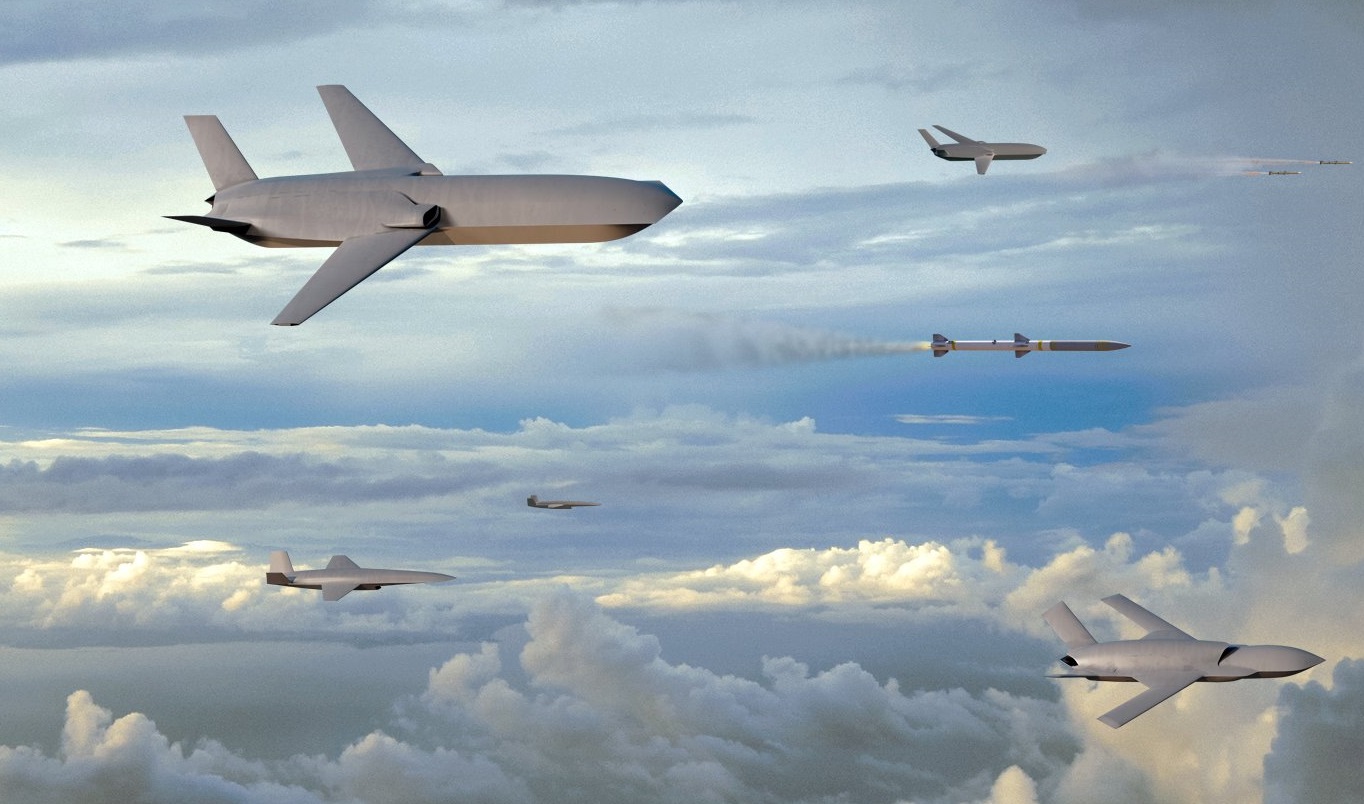
General Atomics Aeronautical Systems, Inc. (GA-ASI) and the U.S. Air Force are targeting the first flight of a new unmanned air-launched vehicle capable of employing air-to-air weapons next year, according to a company news release.
As noted by the company, the Air Force Research Laboratory (AFRL) is projecting the first flight of the newest LongShot drone, described as the unmanned fighter aircraft, in the first half of FY24.”
The game-changer drone is developing as part of the Defense Advanced Research Projects Agency (DARPA) LongShot program. LongShot changes the paradigm of air combat operations by demonstrating an unmanned air-launched vehicle capable of employing air-to-air weapons.
Current air superiority concepts rely on advanced manned fighter aircraft to provide a penetrating counter air capability to effectively deliver weapons. It is envisioned that LongShot will increase the survivability of manned platforms by allowing them to be at standoff ranges far away from enemy threats, while an air-launched LongShot unmanned aerial vehicle (UAV) efficiently “closes the gap” to take more effective missile shots.
After a successful Preliminary Design Review (PDR) in February 2022 at the end of Phase 1, GA-ASI was selected by DARPA to continue into Phase 2 in March 2022. During Phase 2, detailed designs are being completed and ground tests conducted to decrease program risk.
A key test event completed early in Phase 2 was multi-body wind tunnel test, characterizing the LongShot air vehicle and air-to-air weapon separation. Critical Design Review (CDR) for the program is planned for early 2023, which will complete the Phase 2 portion of the program. GA-ASI is currently generating a proposal response for the third phase of the program.
“GA-ASI is committed to the successful flight demonstration of the LongShot air vehicle,” said GA-ASI Senior Director of Advanced Programs Michael Atwood. Upcoming Phase 2 ground tests will demonstrate the viability of key subsystems. Phase 3 would initiate the prototype manufacturing and flight testing phase of the program. Flight testing would begin in 2024.
CORRECTION: The story was corrected on March 10 to note that AFRL’s Off-Board Sensing Station (OBSS) program is not part of DARPA’s LongShot program. General Atomics will build the Gambit series for the OBSS program, not for DARPA’s LongShot program.