

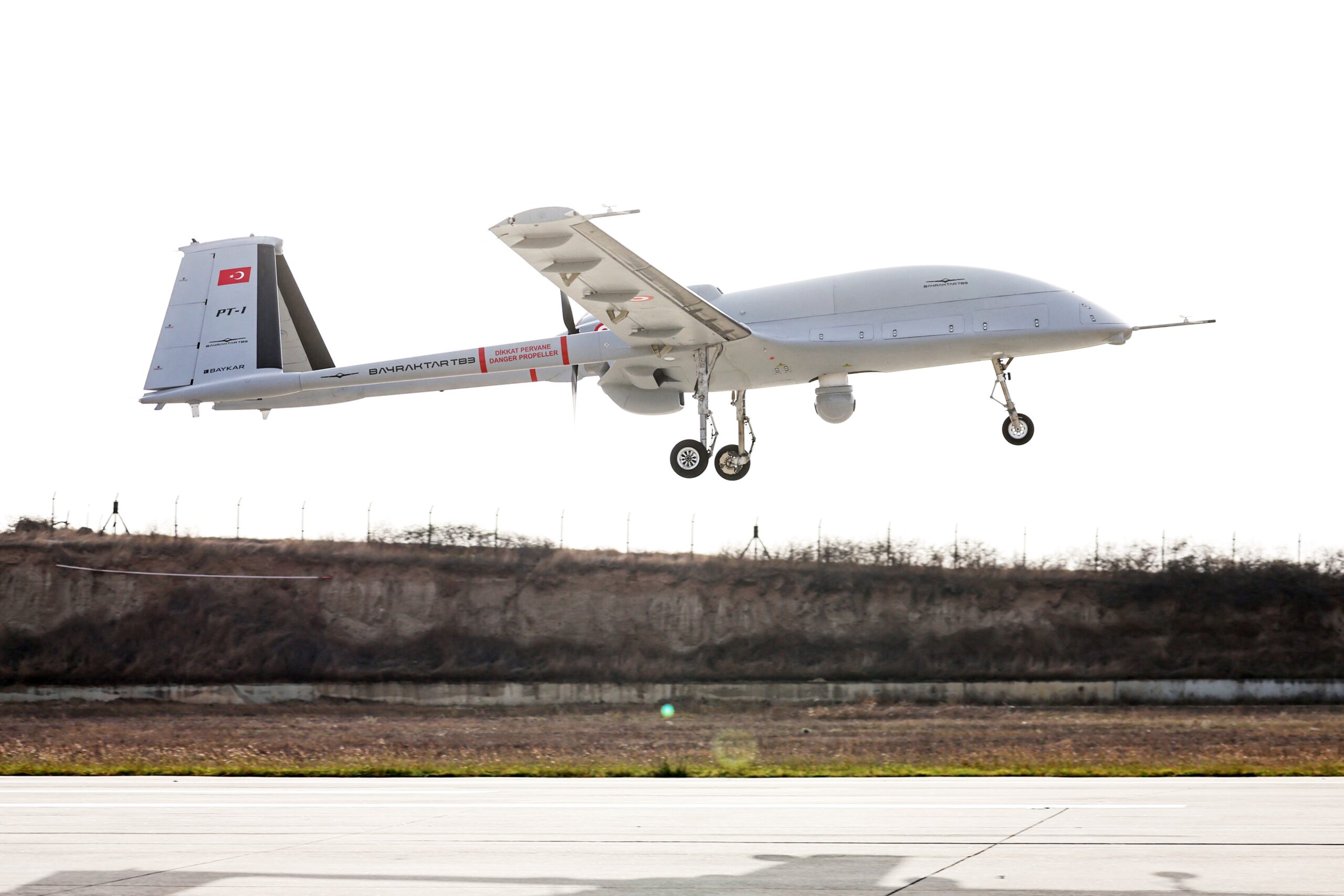
The first Bayraktar TB3, customized for the Türkiye’s recently commissioned aircraft carrier, has taken to the skies for the first time.
Baykar’s Chief Technology Officer (CTO), Selçuk Bayraktar, announced this historic event on the nation’s centennial, stating, “On the Republic of Türkiye’s centennial, the Bayraktar TB3 unmanned aerial vehicle successfully completed its maiden flight.”
The TB3, a variant capable of operating from short runways, is based on Baykar’s renowned Bayraktar TB2 platform. It taxied down a runway in northwestern Türkiye before taking off from the Çorlu Flight Training and Test Center.
What sets the TB3 apart is its unique ability to fold its wings and conduct takeoff and landing operations from an aircraft carrier. This innovation is expected to grant it longer flight times, higher operational altitudes, and an increased payload capacity compared to the TB2, which played pivotal roles in conflicts in various countries, including Azerbaijan, Libya, and most recently, Ukraine, where it countered Russian forces during Moscow’s invasion.
Yeni bir çağa doğru kanatlandık!#BayraktarTB3 ✈️⚓️🚀
İlk Uçuş / First Flight pic.twitter.com/PLign2pToA
— BAYKAR (@BaykarTech) October 27, 2023
The TB3 is specifically designed for deployment from Türkiye’s newly commissioned aircraft carrier, the TCG Anadolu, often referred to as the world’s first drone carrier. The carrier’s air wing will also feature Baykar’s unmanned fighter jet Kızılelma, which successfully completed its maiden flight in December.
Bayraktar expressed the significance of these developments: “Last year, per our promise to our nation, we completed the first flight of our country’s first unmanned combat aircraft, Bayraktar Kızılelma, right here. That happened just one month before the 100th year of our Republic, and today, approximately one year later, we have successfully carried out the first flight of the Bayraktar TB3, which can take off from and land on short-runway ships of our country.”
Kızılelma represents a significant expansion of capabilities for slow-moving reconnaissance and missile-carrying drones. It promises to increase the top speed and carrying capacity of existing drone platforms.
The TB3 is anticipated to have a range of 1,000 nautical miles, equivalent to 1,900 kilometers. When operational on the TCG Anadolu’s air wing, the TB3 and Kızılelma are expected to revolutionize the history of warfare, much like Türkiye’s existing UCAVs.
Bayraktar concluded, “Let this be our gift to the centenary of our Republic.”