

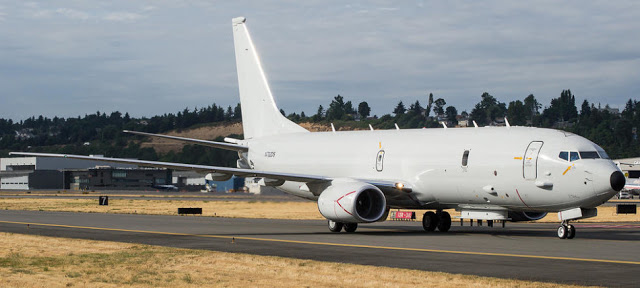

The P-8 Poseidon is quickly becoming the Pentagon’s super-adaptable multi-role surveillance platform of choice. We know it can pack one of the most advanced radar systems in the world, slung under its belly in a huge canoe-like enclosure. Now, another previously unknown external ‘plug and play’ capability for the P-8 appears to be in testing.
This new pod was photographed during a P-8 test flight out of Boeing Field in Seattle by aviation photographer Josh Kaiser. As you can see, it is made up of an antenna farm and housing that can be attached and detached from the P-8’s forward underbelly.
It is unclear what this pod’s exact purpose is, but it is worth a guess (we have reached out to Boeing but are still awaiting a response). It could very well be a modular communications intelligence gathering package that will allow the P-8 to pick up some of the slack for the USAF’s RC-135 and U-2 (in Senior Spear configuration) fleets, as well as the Navy’s own secretive EP-3 Aries cadre among other smaller platforms. Such a capability will allow the P-8 to eavesdrop on potential foes communications in a way in which linguists can translate those intercepts in real-time or in near real-time. Using satellite communications, there is a possibility that those linguists may not be on the jet at all, and could even be halfway around the globe.
Another possibility is that this system is the P-8’s version of a “network gateway” system that will give it similar bolt-on capabilities as other aircraft equipped with Battlefield Airborne Communications Node (BACN) suites. BACN is flying on the EQ-4, E-11A and NASA’s WB-57s, even the KC-135 can deploy simpler and less capable ‘roll-on, roll-off’ unit that accomplishes some of BACN’s basic mission. BACN is one of America’s most powerful force multipliers. It creates an active net over the entire battlefield, far over the horizon, and even at ground level. It also allows different weapon systems that carry various types of data-links, which transmit on their own waveform, to have their situational awareness “pictures” fused into one single common shared picture of battlespace. This single, fused picture is then rebroadcast by BACN on all those same waveforms.