

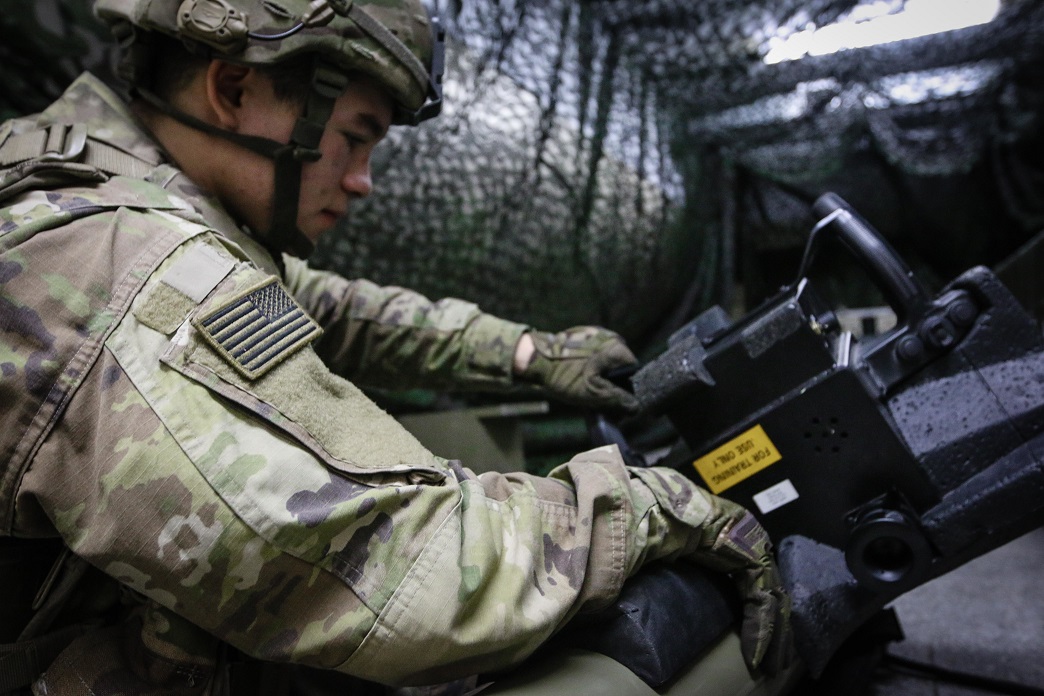
Using advanced virtual reality technology, Soldiers with the 5th Squadron, 4th Cavalry Regiment, 2nd Armored Brigade Combat Team, 1st Infantry Division completed training on the Javelin Weapon System in Swietoszow, Poland, Jan. 11, 2018 in support of Atlantic Resolve.
That was reported by Spc. Hubert Delany.
Atlantic Resolve is a U.S. endeavor to fulfill NATO commitments by rotating units throughout the European theater to deter aggression against NATO allies and partners in Europe.
During the 40-hour block of training, the Long Knife Soldiers from Fort Riley, Kansas learned how to aim, maintain and effectively engage potential targets with the Javelin by training with a Basic Skills Trainer, a computerized system that allows users to train without actually firing live munitions.
Staff Sgt. Shea Raysin, a Homer, Michigan native and a cavalry scout with the 5th Squadron, 4th Cavalry Regiment, has worked with the Javelin system for more than five years and stressed the importance of the training.
“With this course we will have more certified Javelin teams,” said Raysin. “It provides more expertise to our fundamental skills, and it makes the 4th Cavalry Regiment that much more lethal on the battlefield.”
The Soldiers honed their skills by using the Javelin Basic Skills Trainer. Raysin explained the BST’s ability to provide a realistic training experience in varying virtual settings, which saves money and permits the Soldiers in 5th Squadron, 4th Cavalry Regiment to train in simulations that resemble their current surroundings in Europe.
More: Estonia receives batch of Javelin Block-1 anti-tank missiles
Supervisors for each Soldier monitored the battle drills to aid in the training and inserted scenarios that included misfires and malfunctions in order to test each Soldier’s ability to react and overcome obstacles.
The Javelin is considered the first “fire-and-forget” shoulder-fired anti-armor weapon system. It has unique top-attack flight mode, self-guiding tracking system and advanced warhead design that allows it to defeat all known tanks up to thousands of meters away from the firer.
Pvt. Brandon Cook, from Boone, North Carolina, took part in the training and said he felt it better prepared him and his teammates for their current mission.
More: Expert: Russian tanks helpless against US-made Javelin anti-tank missiles
“We will be quicker and more proficient with this weapon system now,” said Cook, a scout with 5th Squadron, 4th Cavalry Regiment. “We are going to take this training and we are going to use it to do what we do best — get the job done. Whatever may come, every one of us is going to be ready.”