

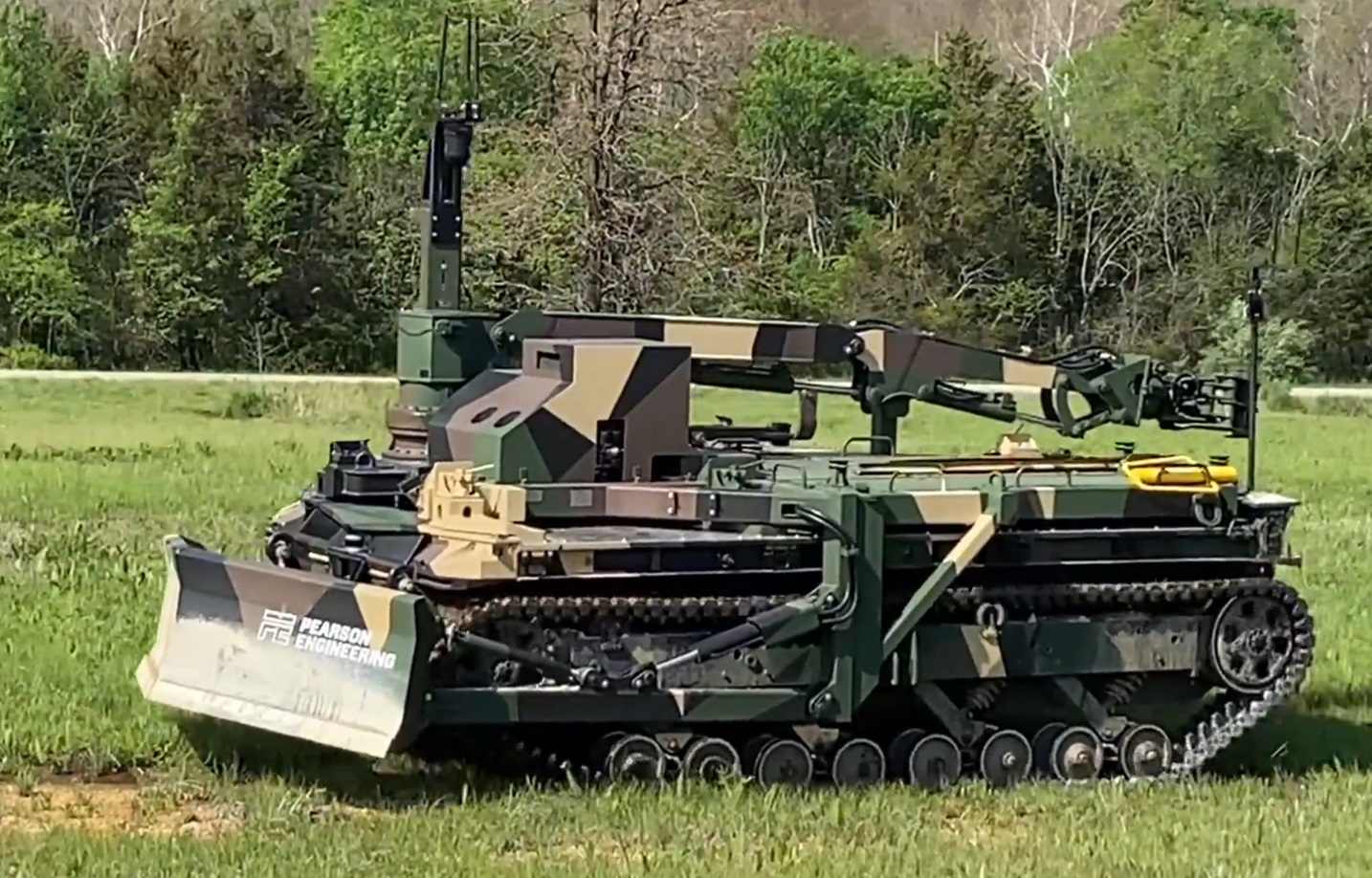
The U.K. defense contractor Pearson Engineering has announced that it has developed a new modular mission kit for the Robotic Combat Vehicle (RCV) known as RCV-Pioneer, equipped with an obstacle clearance mission pack.
As noted by the company, robotic engineering vehicles offer remotely controlled engineering capabilities to robotic combat vehicles, allowing them to adapt and excel in various tasks. The Obstacle Clearance mission pack boasts a dozer blade capable of swiftly creating and removing obstacles, as well as an excavator manipulator arm designed for tasks such as digging, demolishing, and filling trenches.
Built on the foundation of rapid interchangeability and agility, the RCV-Pioneer brings advanced engineering capabilities to the forefront. This system is designed as a self-contained, pre-configured frame that seamlessly integrates Pearson Engineering’s combat engineering equipment for specific missions. These equipment options come in palletized Mission Packs, including obstacle clearance, route proving, minefield breaching, and assault gap crossing, all of which can be swiftly swapped out in field conditions.
RCV-Pioneer boasts an innovative self-lifting system that enables RCVs to maneuver beneath mission packs quickly for effortless integration and removal. Its mounting to the host platform employs quick-release fastenings that require no tools for operation, facilitating rapid fitting and removal from the RCV. Only two soldiers can complete the fitting or removal of RCV-Pioneer from the RCV in approximately 30 minutes.
Notably, RCV-Pioneer doesn’t rely on hydraulic power from the host platform, as it includes all the necessary hydraulic controls for its mission-specific tools, such as plows, dozer blades, and excavator’s arms. It can draw electrical power from the host RCV platform or generate the required power using its integral diesel engine.
Remote control of the RCV-Pioneer Mission Packs is managed through an intuitive Operator Control Unit (OCU), featuring joysticks and touchscreen controls that oversee all functions. The OCU provides vital video feeds from cameras mounted on RCV-Pioneer, ensuring optimal situational awareness during engineering tasks.
Correction: Story was corrected on February 02 to note that Pearson Engineering has not developed a robotic combat vehicle. Pearson Engineering provides modular mission payloads that can be integrated to wide ranging robotic combat vehicles.