

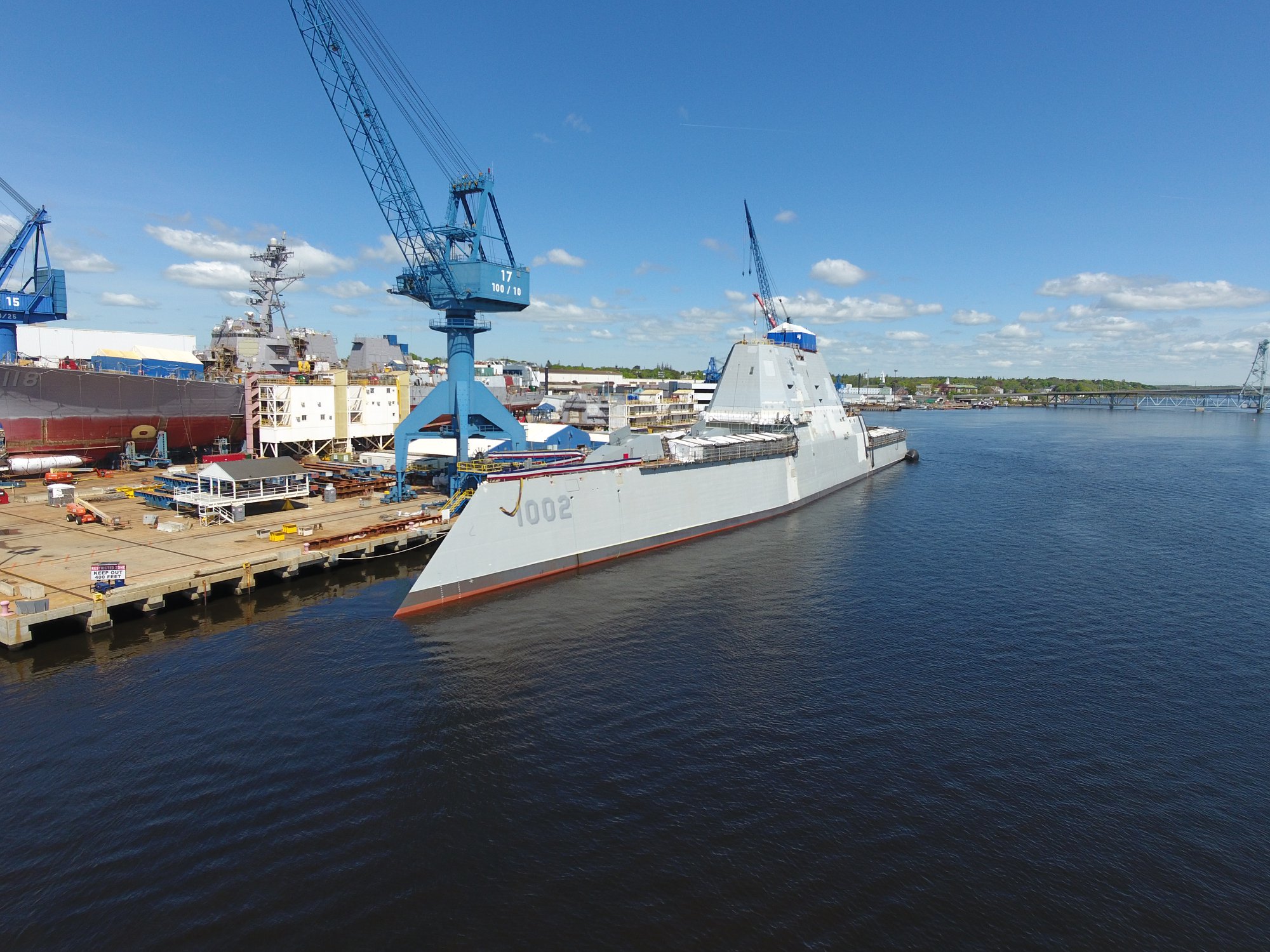
General Dynamics Bath Iron Works shipbuilder said the U.S. Navy stealthy warship USS Lyndon B. Johnson (DDG 1002) achieved an important milestone – the Data Center Light-Off for the ship’s Total Computing Environment.
According to a Friday company statement, the achievement brings the Ship Mission Center to life and provides the next level of capability in the state-of-the-art DDG 1002.
“We have taken complicated spaces from bare bones to finished product. Everyone who works on this fine ship should be proud. Thank you all for your hard work!,” the shipbuilder message states.
The contract to build her was awarded to General Dynamics Bath Iron Works located in Bath, Maine, on 15 September 2011.
The largest and most technologically advanced surface combatant in the world, designed for sustained operations in the littorals and land attack, the multi-mission Zumwalt-class destroyers will provide independent forward presence and deterrence, support special operations forces, and operate as an integral part of joint and combined expeditionary forces.
The vessel displaces 14,565 tons and features a length of 600 feet, a beam of 80.7 feet and a draught of 27.5 feet. Power is from 2 x Rolls-Royce Marine Trent-30 gas turbines paired with 2 x Rolls-Royce RR4500 gas turbine generators driving a pair of shafts under stern at speeds over 30 knots. The standard crew complement is 140 personnel made up of officers and sailors.
The ship’s profile is futuristic to the core, with angle faces and limited protrusions to keep her as stealthy as possible and generate a low profile on the horizon. There is a stern flight deck that supports the launching and retrieval of up to 2 x Sikorsky SH-60 Seahawk LAMPS naval helicopters. The deck also supports general transport helicopters as well as up to three Northrop Grumman MQ-8 “Fire Scout” helicopter drones. Full service hangar facilities are also provided.
This warship integrates numerous critical technologies, systems, and principles into a complete warfighting system. These include employment of optimal manning through human systems integration, improved quality of life, low operations and support costs, multi-spectral signature reduction, balanced warfighting design, survivability, and adaptability.
Last week, the U.S. Navy also accepted the delivery of USS Zumwalt (DDG 1000).
The U.S. Navy said that delivery of the first warship marks a major milestone of the dual delivery approach for USS Zumwalt, which achieved Hull Mechanical & Electrical delivery from shipbuilder General Dynamics’ Bath Iron Works in May 2016. Raytheon Integrated Defense Systems was the prime contractor for the Zumwalt Combat System, and has lead activation and integration for Zumwalt class ships both in Bath, Maine and San Diego.