

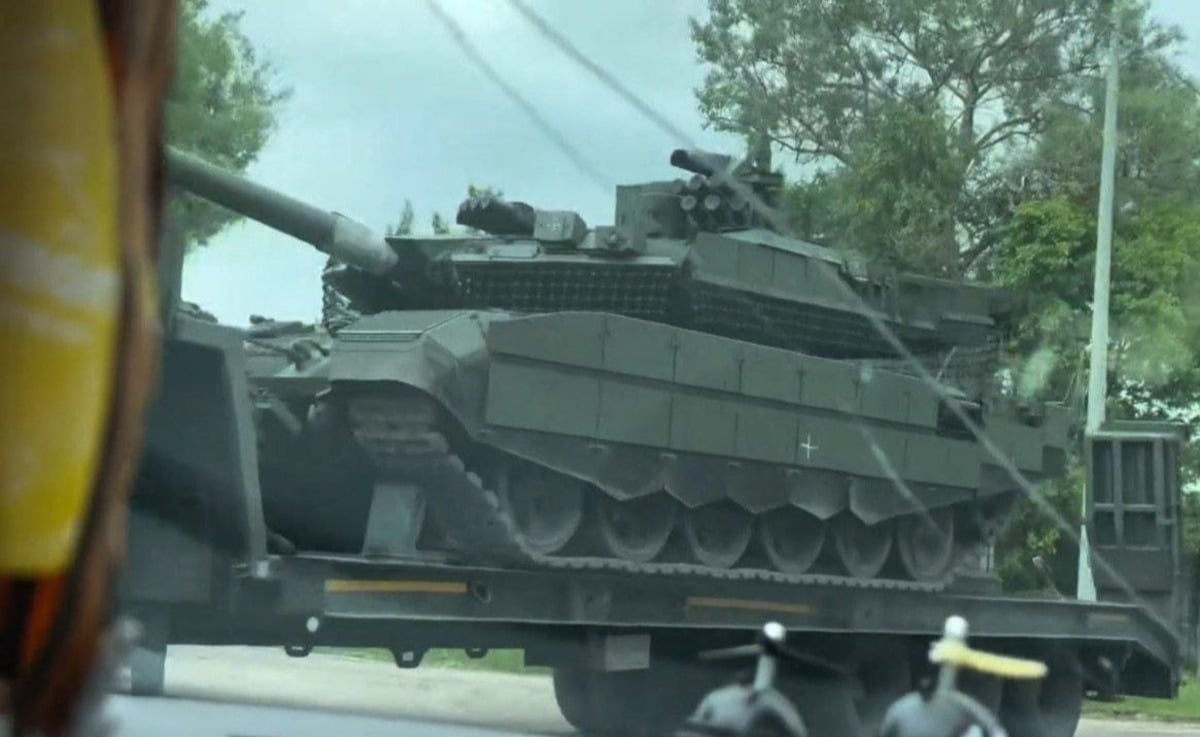
- A photograph shows what appears to be a T-90M tank fitted with Arena-M active protection loaded on a tank transporter in Russia.
- Russian officials confirmed in January 2026 that Arena-M software now includes a mode to intercept drones and loitering munitions.
A photo circulating from inside Russia appears to show a T-90M main battle tank fitted with the Arena-M active protection system riding on a tank transporter, a sighting that, if confirmed, would mark one of the clearer visual indications yet that Russia’s newest hard-kill defense against incoming threats is moving beyond limited trials and into broader distribution.
Tanks are routinely moved by trawl rather than driven under their own power for long-distance transport, a standard practice meant to preserve engine hours and track life rather than any indication of the vehicle’s operational status, so the transport itself is unremarkable.
Arena-M represents Russia’s first operational hard-kill active protection system, a category of defensive technology that uses radar to continuously scan a vehicle’s surroundings for incoming threats, then automatically calculates the trajectory of anything approaching and fires a countermunition to destroy it before impact, functioning as a last line of defense that engages threats a tank’s armor alone cannot reliably stop. The system can intercept rockets, missiles, and high-explosive anti-tank projectiles traveling as fast as 1,000 meters per second (3,281 feet per second) at ranges up to 50 meters (164 feet), according to figures Russian manufacturers have published, a capability that puts it in the same broad category as Israel’s combat-proven Trophy system, though Arena-M has not seen the same extensive real-world testing.
The Defence Blog first reported Uralvagonzavod officially unveiling a T-90M fitted with Arena-M in February 2025, a milestone that came after years of delay dating back to when Russian officials first announced plans in 2020 to integrate the system by 2025. That original announcement predated the full-scale invasion of Ukraine, and the war’s brutal record of tank losses appears to have accelerated a program that had previously moved at a slower pace, driven in large part by the need to counter the anti-tank guided missiles and top-attack munitions, including American-supplied Javelins, that have destroyed Russian armor by the hundreds since 2022. Open-source investigators at the Oryx blog have documented more than 156 confirmed T-90M losses since the war began, a toll that underscores why Russian defense officials have pushed to field active protection more broadly even on their most capable operational tank type.
More recently, Russian defense ministry officials confirmed in early January 2026 that engineers had completed software updates giving Arena-M a dedicated anti-drone mode, extending the system’s role beyond traditional anti-tank munitions to address the first-person-view attack drones and loitering munitions that have become one of the most consistent killers of armored vehicles on both sides of the front. That update reportedly allows the system to engage aerial threats approaching the tank, including drones guided over resistant fiber-optic control lines that are largely immune to the electronic jamming Russian forces otherwise rely on, according to Russian state media reporting on the software’s capabilities.
Some reporting on the program has suggested the drone-capable version of Arena-M may initially be limited to a revised T-90M variant, sometimes referred to informally as the T-90M2, featuring a modified turret with an expanded rear section, and that production of that specific configuration in 2026 would remain limited rather than widespread. Russian defense ministry sources have not publicly confirmed production numbers or specified which sub-variant designation applies to tanks receiving the upgraded system, leaving open exactly how many operational T-90M tanks currently carry the anti-drone-capable Arena-M configuration versus older units still awaiting the upgrade or fitted only with the tank’s original Shtora soft-kill countermeasures, which warn crews of incoming threats without physically intercepting them.
If the tank in this week’s image does carry a functioning Arena-M system, it represents one more data point in a program that has moved from unveiling to incremental, still-limited fielding over the course of roughly a year and a half, rather than the kind of sweeping fleet-wide rollout Russian state media sometimes implies. The tank transporter carrying it may simply be headed toward a training ground, a repair depot, or the front itself, and until independent geolocation or further imagery narrows that down, the image confirms only that Arena-M-equipped armor continues moving through Russia’s logistics network, not where it is ultimately headed or how it will perform once it gets there.