

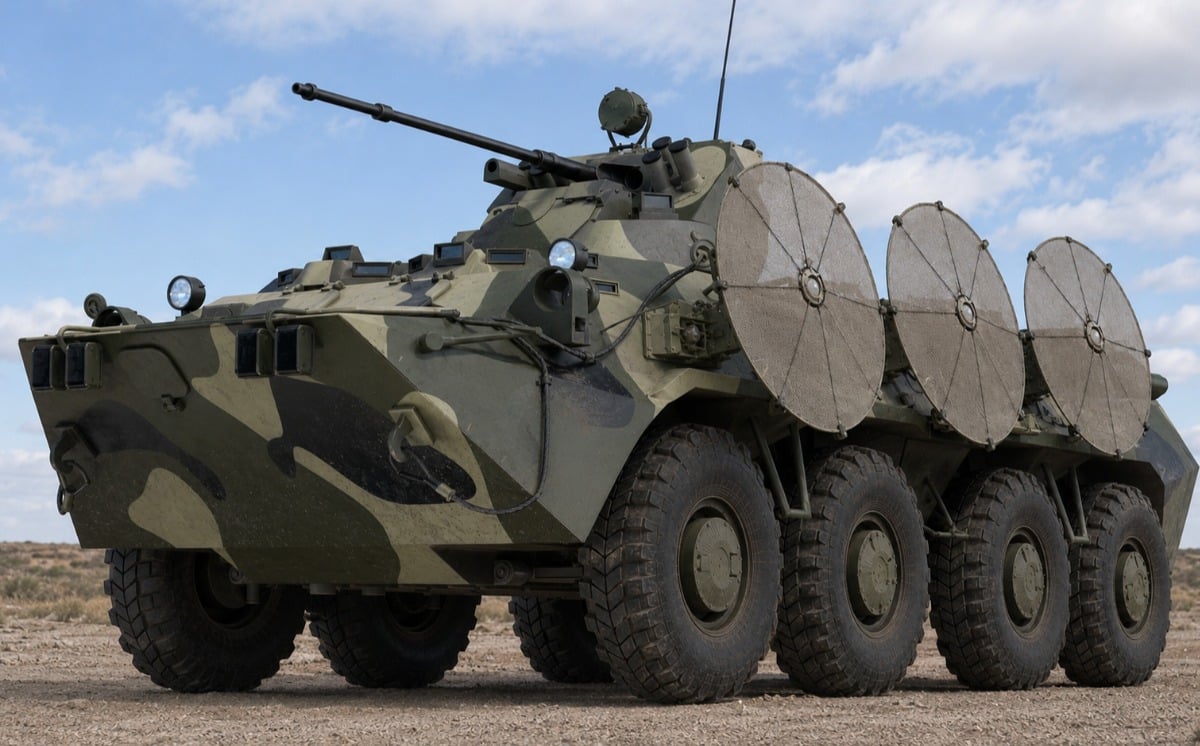
- Russia's Zhukov Combined Arms Academy patented a rotating net launcher designed to intercept drones before they hit a vehicle.
- A 2024 prototype test on a pickup truck knocked down a simulated drone about 3 meters (9.8 feet) from the vehicle.
A spinning umbrella built to save armored vehicles from a kamikaze drone sounds like something out of a cartoon, but Russia’s military has patented exactly that.
The Combined Arms Order of Zhukov Academy, one of the Russian Armed Forces’ premier officer training institutions, has designed and patented a rotating cartridge launcher meant to protect vehicles from loitering munitions, the small, explosive-carrying drones that pilots fly directly into a target and detonate on impact, according to patent documentation describing the device. Rather than jamming a drone’s radio signal or shooting it down with gunfire, the invention physically ejects a spinning net of weighted cables and fabric panels into the drone’s flight path at the last possible moment before impact, a low-tech countermeasure built for a threat that has proven remarkably difficult to stop with high-tech solutions alone.
The device mounts to the rear or side of a vehicle, or to armor plating added specifically to shield it, and consists of a tube-shaped holder connected to a base plate and a housing that contains the drive motor responsible for spinning the whole assembly. A cartridge sits locked onto the holder using dedicated fasteners, and inside that cartridge is a circular disc ringed with small loops, each one tied to a cable that ends in a small weight, with sheets of protective fabric stretched between adjacent cables like the spokes and panels of an actual umbrella. When the system receives a remote signal indicating an incoming drone, an ejection mechanism fires the cartridge outward while the drive motor spins it, and centrifugal force, the same physics that flings water off a spinning umbrella or mud off a bicycle tire, throws the weighted cables and fabric panels outward into a wide net pattern designed to catch the drone’s propellers or airframe before it reaches the vehicle.
Loitering munitions, commonly called FPV drones because pilots fly them using a first-person-view camera feed streamed to goggles or a screen, have become one of the defining weapons of the war in Ukraine, cheap enough to mass-produce by the tens of thousands and precise enough to destroy tanks, trucks, and armored vehicles worth vastly more than the drone itself. Russian forces have responded to that threat with an escalating series of improvised and now increasingly formalized countermeasures, welding metal cages and slat armor onto tanks in configurations Ukrainian and Western observers nicknamed “cope cages,” and more recently patenting purpose-built solutions rather than relying purely on battlefield improvisation. This rotating umbrella patent joins a growing list that includes a flexible, tree-like rod armor system nicknamed Oduvanchik, Russian for dandelion, patented earlier this year to snag drones on flexible fiberglass rods before they can detonate against a hull, and a separate net-launching turret system patented by Russia’s Karbyshev Military Engineering Academy specifically for the BTR-82A armored personnel carrier, which fires netting from perimeter-mounted containers when a small onboard radar detects an approaching drone.
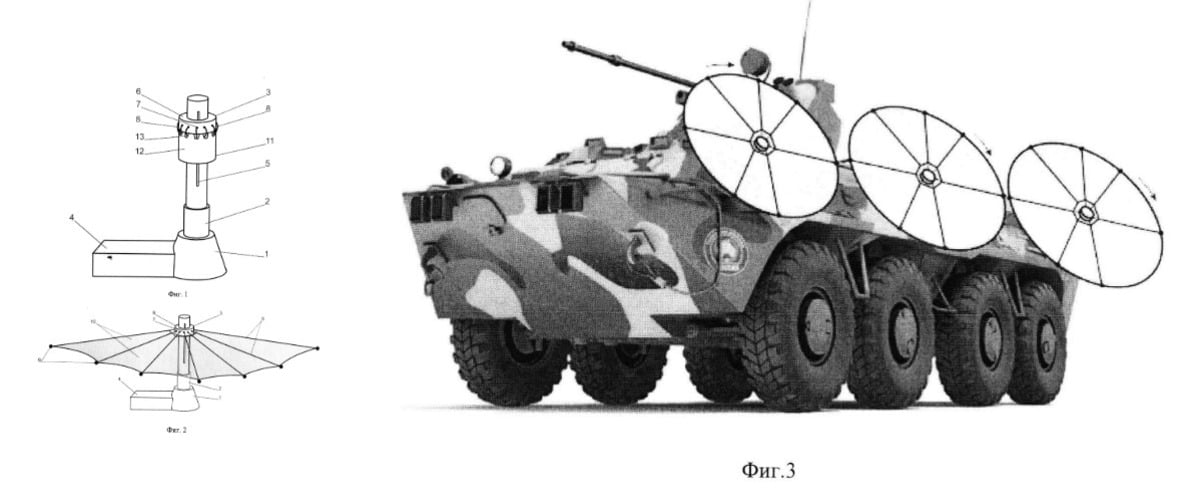
According to the patent filing, Russian engineers built an experimental prototype of the rotating umbrella device in 2024, implementing only some of the design’s full feature set, and mounted it to the rear of a pickup truck for testing. Engineers used a DJI Mavic-series consumer quadcopter to simulate an attacking loitering munition, flying it toward the truck from behind in what the patent describes as a pursuing hunter approach pattern, mimicking how an actual FPV drone often chases a moving vehicle from its blind rear angle before diving in for the kill. The ejection mechanism fired at a distance of roughly 3.5 meters (11.5 feet) from the truck, and the deployed protective covering successfully knocked the simulated drone out of the air, with the patent noting that the drone’s simulated detonation occurred approximately 3 meters (9.8 feet) from the vehicle, a standoff distance the patent’s authors argue meaningfully improves the vehicle’s chances of survival compared to a direct hit.
That distinction between a near-miss and a direct strike matters enormously for vehicle crews, since even a few meters of separation between an explosive warhead and a vehicle’s hull or crew compartment can be the difference between minor damage and catastrophic loss, given how blast and fragmentation effects diminish sharply with distance. Whether three meters proves consistently sufficient against real combat munitions carrying larger warheads than a converted commercial quadcopter remains an open question the patent testing alone cannot answer, since the experiment used an unarmed hobbyist drone rather than an actual loitering munition rigged with a live explosive charge.
Patenting a device in Russia does not guarantee it will ever reach frontline units at scale, and the country’s defense-adjacent research institutions have filed a wide range of anti-drone concepts over the past two years that range from genuinely fielded countermeasures to experimental designs that never progress past prototype testing. What this rotating umbrella patent does confirm is how far Russian military engineers are willing to go in physical, mechanical terms to solve a problem that jamming, electronic warfare, and armor plating have not fully resolved on their own, since a drone guided by a human pilot watching a live video feed, or increasingly by onboard artificial intelligence with no radio link at all, cannot always be stopped by disrupting a signal that may not even exist.
Sometimes, apparently, the answer a general’s academy reaches for is closer to a battlefield umbrella than a battlefield computer, a solution as strange to describe as it is oddly logical once you consider what it is actually trying to catch.