

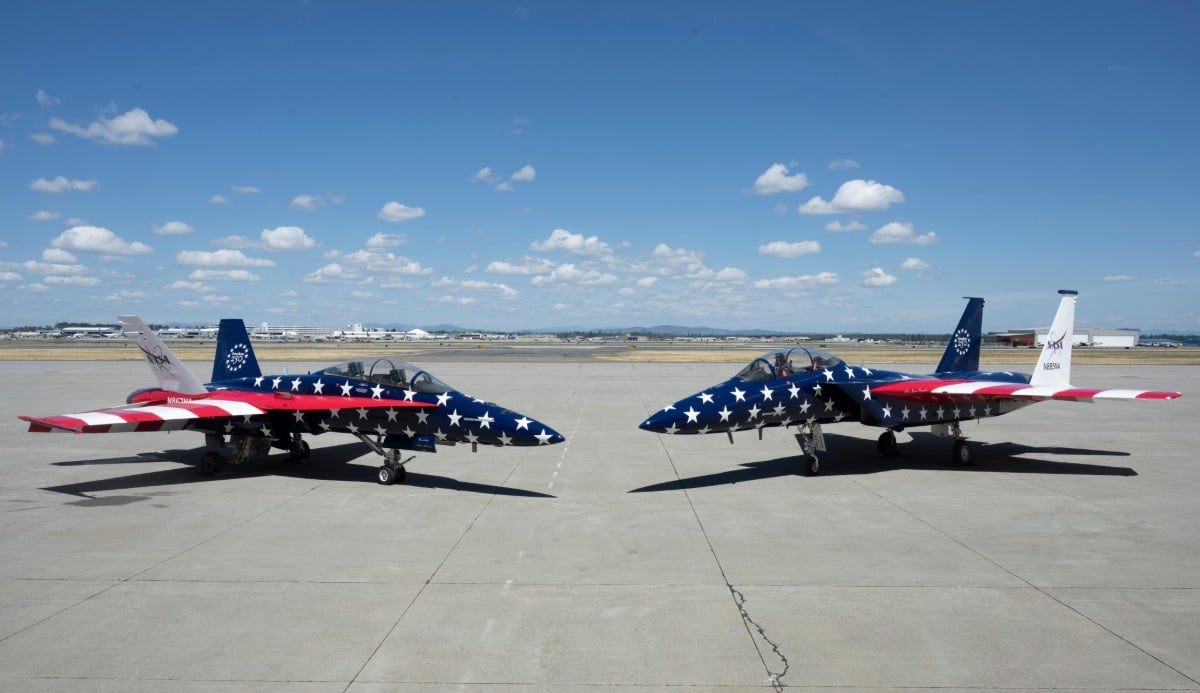
- NASA's Armstrong Flight Research Center repainted an F/A-18 and an F-15 research aircraft in patriotic colors for Freedom250.
- The announcement marks the 250th anniversary of the Declaration of Independence, celebrated on July 4, 2026.
Two of NASA’s most storied research jets have traded their usual gray paint for a full red, white, and blue makeover, and the aircraft getting the treatment have spent decades doing work most Americans have never heard of despite watching some of its results on the evening news for years.
NASA’s Armstrong Flight Research Center announced on social media that it repainted one of its F/A-18 research aircraft and one of its F-15 research aircraft in patriotic colors, tying the makeover to Freedom250, the White House initiative marking the 250th anniversary of the Declaration of Independence on July 4, 2026.
These are not combat aircraft flying in America’s wars, even though both jet types are best known to the public as fighters flown by the U.S. Air Force and Navy. NASA operates three two-seat F/A-18 jets out of Armstrong, located inside Edwards Air Force Base in the Mojave Desert, using them for research support, pilot training, and as photo and video chase planes that fly alongside experimental aircraft to capture footage engineers use to monitor test flights in real time. One of NASA’s F/A-18s flew chase for the agency’s X-59 quiet supersonic aircraft during its first flight on October 28, 2025, streaming live video back to mission controllers on the ground so they could watch the test unfold as it happened rather than waiting for post-flight data review.
NASA’s F-15 fleet performs a similar but distinct mission, since the agency currently operates several modified, two-seat F-15s specifically built for research work, capable of flying safely up to 60,000 feet, an altitude ceiling that lets them test aerodynamic, instrumentation, and propulsion experiments in conditions most standard aircraft never reach. NASA expanded that fleet significantly in December 2025, when the Oregon Air National Guard’s 173rd Fighter Wing delivered two recently retired F-15D Eagles to Armstrong specifically to support the X-59 program, since the quiet supersonic aircraft’s flight envelope reaches altitudes existing NASA jets needed additional airframes to match. NASA has actually flown F-15s since some of the type’s earliest models emerged in the early 1970s, giving the agency more than five decades of continuous experience operating the aircraft for research rather than combat.
Armstrong itself carries a legacy that makes a patriotic paint job feel less like a marketing gesture and more like a nod to genuine history. The center, renamed in 2014 in honor of astronaut Neil Armstrong, sits on the same stretch of the Mojave Desert where Chuck Yeager broke the sound barrier in the Bell X-1 in October 1947, and it later hosted the rocket-powered X-15 program that set speed and altitude records still relevant to aerospace engineering today. Engineers at the facility also flew the first pure digital fly-by-wire aircraft, a modified F-8 whose electronic flight control system paved the way for the computer-assisted controls found on virtually every modern airliner and fighter jet built since. That history of pushing flight technology forward, often quietly and without the public attention a fighter squadron or a spacecraft launch attracts, is precisely the kind of work NASA’s own social media post framed the new paint scheme as honoring, describing the repainted jets as representing what the agency called the legacy of determination, service, and unity that define America.
The Trump administration created Freedom250 by executive order in January 2025 to lead a parallel slate of anniversary programming, and the two organizations have coordinated on some events while running distinct branding and fundraising operations, a division that has drawn scrutiny from congressional Democrats over how anniversary-related federal funding has been allocated between the two groups. NASA’s aircraft repainting announcement did not address that broader organizational dynamic, framing the gesture simply as the agency’s own contribution to marking the milestone.