

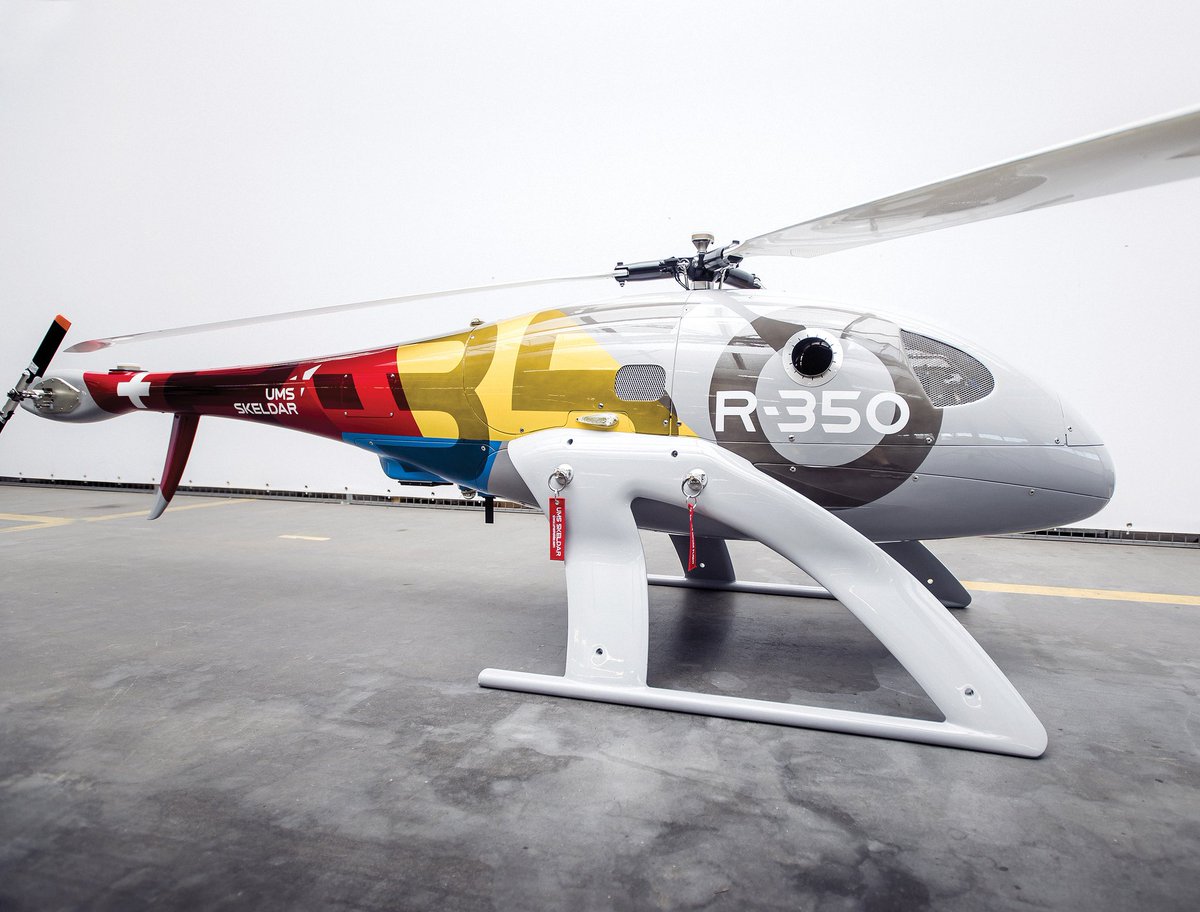
UMS Skeldar, the joint venture (JV) between Saab and UMS Aero, has unveiled medium sized unmanned helicopters at UMEX 2018 exhibition in UAE.
UMS Skeldar is now marketing a new SKELDAR V-200 and R-350 unmanned aerial vehicles in the Gulf region.
The Gulf region is a challenging environment ideally suited to UMS SKELDAR’s twin portfolio of medium sized unmanned helicopters. With a peninsular, maritime and land borders, and a spectrum of security challenges, the need for fast response and interdiction integrated with land and naval forces demands agile assets.
From infrastructure inspection, maintenance and protection for vital energy resources such as refineries and pipelines, through to military and ‘blue light’ (i.e. police, fire and associated rescue services) there is a constant need for ‘eyes in the sky’.
The SKELDAR V-200 unmanned aerial vehicle is designed as a highly effective Vertical Take-Off & Landing (VTOL) aircraft, this system is provided ready for seaborne missions. This flexible rotary Vertical Take-Off & Landing (VTOL) is suited to a range of military and civilian applications from oil exploration platforms and Search and Rescue (SAR) operations to C4ISR missions from battlefield situations, border surveillance and security patrols. Equally at home, at land or sea, the V-200 is recognised as a best-in-class Vertical Take-Off & Landing (VTOL) in its endurance segment.

Developed with a low lifecycle cost in mind, the modular design of the SKELDAR V-200 Remotely Piloted Aircraft System (RPAS) enables system customisation and functional development, with air maintenance carried out at unit level. Compartments can be easily accessed for service, maintenance and payload reconfiguration.
The R-350 is a light tactical high-performance ITAR-free (International Traffic in Arms Regulations) rotary UAV. This newly modified platform offers a variety of concepts regarding payload options, combining advanced Electro-Optical and Infrared sensors (EO/IR) with other systems such as LiDAR, Multi and Hyperspectral imaging systems for airborne remote sensing and Chemical Sniffers.
Under 150kg Maximum Take-Off Weight (MTOW) the R-350 features include a propulsion unit that can be replaced in less than 45 minutes, and a jet turbine that can be changed in less than 15 minutes.
