

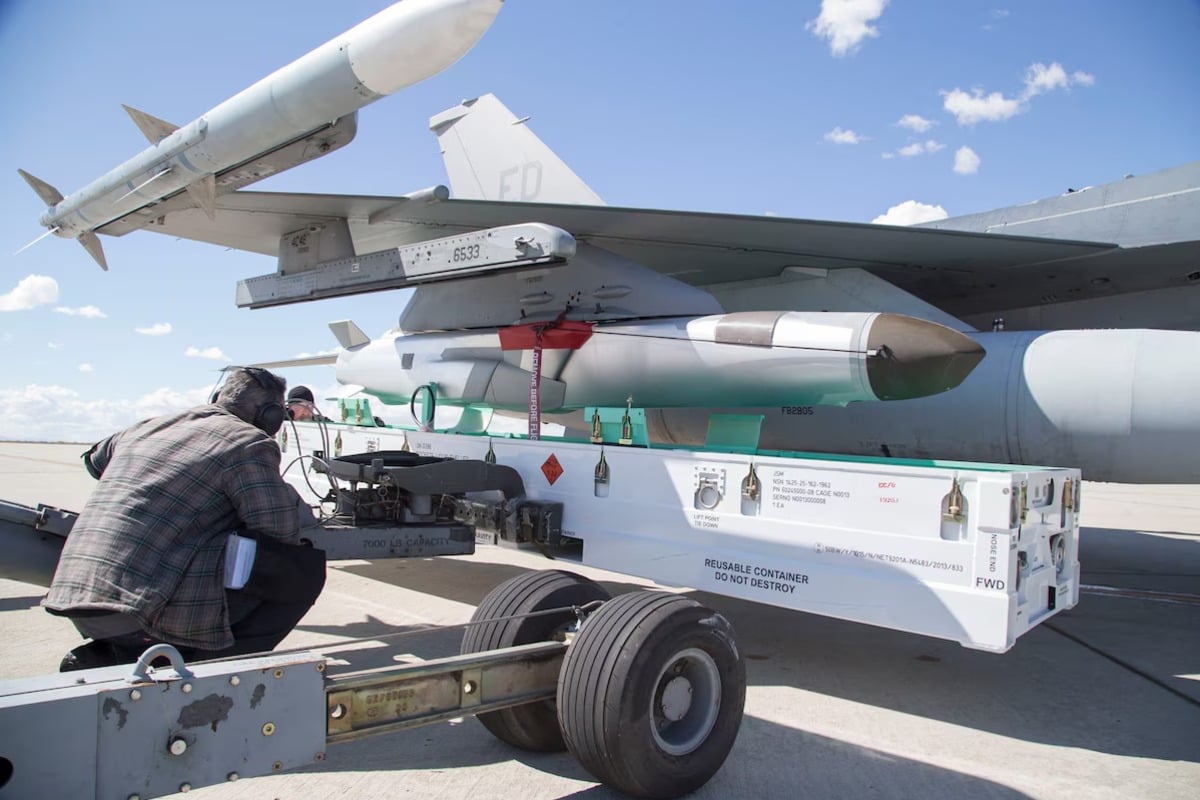
- The U.S. Air Force awarded Kongsberg Defence & Aerospace $98.4 million for Joint Strike Missile Lot Three B production.
- Work will take place in Kongsberg, Norway, with an estimated completion date of June 30, 2030.
The U.S. Air Force awarded Kongsberg Defence & Aerospace, the Norwegian company that builds the weapon, $98.4 million to produce the next batch of Joint Strike Missiles, with work taking place at Kongsberg’s factory in Norway and wrapping up by June 30, 2030.
The Joint Strike Missile, known by its American designation AGM-184A, solves a problem that has quietly nagged at the F-35 program since the stealth fighter first entered service. The jet’s entire design philosophy depends on carrying weapons inside its body rather than hanging them under the wings, since anything mounted externally dramatically increases how visible the aircraft appears on enemy radar, defeating much of the point of building a stealth fighter in the first place.
For years, that internal-carriage requirement meant the F-35 had no true long-range weapon for striking ships or hardened targets from a distance, since larger missiles like the AGM-158C Long-Range Anti-Ship Missile simply do not fit inside the jet’s internal weapons bay. The Joint Strike Missile, developed by Kongsberg and built around the company’s earlier Naval Strike Missile, was engineered from the start specifically to squeeze into that confined space, measuring roughly 13 feet (4 meters) long and weighing about 897 pounds (407 kilograms), including a 260-pound (118-kilogram) warhead, dimensions dictated entirely by the F-35’s internal bay rather than by pure performance targets.
Once launched, the missile can travel more than 217 miles (350 kilometers) at high subsonic speed, using GPS and inertial navigation to reach the general target area before switching to an imaging infrared seeker for precise targeting in the missile’s final approach, a guidance combination that lets it distinguish its intended target from decoys or nearby objects in the closing seconds of flight. That range lets an F-35 launch the missile from well outside the reach of many modern ship-based air defense systems, then let the weapon fly a low, evasive path toward its target rather than approaching in a straight, predictable line.
This new $98.4 million award covers what the Air Force calls Lot Three B, the latest increment in a production schedule that has steadily grown since the service first committed to the missile. The Air Force placed its initial order for the Joint Strike Missile in 2024, then followed with a $240.9 million Lot Two contract in June 2026 covering complete operational rounds, launch containers, test hardware, and support equipment, with that batch of missiles scheduled for completion by November 2028. Wednesday’s Lot Three B award extends the program roughly 19 months beyond that earlier deadline, pushing Kongsberg’s Norwegian production line to keep running well into the next decade as the Air Force continues building out its stockpile.
Norway holds a special place in this program’s history, since the country was both the missile’s original developer and the first nation to actually field it operationally. Norway completed its full fleet of 52 F-35A fighters in April 2025 and received its first Joint Strike Missiles the same month, a milestone Norwegian defense officials framed at the time as proof the country could still develop cutting-edge weapons technology despite its relatively small defense budget compared to larger NATO allies. That head start has translated directly into export success, with Japan, Australia, and the United States all signing on to acquire the missile in the years since, and Germany joining the customer list in 2026 after committing to equip its own F-35A fleet with the weapon. Kongsberg announced a separate order in June 2026 worth roughly $472 million from an undisclosed sixth customer, a deal the company has not yet publicly identified but which underscores how quickly demand for the missile has spread beyond its original Norwegian and American buyers.
Fiscal 2025 Air Force missile procurement funds cover the full $98.4 million obligated under this contract, and the Air Force Life Cycle Management Center at Eglin Air Force Base in Florida is managing the agreement on the government’s behalf, the same office that has overseen every prior Joint Strike Missile production lot the service has purchased. The contract takes the form of what the government calls a firm-fixed-price modification, meaning Kongsberg agreed to deliver this batch of missiles for a set price rather than being reimbursed for costs as they arise, a structure that puts the financial risk of any production overruns on the manufacturer rather than the Air Force.
The Joint Strike Missile remains the only weapon of its kind that fits inside the F-35’s weapons bay, and until a domestic alternative reaches that same level of maturity, every additional lot the Air Force orders is really a bet that keeping the stealth fighter stealthy while it hunts ships and hardened targets is worth outsourcing to the same country that solved the problem first.