

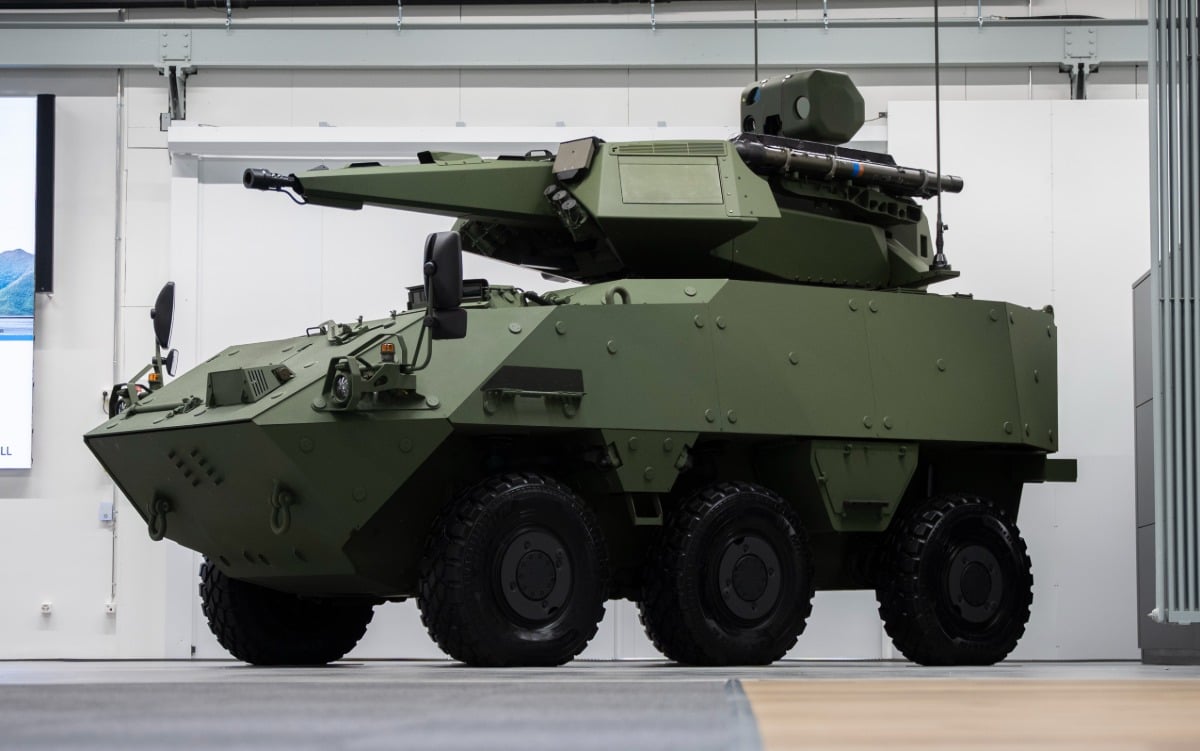
- Swiss Federal Councillor Martin Pfister and Austrian Defense Minister Klaudia Tanner toured Rheinmetall's air defense facility in Zurich this week.
- Austria confirmed its first Skyranger systems, mounted on Pandur armored vehicles, will arrive in 2027, while Switzerland's purchase is still pending parliamentary approval.
Two European defense ministers who normally answer only to the citizens of neutral countries walked through a Zurich weapons factory together this week, and what they saw helps explain why a small Swiss suburb has quietly become one of the most important addresses in Europe’s air defense industry.
Switzerland’s Federal Councillor Martin Pfister and Austria’s Defense Minister Klaudia Tanner toured Rheinmetall’s air defense facility in Zurich, according to a statement from Switzerland’s Federal Department of Defense, Civil Protection and Sport, where they examined ground-based air defense technology and confirmed that Switzerland intends to purchase a system called Bodluv KR from the company, while Austria has already committed to related Rheinmetall systems of its own.
Bodluv KR is Switzerland’s internal name for a short-range ground-based air defense system, translating roughly to “ground-based air defense, short range,” and it refers to Rheinmetall’s Skyranger, a 30mm automatic cannon system designed specifically to shoot down the kind of small, fast, low-flying drones that have become one of the defining threats of modern warfare. The system pairs a rapid-fire cannon with radar and sensor equipment capable of detecting and tracking small aerial targets that older air defense systems, built decades ago to intercept fighter jets rather than commercial-grade drones, often struggle to even see coming. Switzerland’s plan, according to Swiss news outlet 20 Minuten, calls for purchasing 32 Skyranger systems at a total cost of roughly $900 million (CHF 800 million), a request Pfister has already submitted to parliament as part of the country’s 2026 defense budget proposal, with the upper house already approving the purchase without opposition and a vote in the lower house expected in September.
The urgency behind that purchase became harder to ignore in recent days, as Swiss news outlet NZZ reported that unidentified drones have been spotted flying over Swiss army installations, incidents that exposed just how limited the country’s current defenses against small aerial threats actually are. Rheinmetall Air Defence CEO Oliver Dürr told journalists touring the Zurich facility, as reported by NZZ, that Switzerland is currently practically defenseless when it comes to intercepting drones, a gap the Skyranger system is specifically designed to close by giving the army a mobile, truck-mounted weapon capable of protecting critical infrastructure like power plants, airfields, and military logistics centers rather than relying on fixed installations tied to a single location.
Austria’s relationship with the same manufacturer runs a bit further along than Switzerland’s does. Vienna became the first customer in the world for series production of the Skyranger system three years ago, and NZZ reported that Austria has ordered 36 units of Rheinmetall’s related Skynex air defense system, mounted on wheeled armored vehicles rather than trucks, in what Austrian officials describe as the country’s largest single defense purchase in two decades. Tanner herself confirmed on social media that the Skyranger units will be mounted on Austria’s Pandur wheeled armored personnel carriers, a platform already in service with the Austrian military, and that the first Skyranger systems are scheduled to arrive in Austria in 2027, giving Vienna an operational head start on a weapon system Switzerland is still working to get through its own parliament even though delivery remains further out than initially suggested by earlier reporting.
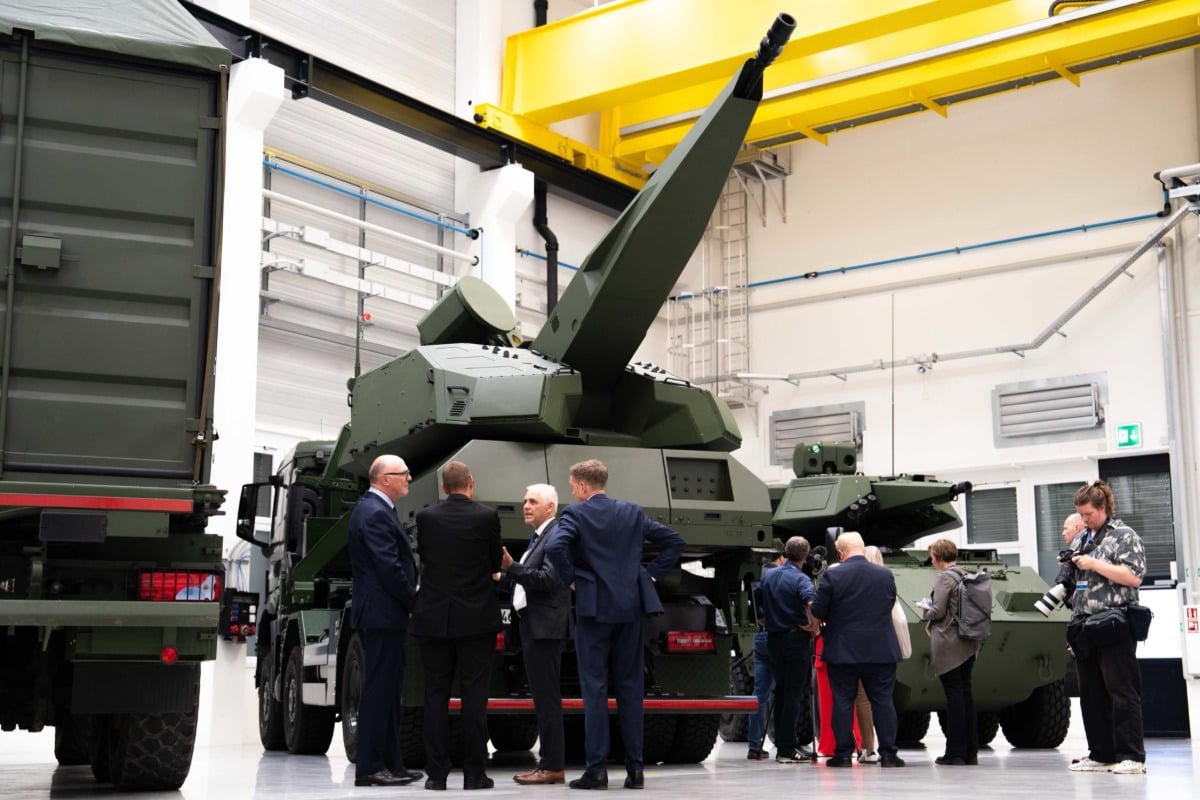
The plant traces its roots back to the Oerlikon-Bührle machine tool works, which began producing anti-aircraft cannons in 1930 and later developed the well-known 35mm twin cannon system in the 1960s, a design Austria has separately had Rheinmetall modernize by removing the human gunner entirely and shifting firing control to a remote container positioned away from the weapon itself. Pfister told reporters at the facility, according to NZZ, that Switzerland examined that same remote-fire approach for its own forces and ultimately decided against it, opting instead for the newer Skyranger platform for its short-range needs.
Both ministers used the factory visit to signal a broader shift toward joint European defense procurement, a trend driven largely by the rising cost of modern weapons systems and the shrinking ability of any single mid-sized country to develop or buy cutting-edge air defense technology entirely on its own. Pfister said cooperative purchasing across Europe remains in its early stages but will need to expand significantly in the coming years, particularly in air defense, according to Swiss broadcaster SRF, while Tanner argued that pooling resources between neutral states like Austria and Switzerland makes systems both cheaper and more efficient to acquire and maintain. Tanner reinforced that point directly on social media following the visit, describing major synergies available to the two neutral countries specifically in joint procurement and thanking Pfister for what she called strong cooperation and friendship between the two nations. Both countries have already taken a concrete step in that direction by joining Germany’s European Sky Shield Initiative, a program launched in response to Russia’s invasion of Ukraine that aims to build a stronger, more integrated air defense umbrella over the continent partly through coordinated equipment purchases, which Switzerland and Austria formally signed onto together in July 2023 despite their traditional neutrality.
Switzerland’s air defense modernization does not stop at short-range drone defense either. Pfister confirmed the country is separately acquiring five medium-range ground-based air defense systems under the same Sky Shield framework, part of a broader Bodluv MR competition that has drawn proposals from manufacturers offering systems including Germany’s IRIS-T SLM, the Norwegian-American NASAMS, and multiple options from European missile maker MBDA, while Switzerland has also moved forward with a separate long-range acquisition of the American Patriot system under a program known internally as Bodluv GR. Taken together, the short, medium, and long-range purchases represent an attempt to rebuild a layered air defense network essentially from the ground up, addressing gaps across every altitude band from small commercial drones skimming just above rooftops to high-flying combat aircraft and ballistic threats.