

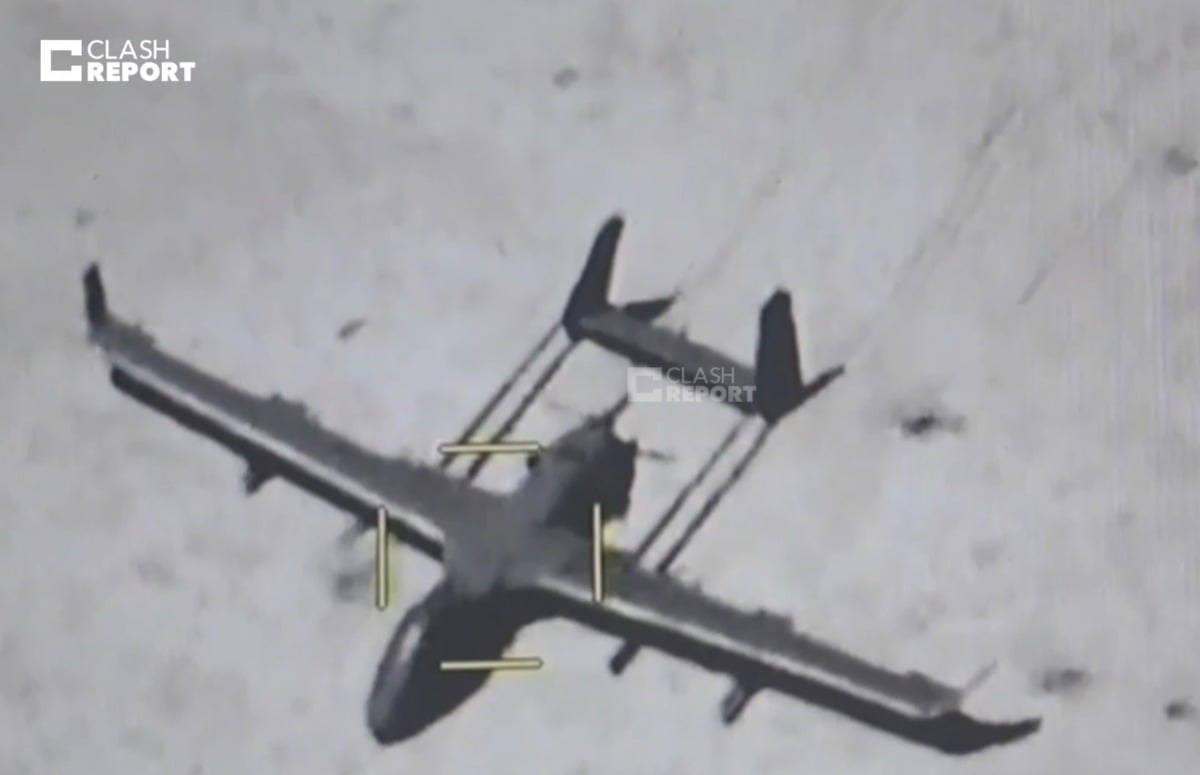
- Clash Report posted footage July 13, 2026 claiming a Sudanese Bayraktar AKINCI drone shot down one Chinese-made CH-95 drone and destroyed a second on the ground.
- Neither the Sudanese Armed Forces nor the Rapid Support Forces had confirmed either claimed incident at the time of this reporting.
Sudan’s army destroyed two Chinese-made combat drones flown by the paramilitary Rapid Support Forces within the same operation, one shot out of the sky with an air-to-air missile and a second wrecked on the ground, according to footage published July 13 by Clash Report, a Turkish-based news outlet that has covered Sudan’s drone war extensively.
The footage shows a Sudanese Armed Forces Bayraktar AKINCI, a Turkish-built combat drone, firing what appears to be an air-to-air missile at a Chinese-made CH-95 drone that Clash Report says the United Arab Emirates supplied to the RSF, a paramilitary group the Sudanese government and its allies have repeatedly labeled a terrorist organization. A second report from Clash Report says a separate CH-95 was destroyed on the ground, though it remains unclear from available footage whether that strike hit the same base or a different location.
Sudan’s civil war has raged since April 2023, when fighting broke out between the Sudanese Armed Forces, the country’s official military, and the Rapid Support Forces, a paramilitary group that grew out of the Janjaweed militias responsible for mass atrocities in Darfur two decades earlier. The conflict has killed tens of thousands of people, displaced millions more, and produced what humanitarian organizations describe as one of the world’s worst ongoing crises, with both sides increasingly relying on imported drones to strike targets, gather intelligence, and contest airspace that neither force could realistically control using conventional aircraft.
The Defence Blog previously reported on a related engagement in May, when the Sudanese Armed Forces used a Bayraktar AKINCI to shoot down another AKINCI-type drone suspected of Ethiopian origin, an incident that marked one of the first documented cases of an armed drone destroying another drone in direct aerial combat. If this weekend’s claimed CH-95 shootdown holds up, it would extend a pattern that has emerged repeatedly since March, when Sudanese officials first accused the UAE and Ethiopia of launching drones into Sudanese airspace from an airbase in Ethiopia, with the AKINCI increasingly functioning less as a strike platform against ground targets and more as an improvised airborne interceptor against a growing mix of hostile drones entering Sudanese skies.
The AKINCI itself is Turkey’s most capable combat drone, built by the Istanbul-based company Baykar, and it has become central to the Sudanese military’s aerial campaign since it entered service with Sudan’s forces in late 2024. The aircraft has a wingspan around 20 meters (66 feet), can operate at altitudes above 12,192 meters (40,000 feet), and carries a payload of up to 1,350 kilograms (2,976 pounds) of guided munitions, giving it the range and altitude to loiter for extended periods while carrying enough weapons variety to engage both ground targets and, increasingly, other aircraft.
The CH-95, the type of drone Clash Report says was destroyed twice in this latest engagement, has been reported inconsistently across Sudan war coverage, with some outlets and the Sudanese military’s own official statements referring to what appears to be the same aircraft type as the FH-95, built by Aerospace Times Feihong Technology Company, a subsidiary of the state-owned China Aerospace Science and Technology Corporation. Specifications previously reported for the type describe a strategic reconnaissance and strike drone with a service ceiling above 7,000 meters (22,966 feet), a combat radius of roughly 250 kilometers (155 miles), and an endurance of up to 24 hours depending on which designation and source is cited, differences that likely reflect confusion between similarly named Chinese drone families rather than two entirely distinct aircraft.
Reports of Chinese-made drones reaching the RSF through the UAE are not new, and human rights organizations including Amnesty International have previously documented evidence pointing to Chinese weapons systems, including combat drones and their delivery equipment, entering RSF hands with what investigators have described as Emirati involvement in the supply chain. The UAE has consistently denied providing military support to either side in Sudan’s conflict, and no international body has issued a definitive, universally accepted finding establishing direct UAE government responsibility for arming the RSF, leaving the precise mechanics of how Chinese-made drones end up in RSF service a matter of ongoing investigation rather than settled fact.