

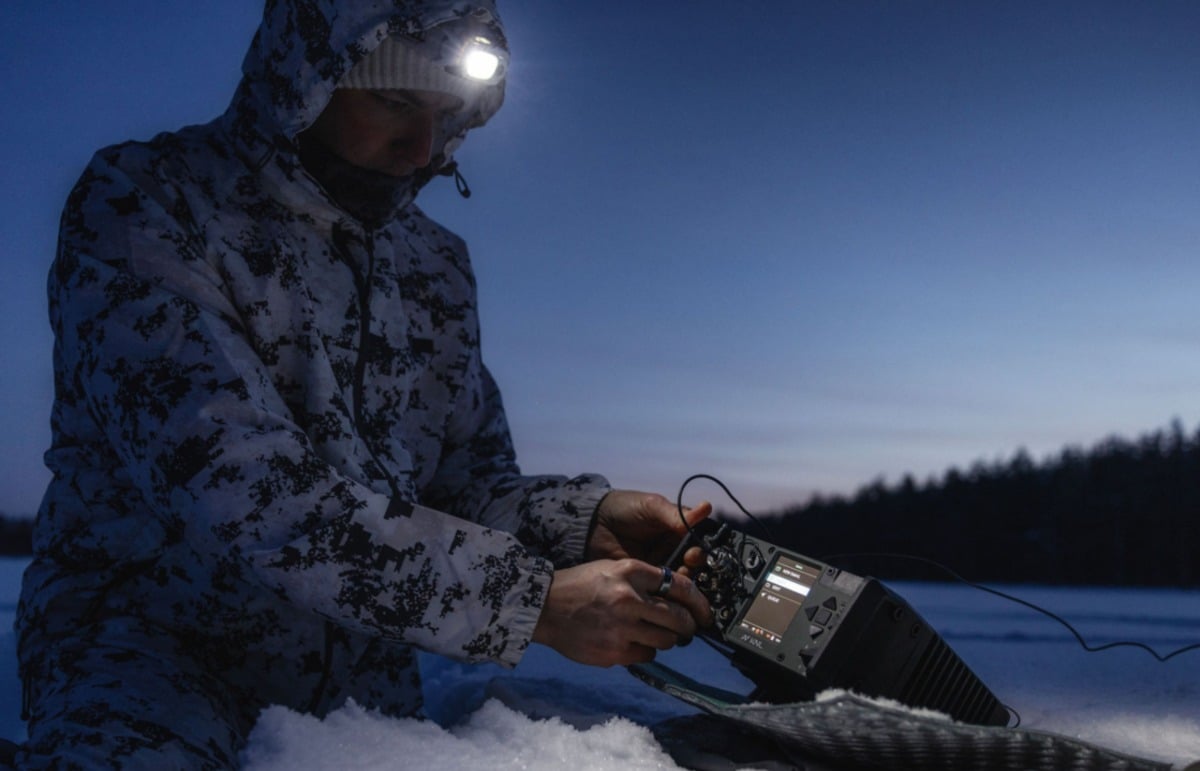
- The Finnish Defence Forces awarded KNL a contract worth approximately $7.45 million for Cognitive Networked HF radios.
- This marks KNL's third order from Finland, following a joint $17.2 million order with Sweden in August 2025 and a $2.29 million order in November 2025.
Finland has placed its third order in less than a year for radios that can keep soldiers talking across hundreds of miles without satellites, cell towers, or GPS, a technology bet that keeps paying off as tensions with Russia push Nordic militaries to rebuild communications systems that can survive jamming and outages.
The Finnish Defence Forces awarded KNL, a Finnish defense communications company owned by Norwegian telecom giant Telenor Group, a contract worth approximately $7.45 million for its Cognitive Networked HF radios, with deliveries scheduled to begin immediately once the contract takes effect.
The radios at the center of the deal rely on high frequency, or HF, a part of the radio spectrum that has been used for long-distance communication since the early 20th century because its signals can bounce off the ionosphere, the electrically charged layer of Earth’s upper atmosphere, and travel thousands of kilometers without needing satellites or ground relay stations. That property makes HF radio nearly impossible to fully jam or knock out, since there is no single satellite or tower an adversary can target to cut off communication, though older HF systems have historically suffered from slow, unreliable connections that could take precious seconds or longer to establish a link, a serious liability for troops trying to coordinate under fire. KNL built its Cognitive Networked HF technology specifically to fix that weakness, using what the company calls a cognitive waveform, software that continuously scans the HF spectrum and automatically steers communications around interference or jamming in real time rather than requiring an operator to manually search for a clear channel.
This latest order covers systems built to work as what KNL describes as a unified communications architecture, meaning the same underlying technology and user interface can run on fixed installations, vehicle-mounted radios, and portable units carried by individual soldiers, all speaking the same cognitive waveform to each other. That consistency matters more than it might sound, because military communications equipment has historically suffered from a patchwork problem, where different units running different radio systems across the same battlefield struggle to talk directly to one another without extra translation equipment, complicating everything from routine logistics coordination to a commander trying to redirect forces during an active engagement. By standardizing on one shared waveform across every deployment scenario, the Finnish military can simplify training soldiers only have to learn one system, cut down on spare parts and maintenance headaches, and rely on radios that keep working even when GPS satellite navigation, known formally as GNSS, gets jammed or spoofed, a growing concern given how routinely Russia has been accused of disrupting satellite navigation signals across the Baltic region in recent years.
Toni Lindén, KNL’s CEO, framed the repeat business as proof the company’s technology has moved from an experimental pitch to a trusted part of Finland’s defense infrastructure.
“We greatly value the continued trust the Finnish Defence Forces have placed in KNL and our technology,” Lindén said. “This order reflects our shared commitment to delivering resilient communications capabilities that meet evolving operational requirements while strengthening Nordic defence cooperation.”
Finland’s relationship with KNL didn’t start with this contract. In August 2025, the Finnish Defence Forces and Sweden’s Defence Materiel Administration placed a joint order worth roughly $17.2 million for KNL’s CNHF Manpack radios, the portable, soldier-carried version of the system, marking the first joint acquisition under a NORDEFCO agreement, a Nordic defense cooperation framework Finland, Sweden, and KNL signed in April 2025 specifically to standardize communications equipment across both countries’ militaries as part of a broader effort to strengthen interoperability following Finland and Sweden’s recent accessions to NATO. Major General Jarmo Vähätiitto, the Finnish Defence Forces’ Chief of C5, the military designation for the branch overseeing communications and information systems, said at the time that Finland’s operational requirements demanded an HF communications system spanning fixed stations and portable manpacks that all shared the same waveform and could integrate seamlessly into the broader command and control network the Finnish military relies on. That joint order ran under a ten-year NORDEFCO framework agreement covering 2025 through 2035, with automatic annual extensions built in beyond the initial term, giving KNL a stable, long-term revenue relationship with both Nordic militaries rather than a single one-off purchase. Finland followed that August order with a second, smaller purchase in November 2025 worth roughly $2.29 million, covering additional CNHF radios along with software and maintenance services, before Wednesday’s third order brought the total value of Finland’s KNL contracts to date past $26 million.
The CNHF Manpack radio itself can automatically monitor more than 4,000 HF and VHF channels simultaneously and establish a new communications link in about half a second whenever it detects interference, according to KNL, a dramatic improvement over legacy HF systems that could take considerably longer to reestablish contact after losing a signal, a delay that matters enormously to a soldier trying to call in support during an active firefight. The radios also support internet protocol connectivity over HF, letting them plug directly into broader digital command networks alongside more conventional communication tools, and KNL has said the system carries NATO-specific quality assurance certification, positioning it for potential adoption well beyond Finland and Sweden as other alliance members look to modernize aging communications equipment.
Sweden’s own defense materiel administration first acquired KNL’s CNHF system at the end of 2024, and KNL has said it has already begun pilot testing with Norway and other NATO members.