

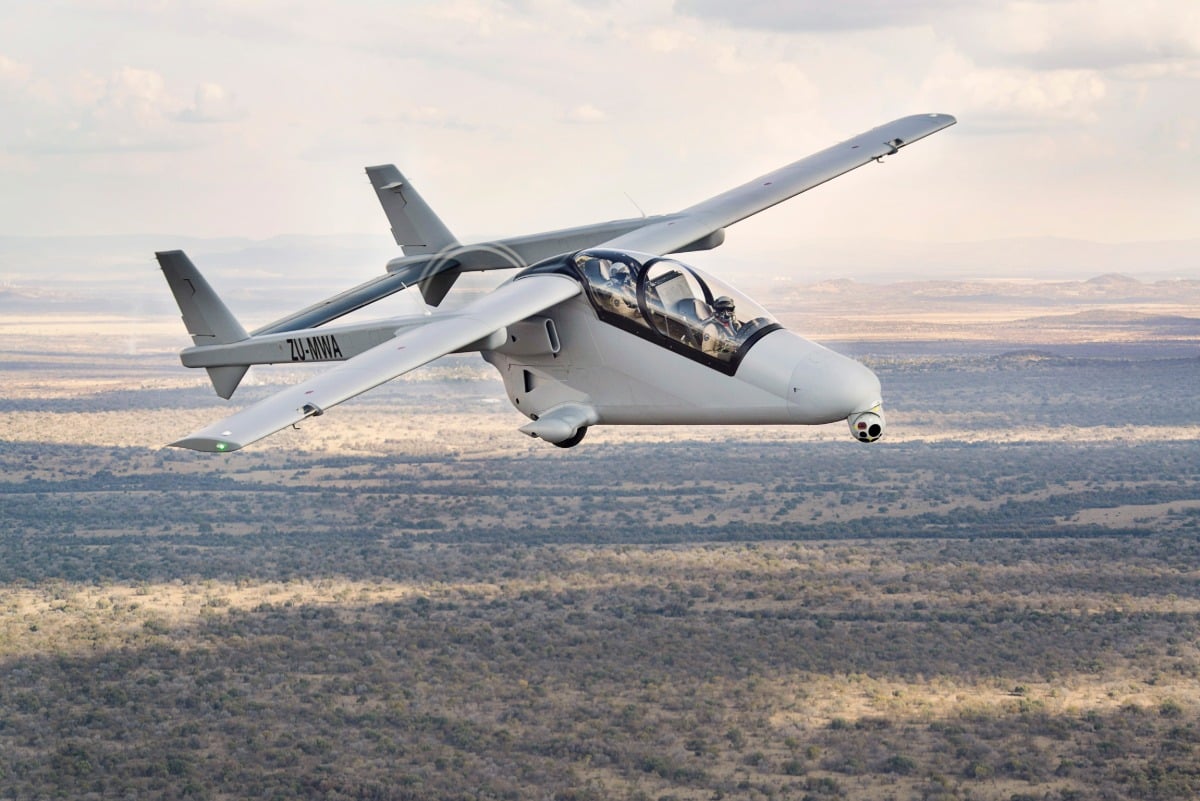
- Paramount Aerospace Industries unveiled a Mwari Counter-UAS configuration on July 16 to counter one-way attack drone threats.
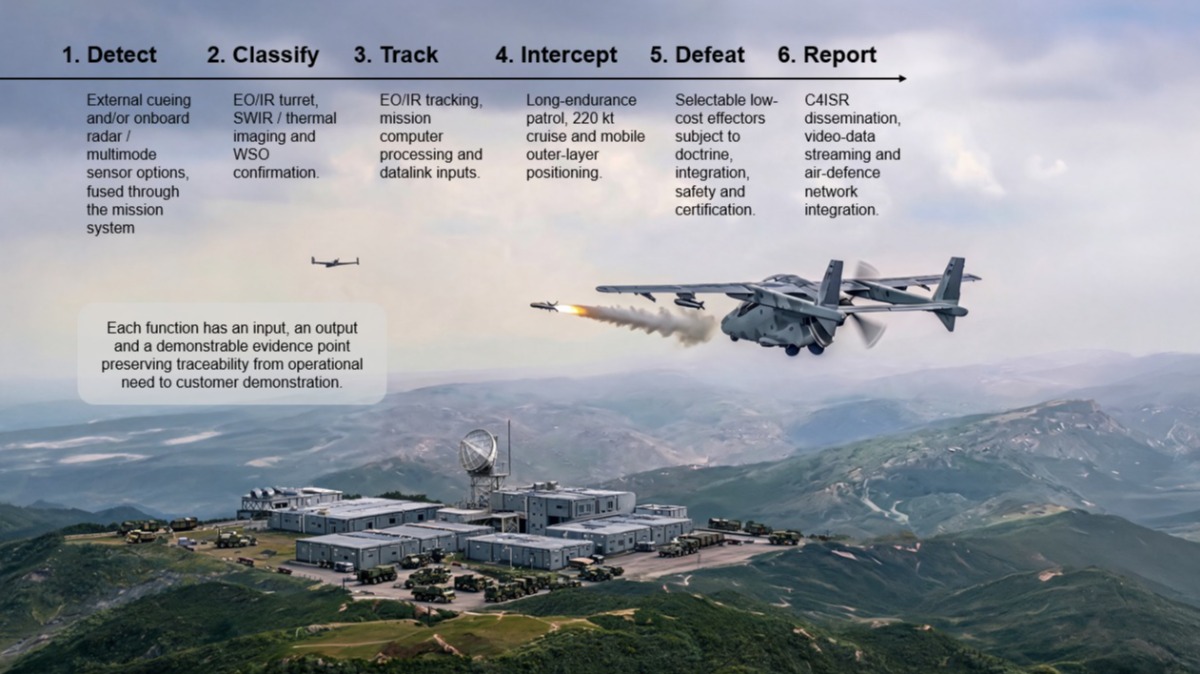
- The configuration combines electro-optical surveillance, human-in-the-loop targeting, and configurable gun and rocket effectors on the existing Mwari aircraft.
A South African aircraft manufacturer has unveiled a new way to hunt down the cheap, disposable drones that have started terrorizing power plants, ports, and military bases around the world, and its answer involves putting a human pilot back in the loop rather than relying purely on ground-based radar networks.
Paramount Aerospace Industries announced a dedicated counter-drone configuration for its Mwari aircraft, a twin-boom, propeller-driven surveillance and light attack plane the company has been selling for more than a decade, built specifically to detect and shoot down the one-way attack drones increasingly threatening infrastructure that traditional air defenses were never designed to protect.
One-way attack drones, sometimes called kamikaze or suicide drones, are cheap, expendable aircraft flown directly into a target rather than returning to base, and their low cost has made them a favorite weapon for both state militaries and non-state groups looking to overwhelm expensive defensive systems with sheer volume. That threat has expanded well beyond active battlefields in Ukraine and the Middle East, reaching critical infrastructure operators and smaller militaries around the world that never built the layered, ground-based radar networks wealthy nations use to spot slow, low-flying targets before they strike. Paramount’s pitch with the Mwari Counter-UAS configuration is that an aircraft already circling overhead can fill that detection gap without requiring a country to first build an expensive network of fixed radar installations.
Originally developed under the name AHRLAC, the Advanced High Performance Reconnaissance Light Aircraft, the plane first flew in July 2014 near Pretoria, becoming the first fully indigenous military aircraft built in Africa since Denel’s Rooivalk attack helicopter decades earlier. Paramount later partnered with Boeing to develop the aircraft’s mission systems, and the resulting Mwari carries a single Pratt & Whitney PT6A-66B turboprop engine producing 950 horsepower (710 kilowatts), giving it a maximum cruise speed of roughly 500 kilometers per hour (311 miles per hour), a service ceiling of 9,450 meters (31,000 feet), and a ferry range approaching 3,700 kilometers (2,300 miles), specifications that let it loiter over a protected area far longer than a typical fighter jet ever could.
What makes the aircraft adaptable to a mission like counter-drone defense is a design feature Paramount calls the Interchangeable Mission System Bay, a belly-mounted compartment that lets ground crews swap sensors and equipment in and out in under two hours, alongside six wing-mounted hardpoints that can carry everything from gun pods to guided rockets depending on the mission at hand. For the new counter-drone role, the company is pairing that flexible hardware with an electro-optical targeting system that gives the two-person crew day and night surveillance, allowing them to identify and track potential drone threats visually rather than depending entirely on radar returns, while keeping a human directly involved in every engagement decision rather than automating the kill chain end to end.
Lee Connolly, CEO of Paramount Aerospace Industries, framed the launch as a response to a widening gap between the drone threat and the defenses most operators currently have available.
“The proliferation of low-cost one-way attack drones has created an acute vulnerability for defence forces and infrastructure operators worldwide. These systems are placing enormous pressure on conventional air defence networks while creating a significant cost imbalance for the defender,” Connolly said.
“For many nations, the detection problem can be as challenging as the defeat problem. Mwari’s modular architecture allows us to configure the aircraft around the customer’s existing air defence environment and the specific threat they face,” Connolly said.
That distinction between detecting a drone and actually shooting it down matters more than it might sound, since most counter-drone systems on the market today assume a customer already has some way of spotting a low, slow-flying target in the first place. Many of the countries and infrastructure operators most exposed to drone attacks, Paramount noted, simply do not have that kind of comprehensive ground-based radar coverage, and building one from scratch demands significant time, money, and technical infrastructure that smaller defense forces or private port and energy operators may not have readily available. Mwari’s answer is to fly the detection network instead of building it, conducting barrier patrols and airborne surveillance sweeps ahead of a defended area, then transitioning directly into an intercept role once a threat is confirmed, all without needing a fixed radar site to feed it targeting data.
Paramount built the configuration around an open architecture that supports gun systems for close-range engagements alongside guided or precision rocket systems for longer stand-off shots, and the company says it deliberately designed the platform to integrate weapons from multiple international suppliers rather than locking customers into a single proprietary effector, giving governments the flexibility to match new counter-drone weapons to whatever ammunition and missile inventories, procurement rules, or industrial partnerships they already maintain.
That flexibility reflects a broader bet Paramount is making about how the counter-drone threat will keep evolving. Rather than building a single-purpose interceptor tuned to today’s drones, the company designed Mwari’s counter-UAS role around the same modular philosophy that has defined the aircraft since its earliest days as the AHRLAC, treating sensors and weapons as swappable components that customers can upgrade individually as both drone tactics and counter-drone technology continue changing.