

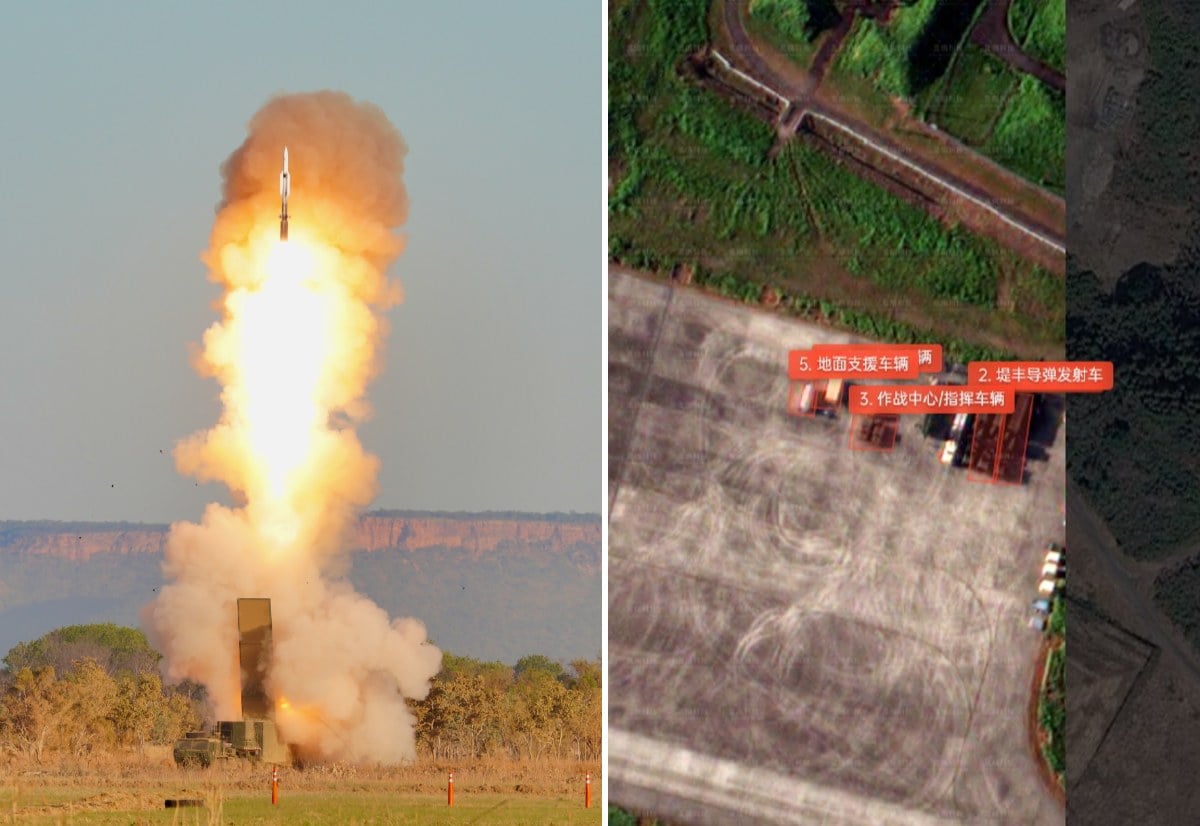
- MizarVision released satellite imagery showing elements of the U.S. Army's Typhon missile system at Kanoya Air Base in Kagoshima Prefecture, Japan.
- The Typhon system can fire Tomahawk cruise missiles roughly 1,600 kilometers (994 miles) and SM-6 multipurpose missiles.
MizarVision, a Chinese satellite imagery firm, released additional overhead images showing what it identified as elements of the U.S. Army’s Typhon Mid-Range Capability missile system positioned at Kanoya Air Base, a Japan Maritime Self-Defense Force installation in Kagoshima Prefecture on the southern island of Kyushu.
The Typhon system is not a single missile but a mobile ground-launched battery, built around a truck-mounted launcher, a battery operations center, and the missiles themselves, capable of firing both the Tomahawk cruise missile and the SM-6, a multipurpose missile that can intercept aircraft and other missiles or strike ground and sea targets. What makes Typhon significant is range. A Tomahawk fired from the system can travel roughly 1,600 kilometers (994 miles), a distance that puts major Chinese coastal cities including Shanghai, along with large portions of Fujian and Zhejiang provinces, within theoretical striking range from a launch site on Kyushu, according to Chinese military analyst Fu Qianshao, who spoke to the South China Morning Post about the system’s reach.
MizarVision described the imagery as consistent with previously announced U.S.-Japan plans to temporarily station Typhon at Kanoya during joint military exercises, and that timeline matches publicly confirmed deployment plans. Japan’s Ministry of Defense announced in May that the Army’s 3rd Multi-Domain Task Force, based at Fort Shafter, Hawaii, would bring Typhon to Kanoya alongside the High Mobility Artillery Rocket System, known as HIMARS, for Valiant Shield 2026, a biennial multinational exercise that ran from June 22 through July 1 across Japan, Hawaii, Guam, and surrounding waters. The system is scheduled to remain in the region for Orient Shield, an annual U.S.-Japan ground forces exercise held in September, before moving to a U.S. military base in Japan for storage starting around mid-October, a departure from how the deployment played out during Typhon’s first visit to Japan.
That first deployment happened in September 2025 at Marine Corps Air Station Iwakuni in Yamaguchi Prefecture, and it stayed considerably longer than officials initially indicated, drawing criticism from local residents who felt the extended presence had not been fully explained to them in advance. This marks Typhon’s second appearance in Japan and its first time specifically on Kyushu, positioning the system noticeably closer to both Taiwan and mainland China than the Iwakuni location did, a shift regional analysts have described as part of a broader effort to reinforce what the U.S. military calls the first island chain, a strategic arc of allied and partner territory stretching from Japan through Taiwan to the Philippines that Washington has increasingly relied on to constrain Chinese naval movement into the wider Pacific.
Neither government has scheduled a live-fire test of Typhon during its time at Kanoya, a restriction Japan’s Ministry of Defense confirmed applies to both the missile system and the accompanying HIMARS batteries throughout the current exercises. That caution stands in contrast to how the U.S. Army has used Typhon elsewhere in the region. American forces fired a live Tomahawk missile from a Typhon launcher during the Balikatan exercise in the Philippines earlier this year, marking the first time the weapon had actually launched from that system since it arrived in the country back in 2024, a deployment that drew sharp criticism from Beijing at the time and demands for its immediate removal.
Commercial satellite imagery analysis has become an increasingly common tool for independently verifying military movements that governments announce only in general terms, and the fact that a Chinese firm is the one publishing detailed images of American missile hardware inside Japan underscores how closely Beijing is monitoring a system it has repeatedly and publicly condemned. China’s Foreign Ministry has previously criticized Typhon’s presence in the region as a destabilizing move that raises the risk of military confrontation, and Russia has separately voiced similar objections to the broader expansion of U.S. land-based missile systems across the Indo-Pacific, arguing that such deployments undermine the region’s existing security balance.
MizarVision noted that while the Typhon deployment itself was officially announced by the U.S. and Japanese governments, the precise timing and specific identification of the equipment visible in its newly published imagery reflect the company’s own independent analysis rather than confirmation from either government, a distinction worth keeping in mind given that commercial satellite analysis, however sophisticated, still involves interpretation rather than official verification.
A missile system built to hold Chinese targets at risk, photographed and publicized by a Chinese company, sitting on Japanese soil that Beijing has already labeled a threat to regional stability, captures in a single set of images exactly the kind of great-power surveillance loop that now defines military transparency in the Indo-Pacific: allies announce their exercises, rivals photograph the results, and everyone watches everyone else watching.