

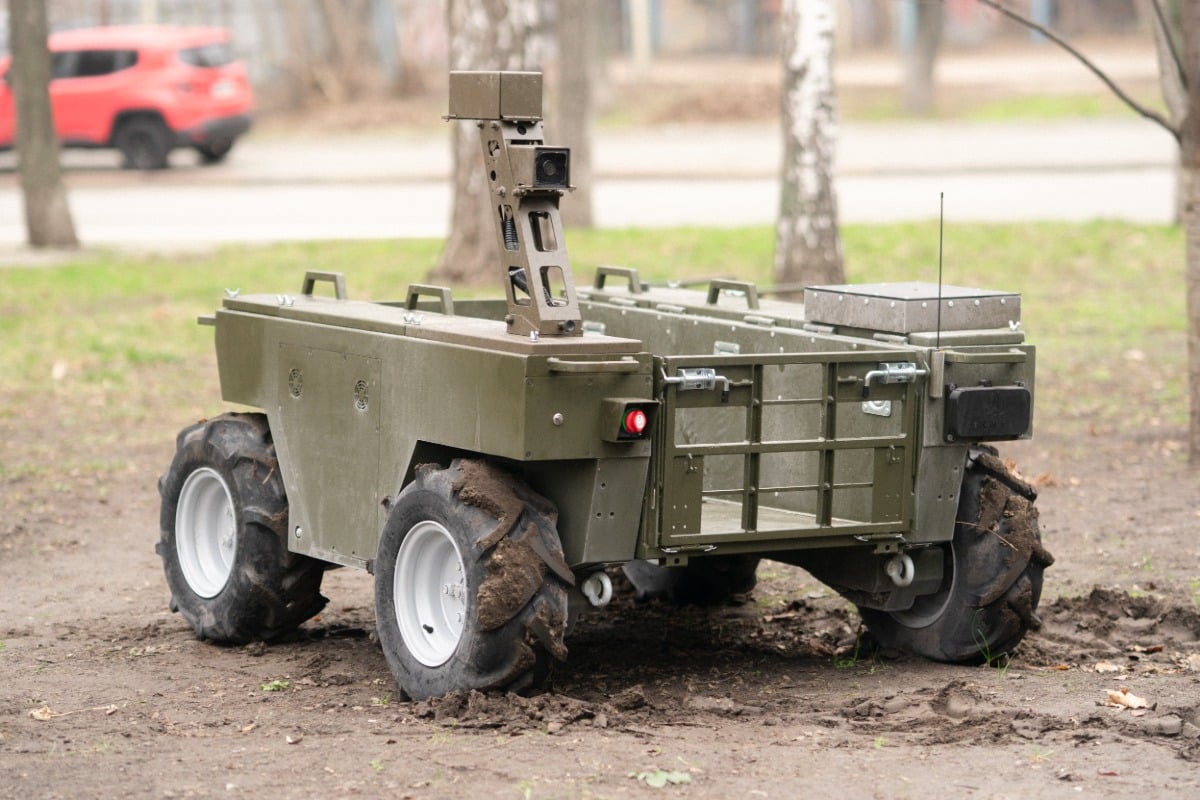
- Trinity Robotics announced a strategic investment of more than €500,000 from Front Ventures AB, Hede Capital, and Defence Builder Fund I on July 7, 2026.
- The Kyiv-based company plans to scale monthly production of its Konyk ONE combat robot from up to 70 units to more than 150 starting in July 2026.
A Ukrainian company that builds robots to carry wounded soldiers off the battlefield just landed more than €500,000 ($571,600) in fresh funding from Swedish investors, money the company says will help it nearly double how many combat robots it can build every month.
Trinity Robotics announced the strategic investment round on July 7, 2026, backed by Swedish firms Front Ventures AB and Hede Capital alongside Defence Builder Fund I, with the funds earmarked to expand production, speed up deployment, and push further research into the company’s flagship unmanned ground vehicle, known as Konyk ONE.
Konyk ONE belongs to a category of machine that has quietly become one of the most consequential technologies of the war in Ukraine, even as flying drones tend to grab the headlines. Unmanned ground vehicles, or UGVs, are remotely operated or autonomous robots built to handle jobs that would otherwise put a soldier’s body directly in the line of fire, hauling ammunition and supplies to forward positions, pulling wounded troops out of contested ground, and running other high-risk errands across terrain saturated with enemy drone surveillance and artillery fire. Trinity’s platform is built specifically for that punishing environment, rated to carry payloads of up to 300 kg (660 lb) across off-road terrain and through destroyed infrastructure, and it stays in contact with operators through a mix of LTE, Starlink satellite internet, and digital radio links, giving crews multiple ways to keep controlling the machine even if one communications channel gets jammed or knocked out.
The company says it currently runs serial production at a rate of up to 70 systems per month and plans to push that figure past 150 systems monthly starting this July, a jump that would more than double its output in a matter of weeks rather than years. That kind of production ramp reflects just how much demand for ground robotics has grown across Ukraine’s military over the past year, with Ukrainian Defense Forces data showing more than 9,000 robotic ground missions carried out in a single month earlier this year, up from under 3,000 missions per month less than a year and a half ago, as more frontline units adopt robots for logistics runs and casualty evacuation that used to require exposing soldiers directly to enemy fire.
Trinity says its robots are deployed in nearly every frontline sector and are currently in use by more than 20 separate Ukrainian military units, operating under government contracts alongside direct cooperation with the armed forces. That deployment runs through formal channels rather than informal battlefield adoption alone, with Trinity working directly with Ukraine’s Defense Procurement Agency and the State Service of Special Communications and Information Protection, and the company has also completed NATO codification for its systems, a standardization process that certifies a piece of military equipment meets alliance technical and logistics standards, making it easier for NATO member militaries to evaluate, purchase, or integrate the platform into their own forces.
“Our mission is to replace humans in dangerous environments with reliable robotic systems,” said Oleksii Konik, co-founder of Trinity Robotics. “Ground robots are no longer an experimental technology, they are becoming a critical part of modern warfare and a tool for saving lives on the battlefield. We are proud to welcome Defence Builder, Front Ventures and Hede Capital as partners. Their commitment demonstrates growing international confidence in Ukraine’s defence technology sector and supports our mission to replace soldiers in dangerous environments with reliable robotic systems. We are grateful to Axendra for its support throughout the fundraising process and for helping establish this strategic partnership.”
Front Ventures, a Nordic defense-focused investment firm headquartered in Sweden, has built its recent strategy specifically around backing early-stage companies building deployable, frontline-relevant technology, with a strong operational focus on Ukraine that includes appointing a dedicated local investment manager and establishing legal cooperation with a Lviv-based law firm earlier this year. The firm, listed on Sweden’s NGM Nordic SME exchange, carried a market capitalization of roughly SEK 250 million as of May 2026 and raised SEK 52 million that same month, giving it fresh capital to deploy into exactly the kind of early-stage defense technology bet that Trinity Robotics represents. Front Ventures has indicated it may participate further in Trinity’s financing later in 2026, suggesting this initial investment could be the opening move in a larger funding relationship rather than a one-time transaction.
“Front Ventures sees a growing need for investment in unmanned ground systems,” said Jonas Malmgren, representative of Front Ventures AB. “Ground robots will play an important role in reducing risks for military personnel on the frontline, and we are pleased to support in scaling production.”
Trinity’s fundraise also benefited from Ukraine’s increasingly organized defense innovation ecosystem, with the deal made possible through support from Brave1, the Ukrainian government’s state defense technology cluster that connects startups with funding, testing opportunities, and military end users, and advisory support from Axendra, a defense technology advisory platform that specializes in matching investors with high-potential defense companies. That kind of structured pipeline between battlefield-tested startups and Western capital has become an increasingly well-worn path for Ukrainian robotics firms over the past year, with companies including Tencore, DevDroid, and Ukrainian Armor each announcing major European industrial partnerships or foreign investment deals in recent months as demand for combat-proven ground robots spreads well beyond Ukraine’s own procurement budget.