

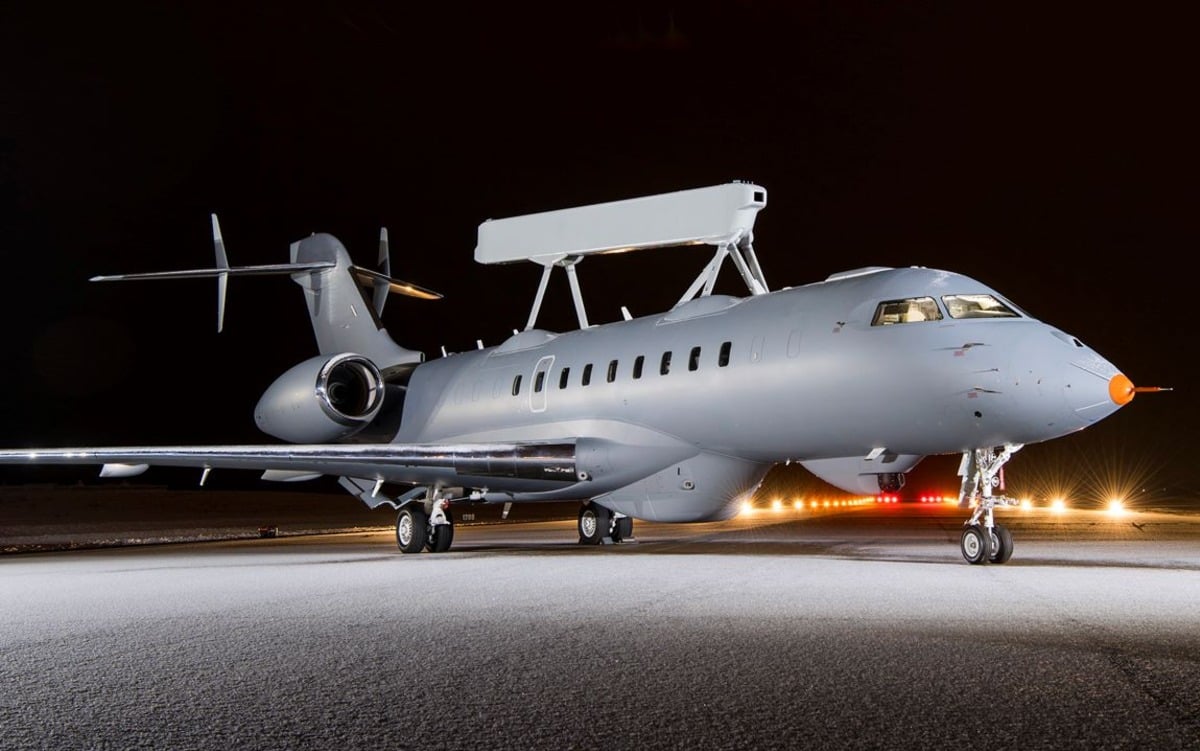
- NATO Secretary General Mark Rutte announced at the Ankara summit that NATO will begin formal negotiations with Saab to acquire up to ten GlobalEye surveillance aircraft.
- The deal would replace NATO's fleet of 14 Boeing E-3A Sentry AWACS aircraft, which have been in service since 1982.
For more than four decades, the same American-built aircraft has been NATO’s eyes in the sky, and that streak is about to end. NATO Secretary General Mark Rutte announced at the alliance’s summit in Ankara, Türkiye, that NATO will open formal negotiations with Swedish defense firm Saab to acquire up to ten GlobalEye surveillance aircraft, a deal that would retire NATO’s aging fleet of Boeing E-3A Sentry AWACS planes and hand the alliance’s core airborne surveillance mission to a non-American manufacturer for the first time since 1988.
The E-3A Sentry, easily recognized by the rotating radar dome mounted on top of its fuselage, has flown NATO’s surveillance missions since 1982. Based on a modified Boeing 707 airframe, the aircraft has tracked hostile aircraft, coordinated allied air operations, and helped patrol NATO’s eastern flank since Russia’s 2022 invasion of Ukraine, all from a fleet of 14 planes stationed at NATO Air Base Geilenkirchen in Germany. Those aircraft are now old enough to legally rent a car in most American states, and NATO has been trying to figure out what replaces them for years. Saab’s own statement makes clear this is not yet a done deal.
“At this point, Saab has not signed a contract or received an order related to the announcement,” the company said, and Saab will now proceed to formal negotiations with the NATO Support and Procurement Agency, the alliance’s purchasing arm, to try to turn Rutte’s announcement into an actual contract.
NATO originally picked Boeing’s E-7A Wedgetail for the job back in 2023, a plan that fell apart after the U.S. Air Force scrapped its own Wedgetail order in 2025 in favor of investing more heavily in satellite-based surveillance instead. With its biggest prospective customer walking away, NATO allies abandoned the six-aircraft Wedgetail purchase, arguing the program had lost its financial and strategic footing, and the alliance reopened the competition to find a replacement. That reversal cleared a path for GlobalEye, and the timing carries its own political weight: the announcement comes as President Donald Trump has repeatedly pressed NATO members to buy American-made defense equipment and has needled European allies over their reliance on U.S. security guarantees, making a Swedish jet’s selection over an American one a notable signal about where some of NATO’s members want their money to go.
GlobalEye itself is built to do more than the E-3A ever could from a single airframe. The aircraft pairs Saab’s Erieye Extended Range radar, a system built into a ridge-shaped fairing running along the top of the fuselage rather than a rotating dome, with a suite of additional sensors and a command-and-control system capable of directing operations across air, sea, and land simultaneously. All of that sits on a Bombardier Global 6500, a business jet airframe that is smaller, cheaper to operate, and easier to maintain than the E-3A’s converted airliner frame, while still offering endurance in the range of 11 to 13 hours and a range exceeding 11,000 km (6,835 miles). The radar suite is designed to pick out low-observable and stealthy aircraft, drones, and both ballistic and hypersonic missiles even when the sky is cluttered with other radar returns or an adversary is actively jamming the signal, a capability gap that has become increasingly urgent as Russia and other militaries field more advanced missile threats along NATO’s borders.
“We are honoured and proud to support NATO in its next-generation AEW&C capability,” said Micael Johansson, President and CEO of Saab. “We are confident that GlobalEye is the right choice for the Alliance, delivering proven capability, adaptability and long-term operational advantage. Today’s announcement clearly positions GlobalEye as the world-leading solution for advanced airborne early warning and control. We look forward to the next steps in the negotiations.”
The GlobalEye aircraft has been in operational service since 2018 with the United Arab Emirates, which was the type’s launch customer, and Saab has since built a growing order book among NATO members and partners. Sweden has ordered three GlobalEye aircraft for its own air force, France signed a contract in December 2025 for two aircraft with options for two more, and Canada announced in May 2026 that it selected GlobalEye over Boeing’s Wedgetail and a competing bid from L3Harris for a fleet of six aircraft worth more than $3.6 billion, with plans to build roughly a third of future GlobalEye production inside Canada through Bombardier’s existing manufacturing base in Quebec and Ontario. A NATO order of up to ten aircraft would become Saab’s largest single sale of the platform to date, at a reported unit cost of roughly $590 million per aircraft, putting the total value of a NATO deal above $5.4 billion before factoring in training, spare parts, or long-term maintenance contracts.
What remains unresolved is exactly how many aircraft NATO will ultimately commit to buying, when deliveries would begin, and how quickly the alliance can retire the E-3A fleet once a contract is signed. NATO has previously indicated Geilenkirchen would remain the operational hub for whatever replaces the Sentry fleet, and the alliance’s broader Allied Future Surveillance and Control program treats the aircraft purchase as one piece of a larger surveillance architecture rather than a simple plane-for-plane swap. Given how long the E-3A has already outlived its original service projections and how the Wedgetail deal collapsed only after years of planning, NATO officials will likely face pressure to move the GlobalEye negotiations faster than the process that preceded it, if only because an aging surveillance fleet does not get any younger while contracts sit unsigned.