

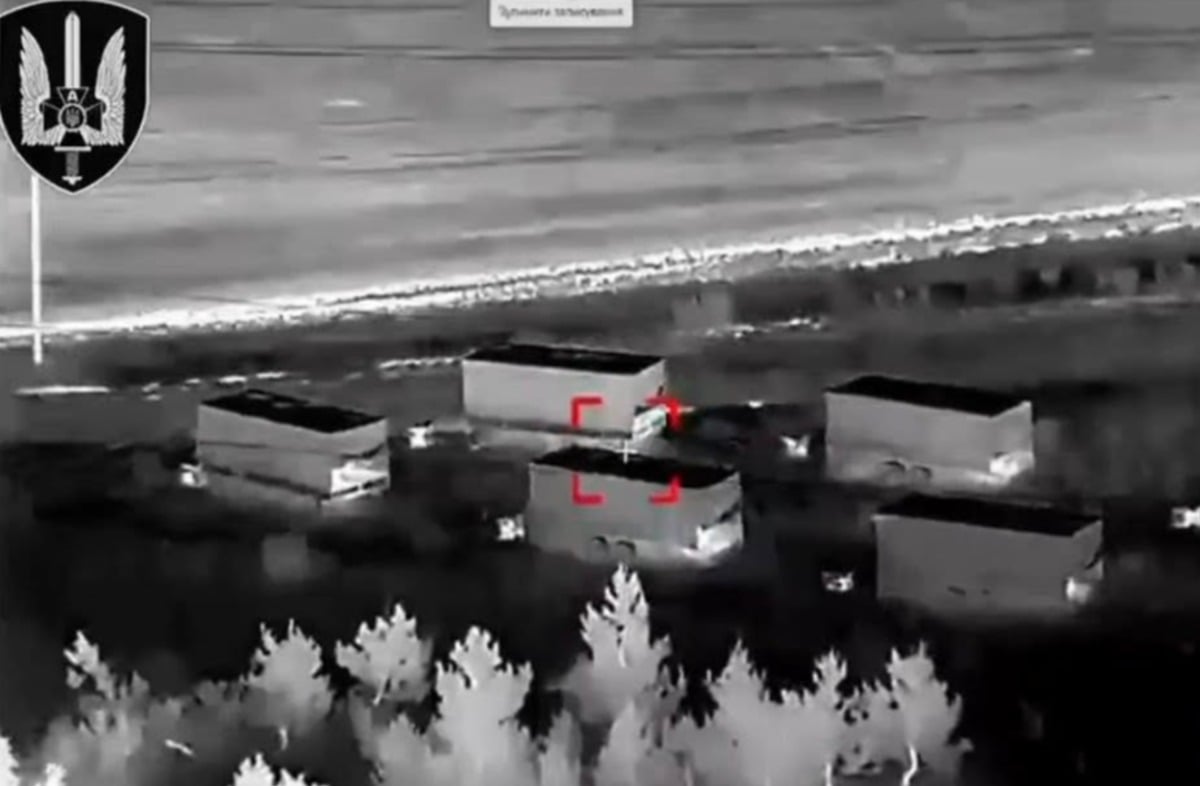
- Ukrainian defense advisor Serhii Beskrestnov identified and confirmed the destruction of Russian "Volna Kupol Garant" Starlink-jamming EW systems being used along the front in 2026.
- The system, made by LLC Rossiysky Kupol of Simferopol, costs $1.5 million per unit and uses 12 antennas on 6 trailers to jam Starlink's 14–14.5 GHz uplink across 20 square kilometers.
The satellite communication network that Ukrainian forces depend on to coordinate everything from drone strikes to artillery fire has a new enemy, and Ukraine is already destroying it. Ukrainian defense advisor Serhii “Flash” Beskrestnov, a widely followed open-source intelligence analyst who tracks electronic warfare developments along the front, has publicly identified a Russian electronic warfare system called “Volna Kupol Garant” that is specifically designed to jam Starlink satellite terminals by overwhelming the satellites themselves with interference rather than targeting the terminals on the ground, and has confirmed that Ukrainian forces are locating and eliminating these systems as a priority target.
Starlink, the low-Earth orbit satellite internet constellation operated by SpaceX, became the backbone of Ukraine’s battlefield communications network after Russia’s full-scale invasion began in February 2022, with tens of thousands of terminals providing the reliable, high-bandwidth connectivity that Ukrainian units use to operate reconnaissance drones, share targeting data, coordinate fires, and maintain command-and-control links across a front stretching hundreds of kilometers. Russia’s ability to jam or disrupt Starlink therefore carries consequences that go well beyond disrupting internet access: it threatens the entire digital nervous system of Ukraine’s military operations, which makes any system capable of doing so a target of exceptional priority.
Beskrestnov described the history of Russian attempts to suppress Starlink in his public reporting, noting that the first confirmed case of Starlink jamming by Russian forces was recorded in 2024 on the Kharkiv axis in northeastern Ukraine. “The Russian EW system was quickly detected by Ukrainian forces and destroyed,” Beskrestnov wrote. “Until 2026, no mass attempts to repeat its use were recorded.” The pattern changed after Ukraine intensified deep strikes against Russian logistics infrastructure using mid-range strike systems, at which point Russian forces apparently resumed efforts to protect their rear areas by denying Ukrainian forces the communication links they need to coordinate and sustain those strikes. “After the start of attacks on Russian logistics with Ukrainian mid-range strikes, we again began to record EW working against the Starlink communication system,” Beskrestnov wrote. “Of course, we detect and will continue to detect such enemy systems and destroy them.”
The technical architecture of the Volna Kupol Garant system is unusual because it attacks the uplink path from the ground to the satellite rather than the downlink path from the satellite to the terminal, which is the more commonly discussed jamming approach. Starlink terminals communicate with satellites using frequencies in the 14 to 14.5 GHz band, which is divided into eight channels of 62.5 MHz each. The Volna Kupol Garant system uses eight satellite dish antennas, one aimed at each channel, each antenna transmitting powerful interference directly at the satellite as it passes overhead, with the goal of overwhelming the satellite’s receiver so that it cannot hear the legitimate signals from Ukrainian terminals on the ground below. The effective coverage area Beskrestnov describes for one complete system is approximately 20 square kilometers (7.7 square miles), meaning a single complex creates a zone within which Starlink terminals lose uplink connectivity for as long as the system remains operational and aimed at the relevant satellite.
The physical configuration of the Volna Kupol Garant makes it transportable but not easily concealable, and that combination of mobility and visual signature appears to be a key factor in Ukraine’s ability to locate and destroy these systems. Beskrestnov describes the system as mounted on trailers, with two antennas per trailer and six trailers in a complete complex, for a total of twelve antennas working across the eight Ku-band uplink channels. Each antenna is visually distinctive, enclosed in what Beskrestnov describes as an egg-shaped radome that conceals a motorized satellite dish with a tracking mechanism inside, allowing the antenna to follow a satellite across its arc without requiring the entire trailer to be repositioned. The antenna arrays can be dismounted from the trailers and deployed on a single platform or installed directly on the ground when the tactical situation requires a lower profile than a trailer-mounted configuration would allow, but the power consumption of the system constrains its deployment options: Volna Kupol Garant can run on generators built into each trailer or draw from external power lines, and the infrastructure required for either approach creates observable signatures that Ukrainian intelligence and drone surveillance can exploit.
The manufacturer of the Volna Kupol Garant is identified by Beskrestnov as LLC “Rossiysky Kupol,” a company based in Simferopol, the capital of Russian-occupied Crimea, which places the manufacturer in territory that Russia has controlled since 2014 and that provides some protection from conventional Ukrainian strike operations, even as the products of that factory travel to forward positions where they become very much within reach. Beskrestnov noted with evident irony the price at which the Simferopol company managed to sell these systems to the Russian military: “The gentlemen from LLC Rossiysky Kupol managed to sell these products to the army at a price of $1.5 million each,” he wrote. “That is simply spectacular.”
The characterization captures both the procurement culture that has allowed Russian defense contractors to charge premium prices for systems of uncertain effectiveness, and the practical reality that a complex requiring twelve egg-shaped antennas on six trailers, with substantial power infrastructure, managed to operate along the front long enough to be detected and destroyed rather than proving invulnerable to the Ukrainian forces it was designed to hamper.
The Volna Kupol Garant may protect 20 square kilometers of Russian rear area for as long as it survives, but Ukraine’s demonstrated willingness and ability to locate and destroy it suggests that the protection it provides comes with an inherent and unavoidable expiration date.