

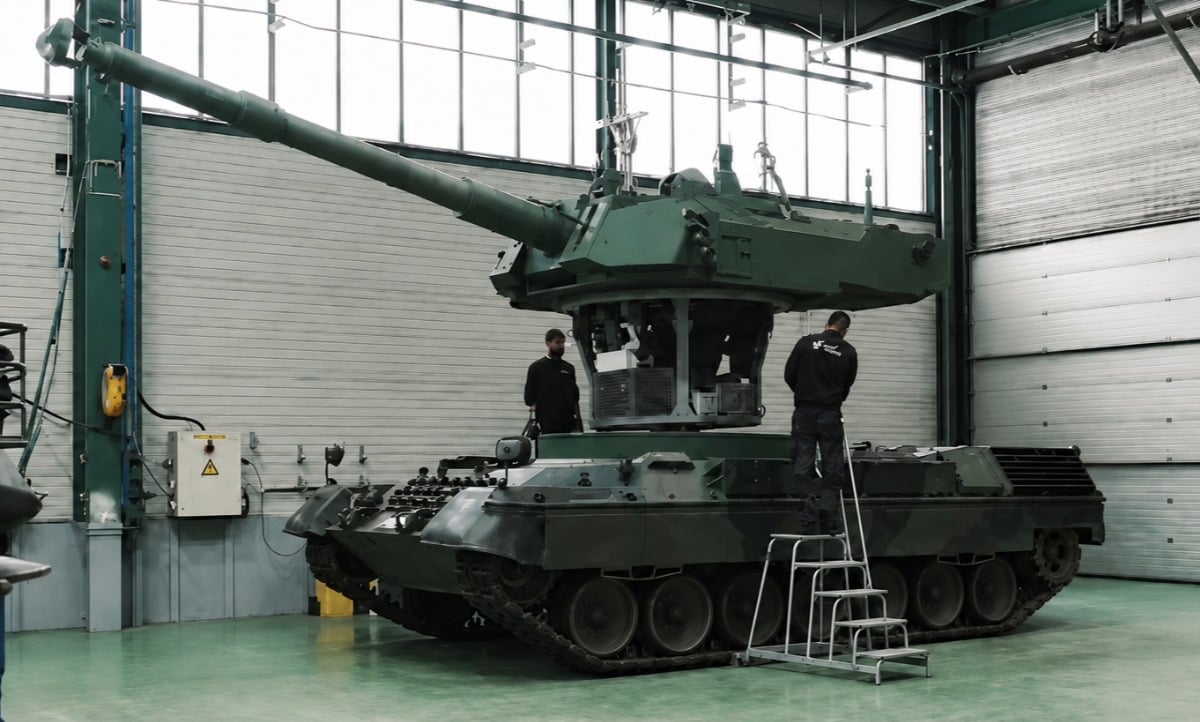
- Defense analyst Jeff reported at Eurosatory 2026 that Cockerill confirmed a contract for 30 C3105 turrets for Ukraine's Leopard 1 tanks, with five due June 2027.
- A prototype Leopard 1 with the Cockerill 3105 turret has been undergoing field trials in Ukraine since May 2025, with testing reported as successful by the manufacturer.
A Cold War-era tank first fielded in 1965 is about to get a new brain, a new gun system, and a new purpose on one of the most dangerous battlefields in the world. Defense analyst Jeff, writing for Defense Archives on Monday, reported that a Cockerill spokesperson confirmed to him at Eurosatory 2026 in Paris that the Belgian company has been contracted to deliver 30 Cockerill 3105 turrets to Ukraine for installation on the country’s fleet of Leopard 1 main battle tanks. Defense Archives reported that the first five systems could be delivered in June 2027, with the rest by the end of the year; this has not been officially confirmed. The identity of who is paying for the contract remains unknown, the analyst noted, and no official announcement has come from John Cockerill Defense, the Ukrainian government, or any donor nation.
That reported detail, 30 turrets, a delivery timeline, and an unnamed buyer, lands on top of a story that has been building for more than a year. A prototype Leopard 1 fitted with the Cockerill 3105 turret arrived in Ukraine in May 2025 for evaluation, and John Cockerill Defense representatives confirmed at the BEDEX 2026 defense exhibition in Brussels in March that testing had gone well, with reports in March 2026 saying the vehicle was expected to be sent to a Ukrainian unit for front-line evaluation. A modernized Leopard 1 equipped with the unmanned Cockerill 3105 turret and the 105 mm Cockerill HP gun remained in Ukraine undergoing trials, with the manufacturer stating that tests were progressing well. The Eurosatory contract disclosure, if confirmed through official channels, would transform what had been a single-vehicle evaluation into a meaningful battlefield capability.
Germany, Denmark, the Netherlands, and other European nations transferred large numbers of retired Leopard 1 fleets to Ukraine after Russia’s full-scale invasion began in February 2022, providing Ukraine with armored firepower at a scale that newer and more expensive tanks could not match in quantity. The trade-off was capability: the Leopard 1’s original turret and fire control system reflect 1960s technology, and the tank’s armor protection is modest by modern standards. What John Cockerill Defense is proposing is not a replacement for the Leopard 1 but a transformation of it, turning an aging armored vehicle into a purpose-built fire support platform by removing what is old and installing what is new.
The Cockerill 3105 turret that would replace the original Leopard 1 turret is a compact, unmanned system built around the company’s 105 mm (4.1 in) high-pressure rifled gun, the same caliber as the Leopard 1’s original armament, which means existing NATO-standard 105 mm ammunition stocks are compatible without modification. Frank Janssens, General Manager of Weapon Systems at John Cockerill Defense, has stated publicly that the 3105 is constructed from armored aluminum, making it approximately 3 tonnes (6,600 lb) lighter than the original steel turret it replaces, and that it provides Level 4 protection under the STANAG 4569 standard, meaning it can resist 14.5 mm armor-piercing rounds from 200 meters (660 ft), with optional active and dynamic protection upgrades available. The turret features an automatic loader for 12 to 16 rounds and modern optical systems that allow target detection at distances of up to 18 km (11.2 miles) during the day and 15 km (9.3 miles) at night.
The capability John Cockerill has consistently highlighted as the central selling point is the 3105’s ability to conduct indirect fire, meaning the tank can engage targets it cannot directly see by firing at a high elevation angle from a concealed position, functioning more like a self-propelled howitzer than a conventional tank. The company has characterized this as a capability “unique among Western tanks,” and while that claim invites scrutiny, the practical point is clear: a tank that can fire from behind a tree line at targets several kilometers away without exposing itself is a fundamentally different threat than one that must crest a ridgeline to shoot. On a battlefield saturated with drones, that distinction is not marginal. It may determine whether a crew survives the mission.
The turret’s unmanned design is equally significant in the Ukrainian context. Because no crew sits in the 3105, the crew operates entirely from within the hull, protected by the vehicle’s base armor and any supplementary protection added by Ukrainian engineers. Photographs of the prototype confirmed the tank appeared without anti-drone cage armor or mesh screens commonly seen on armored vehicles used in the conflict, a gap that Ukrainian units have proven highly capable of addressing with field-fabricated solutions. Whether production vehicles delivered under a potential 30-turret contract would incorporate drone protection from the outset has not been addressed publicly.
The commercial context for the 3105 turret extends well beyond Ukraine, which helps explain why John Cockerill has invested in an evaluation program in an active conflict zone. At least one hundred Cockerill 3105 turrets with 105 mm high-pressure cannons are currently in production for a Middle Eastern customer, integrated onto wheeled vehicles comparable to American Strykers. The Indonesia-Turkey Harimau medium tank also uses the 3105 family. Testing the system in Ukraine, if followed by front-line evaluation, would give John Cockerill data that cannot be replicated at a trade show, and results that Cockerill representatives describe as validating carry weight in procurement conversations that laboratory trials simply cannot match.