

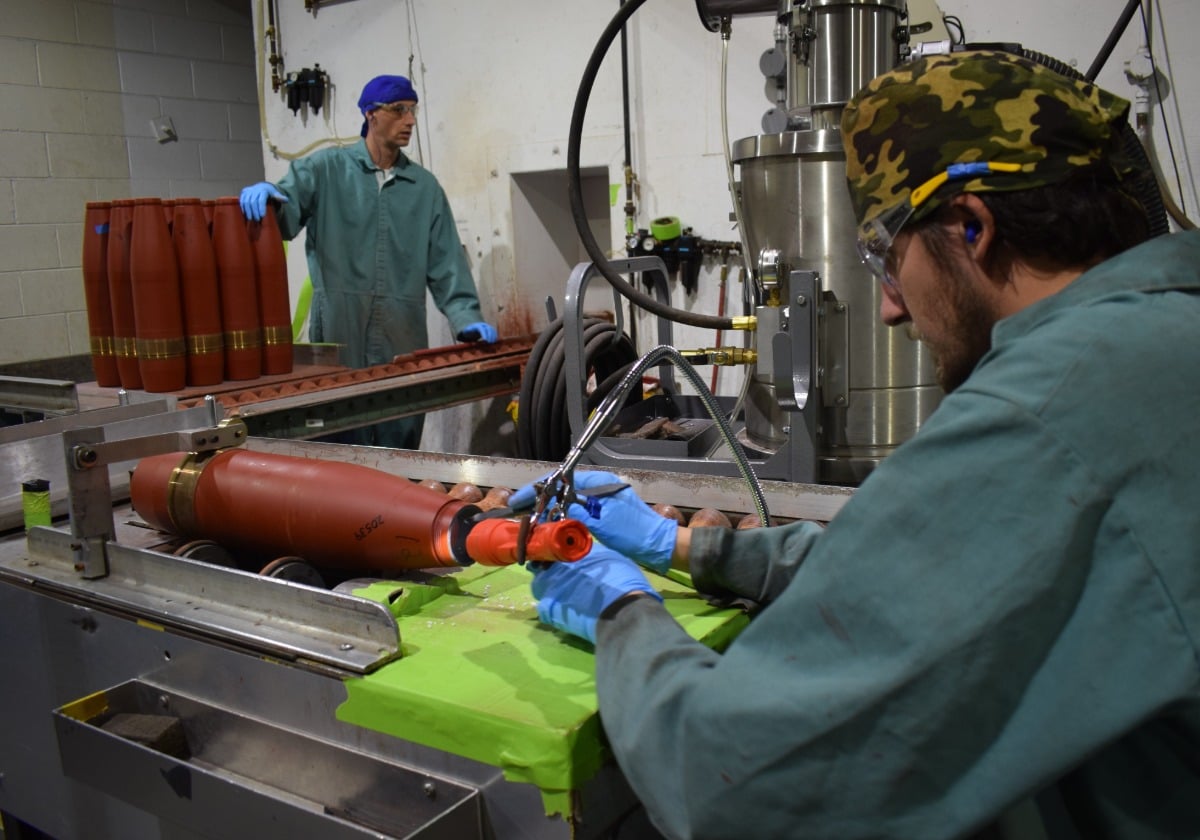
- Willem Mulock Houwer of Red Cobra Defence argues that production rate is becoming a core defence capability, not just a support function.
- Ukraine's conflict has shown that consumption rates often exceed pre-war assumptions, making industrial scalability strategically critical.
For decades, the conversation around defence capability has been anchored almost exclusively to platforms: aircraft, ships, tanks, missiles, and more recently drones, with system performance serving as the primary and largely unchallenged measure of military advantage, built on a logic that was coherent and largely self-reinforcing: if a system outperformed its adversary counterpart in speed, range, precision, or survivability, it conferred an edge that justified its cost and the industrial complexity required to field it. That assumption is now under sustained pressure from the evidence emerging out of active conflict, and the pressure is not marginal but structural, touching the foundations of how procurement models are designed, how capability is defined, and how industrial readiness is resourced.
Willem Mulock Houwer, Founder of Red Cobra Defence, argues that the Western defence establishment is operating with a definition of military capability that active conflict has already rendered incomplete, one that measures advantage through platform performance while systematically underweighting the industrial conditions required to sustain it at operational pace.
Recent conflicts are making visible a different logic of military advantage, one in which capability is no longer determined solely by what a system can do but is also shaped, sometimes decisively, by how quickly it can be produced, replenished, adapted to new threat conditions, and returned to service after loss or degradation. A highly sophisticated system that takes years to design, certify, and replace may represent a genuine technological achievement, but if it cannot be produced at the pace demanded by operational conditions on a contested and rapidly evolving battlefield, its strategic value becomes constrained in ways that no amount of technical superiority can fully compensate for.
Ukraine [Editor’s note: Ukraine has been engaged in full-scale war with Russia since February 2022, and its defence industrial experience is now among the most closely studied by NATO planners and procurement officials] has repeatedly demonstrated this dynamic in concrete and consequential terms: battlefield requirements evolve faster than pre-war planning cycles anticipated, threats change as adversaries adapt, countermeasures emerge and are countered in turn, and systems are modified at a pace that industrial models built around stable long-term contracts were never designed to support, with consumption rates that have in multiple documented categories exceeded the assumptions underpinning national stockpile calculations.
Under these conditions, the ability to sustain, expand, and adapt production has moved from the margins of defence planning to a position of genuine strategic relevance, creating a challenge for planning models that were built around a different set of assumptions about how conflicts begin, how long they last, and how quickly materiel is consumed when they do. Production capacity has long been treated as a supporting function in most Western defence establishments, something that follows strategy, responds to procurement decisions, and is activated by contract rather than shaped in advance as a standing industrial capability maintained at readiness, and that relationship between strategy and production is now being inverted by the weight of operational evidence.
The organisations and nations that can translate operational requirements into scalable, cost-effective, and rapidly expandable production capacity will possess an advantage that differs in kind from technological superiority, because it cannot be acquired through a single procurement decision or addressed by purchasing systems from a partner nation whose own production lines are equally constrained. Technology remains essential to military effectiveness, and nothing in the emerging production-rate argument suggests otherwise, but in an operational environment characterised by rapid adversarial adaptation and sustained high-intensity consumption, the ability to scale production at pace is increasingly a defence capability in its own right, one that must be planned for, resourced, and maintained with the same institutional seriousness applied to the platforms it supports.
Mulock Houwer is writing at a point when European governments are no longer treating industrial base assumptions as settled ground, revisiting decisions about production capacity that went largely unchallenged through three decades of post-Cold War defence contraction. The question of whether production capacity belongs in the same strategic conversation as platforms and technology is now being raised in parliaments, NATO planning cycles, and procurement ministries across the continent with a seriousness that would have been difficult to find three years ago. For most member states, the answer will not be legible in strategy documents or summit communiqués but in the investment decisions, contract structures, and factory capacity that governments choose to put in place or defer over the years immediately ahead.