

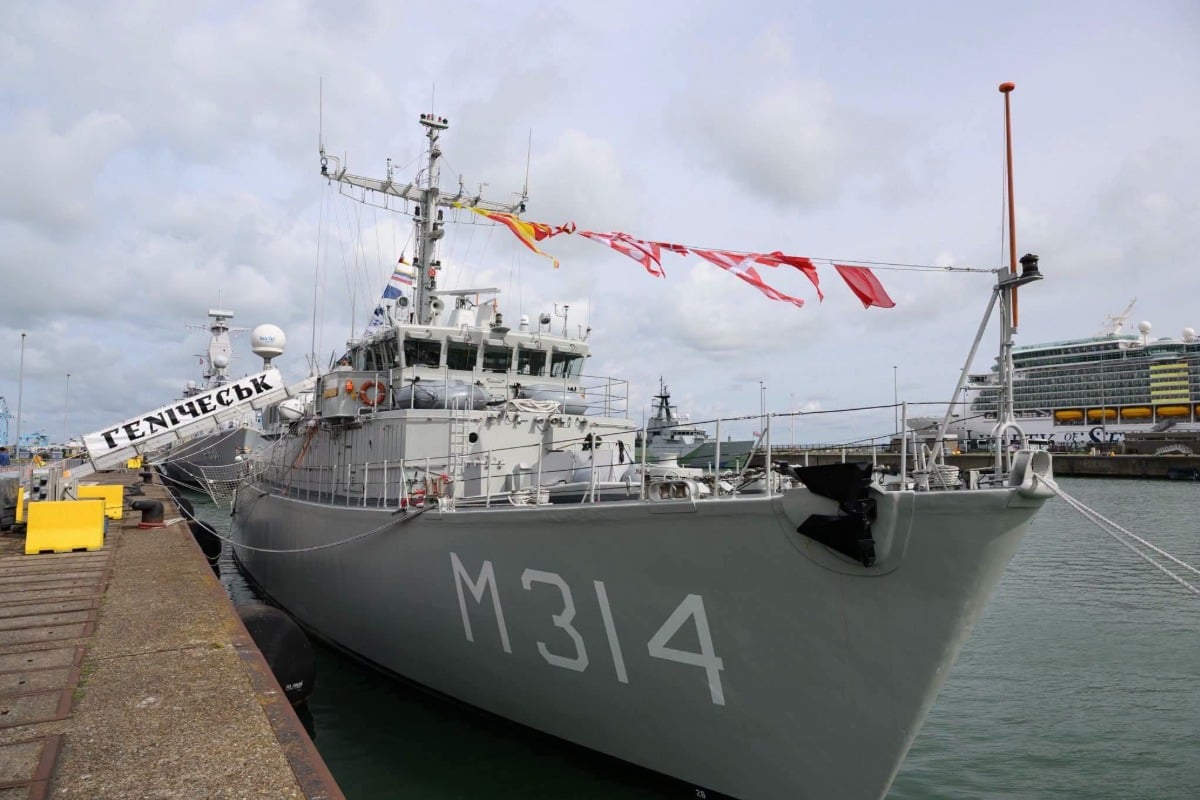
- Ukraine's Navy announced on June 15, 2026, the transfer of the Alkmaar-class minehunter Zr.Ms. Makkum from the Netherlands under the Maritime Capabilities Coalition.
- Ukraine named the vessel Henichesk, bringing its total mine countermeasure fleet to five ships transferred by the UK, Belgium, and the Netherlands.
Russia sank the original Henichesk in 2022, striking the minesweeper with cruise missiles launched from occupied Crimea while it was covering the withdrawal of special forces troops near the Kinburn Spit, and on Monday Ukraine got the name back in the only way that matters at sea: on the bow of a warship flying the Ukrainian Navy flag.
The Netherlands formally transferred an Alkmaar-class minehunter to Ukraine’s Naval Forces, and the crew chose to carry forward the name of a vessel lost in combat rather than let it disappear into the ledger of the war’s early losses. It is the kind of naming tradition that tells you more about a conflict than any briefing ever could.
Ukraine’s Navy announced the formal handover on June 15, with Vice Admiral Oleksii Neizhpapa, commander of Ukraine’s Naval Forces, raising the Ukrainian Navy flag aboard the vessel in the presence of the commanders of the Royal Netherlands Navy, the Royal Belgian Navy, and the navies of Romania, Lithuania, and Latvia. That guest list is not accidental. It reflects the breadth of a coalition that has quietly been rebuilding Ukraine’s ability to operate at sea while the ground war pulls most of the world’s attention.
The transfer happened under the Maritime Capabilities Coalition, an international grouping of more than 20 states established in December 2023 at the initiative of the United Kingdom and Norway with the explicit goal of rebuilding and modernizing Ukraine’s naval forces for Black Sea security. The coalition’s work is methodical and largely unglamorous: decommissioned vessels from Western navies, crew training programs, technical upgrades spread across multiple countries. But the cumulative effect is real. Ukraine now has five dedicated mine countermeasure vessels, rebuilding and expanding a capability that was sharply reduced after the loss of the original Henichesk in 2022.
The ship itself, formerly the Dutch Navy vessel Zr.Ms. Makkum, is no antique. The Alkmaar class was jointly developed by Belgium, France, and the Netherlands based on the French Circé design, with 35 ships built during the 1980s and 1990s. Since 2003, the Dutch variants have undergone significant modernization, gaining the Atlas Elektronik INCMS combat data system, Thales 2022 Mk III sonar, and Atlas Seafox and Double Eagle Mk III Mod 1 remotely operated underwater vehicles for mine detection and disposal. That last element matters enormously: the ROVs allow the crew to find and destroy a mine without ever putting divers in the water near it, which in a heavily mined theatre is the difference between a manageable mission and a catastrophic one.
The vessel’s specifications include a crew of 28 to 38 personnel, a displacement of 543 tonnes, a length of 51.5 meters (169 feet), and a maximum speed of around 13 knots, or roughly 24 km/h (15 mph). The hulls are built from non-magnetic polyester-based fiberglass, a deliberate design choice that makes the ship far harder for a magnetic mine to detect and trigger. The superstructures use lightweight alloys for the same reason. A conventional steel-hulled vessel sailing through a minefield is, in effect, ringing a bell for every device it passes over, and these ships were engineered from the keel up to go in and not ring anything.
The name Henichesk carries weight that goes beyond ceremony. The original vessel was a Project 1258 harbor minesweeper that Ukraine lost during a combat mission in June 2022 near the Kinburn Spit, a narrow strip of land in southern Ukraine that separates the Black Sea from the Dnipro-Bug estuary. Its destruction became publicly known in August 2022, after the minesweeper was struck by cruise missiles launched from occupied Crimea. The ship was providing cover for special forces troops when it was hit, and its former commander, Oleksandr Boychuk, was taken prisoner by Russia and held for years before being returned to Ukraine in a prisoner exchange.
“Within the framework of the Maritime Capabilities Coalition, our Dutch partners transferred an Alkmaar-class minehunter to the Naval Forces of the Armed Forces of Ukraine,” Neizhpapa said at the ceremony. He noted the vessel would bolster Ukraine’s capacity to search for, detect, and neutralize naval mines, a mission that is anything but peripheral given the current state of the Black Sea. The waters and their approaches rank among the most heavily mined maritime areas on the planet right now, a consequence of sustained Russian mining operations and the wider chaos of a war fought partly at sea.
Henichesk joins four previously transferred vessels: Cherkasy and Chernihiv, both Sandown-class minehunters from the United Kingdom, and Melitopol and Mariupol, both Alkmaar-class ships transferred from Belgium and the Netherlands. The Sandown class and the Alkmaar class approach the same problem differently. Sandown-class ships are single-role minehunters built specifically for finding and classifying mines. Alkmaar-class vessels are somewhat more versatile, capable of functioning as logistical support ships and transporting cargo and ammunition when not on minehunting duty, which gives a small navy meaningful operational flexibility without adding hulls to the count.
All five vessels will be temporarily based in the United Kingdom until the end of the war, and the new Henichesk is scheduled to participate in the Sea Breeze international naval exercises in 2027. Sea Breeze is an annual multinational exercise held in the Black Sea region, typically drawing NATO members and partner nations, and Ukraine’s participation with a growing mine countermeasure fleet signals a clear intent to reintegrate into regional maritime security structures even while the conflict grinds on.
Ukrainian crews training on these vessels already include sailors with real combat experience, and personnel are actively mastering the operation of underwater drones for mine search, identification, and neutralization. That combination, Western hardware in the hands of crews who have actually been under fire, represents a qualitative shift that resists easy measurement but is simple enough to understand. These are not sailors learning a new profession from scratch; they are battle-tested mariners learning a new and more capable set of tools.