

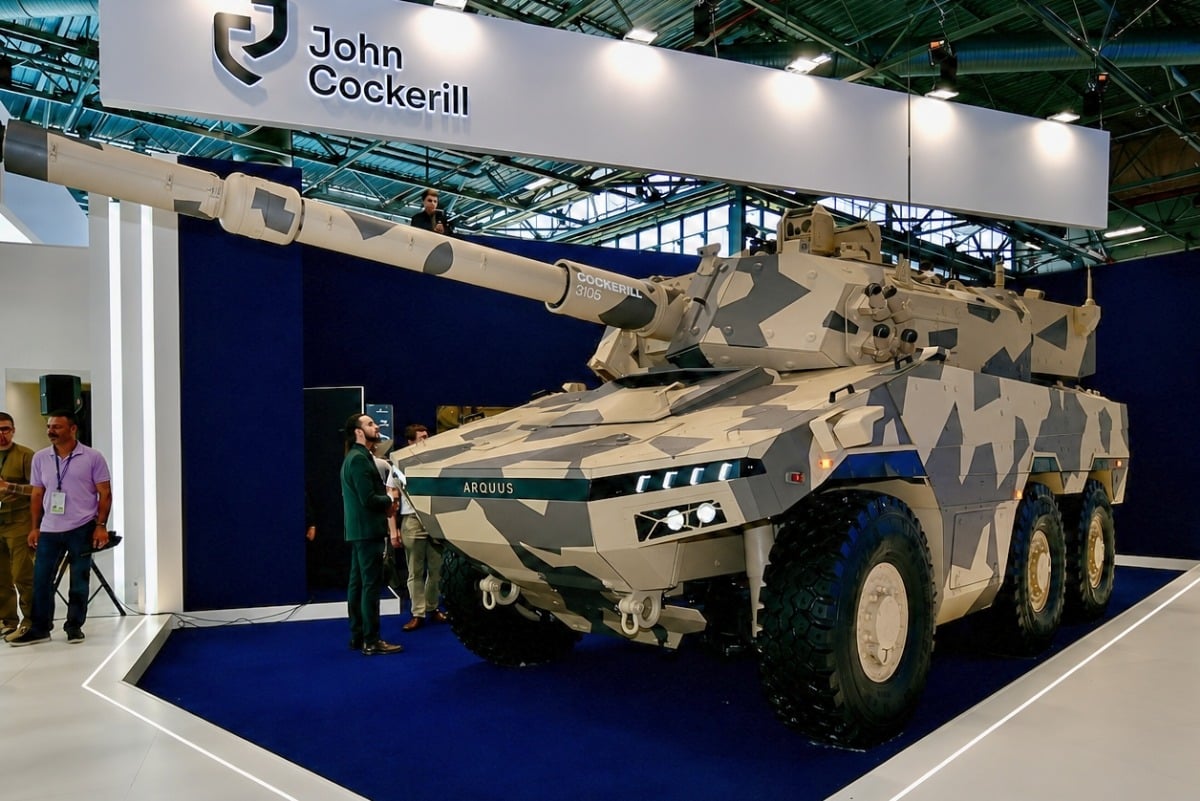
- John Cockerill Defense and Arquus unveiled the FENRIS 6x6 wheeled fire support vehicle at Eurosatory 2026, armed with a 105 mm Cockerill 3105 turret and 36 rounds total.
- The 26-tonne vehicle carries a crew of three, a 500 hp engine, and can engage targets at up to 10 to 11 km in indirect fire mode.
Thirty-six tank-busting rounds, a 105mm cannon, three crew members, and a vehicle light enough to fly aboard an Airbus A400M military transport. That is what John Cockerill Defense and Arquus brought to Eurosatory 2026 in Paris when they pulled the covers off the FENRIS, a wheeled fire support vehicle designed to fill the gap that has existed on modern battlefields between lightly armed reconnaissance vehicles and the heavy main battle tanks that most armies can no longer afford to buy in large numbers or move quickly enough to matter.
John Cockerill, the Belgian industrial and defense group headquartered in Liège, acquired Arquus, a French armored vehicle specialist with roots stretching back decades through the French army’s vehicle programs, in July 2024. The FENRIS is the first major product to emerge from that merger, combining Arquus’s expertise in wheeled military chassis with Cockerill’s proven turret technology into a single platform neither company could have fielded alone. Frank Jansens, General Manager Weapon Systems at John Cockerill Defense, described the vehicle as “easily air-transportable via an Airbus A400M” and “mobile” in all environments, making airlift-capable firepower the central pitch to potential customers evaluating rapid deployment options.
The FENRIS appears to be derived from the Jaguar 6×6 architecture developed under France’s SCORPION program, the major French Army effort to network ground vehicles into a shared digital battlespace, and that pedigree matters because the Jaguar was built from the outset to meet demanding French Army specifications for survivability, agility, and digital connectivity. The vehicle can be configured as either a 6×4 or 6×6 drivetrain depending on mission requirements, weighs 26 tonnes (57,300 lb), carries a crew of three, and runs on a 500 horsepower engine with an automatic transmission. Arquus CEO Emmanuel Levacher emphasized that mobility received particular attention during development, calling it “one of the best assets of the vehicle in its missions, but also its first life insurance against the threats of the modern battlefield.”
The heart of the FENRIS is the Cockerill 3105 turret, a weapon system that John Cockerill has been refining and fielding for years before this debut. The turret carries a 105 mm NATO-standard high-pressure rifled gun fed by a 12-round automatic loader, with two additional ammunition stowage sets bringing total capacity to 36 rounds. That autoloader is significant: it removes one crew member from the turret compared to manually loaded designs, keeping the headcount at three while maintaining a sustained rate of fire without requiring a loader to physically handle heavy rounds in a confined space. The gun can elevate to plus 42 degrees, a firing angle that allows indirect fire engagements at ranges of 10 to 11 km (6.2 to 6.8 miles), according to John Cockerill, extending the vehicle’s utility well beyond direct line-of-sight combat.
The 3105 turret’s track record provides the kind of independent validation that a brand-new platform announcement typically cannot offer. The same turret family arms the Harimau medium tank, a joint Indonesian-Turkish platform developed by PT Pindad and FNSS, and John Cockerill has confirmed that at least one hundred Cockerill 3105 turrets are currently in production for a Middle Eastern customer integrated onto wheeled vehicles comparable to the American Stryker. A combat-proven turret on a new chassis is a materially different proposition from a clean-sheet design, and both John Cockerill and Arquus have emphasized that the platform has been validated under battlefield conditions, though the companies have not publicly specified where or in which conflict.
Secondary armament on the FENRIS consists of two paired 7.62 mm (0.3 in) machine guns alongside panoramic sighting systems and a 360-degree external camera array giving the crew full situational awareness around the vehicle without anyone needing to open a hatch. That camera suite draws on technology the Cockerill 3105 already employs in deployed configurations, where the thermal imager can detect targets at 15 km (9.3 miles) in daytime conditions and identify them at 5 km (3.1 miles), with night-mode thermal detection extending to roughly 3.5 km (2.2 miles). On a wheeled vehicle that relies on speed and situational awareness rather than heavy armor for survival, knowing what is around the vehicle before it becomes a threat is as important as the gun itself.
The operational logic behind the FENRIS addresses a problem that has become increasingly visible in the wars of the past decade. Main battle tanks are enormously capable but expensive to buy, expensive to maintain, limited in where they can deploy, and difficult to move at the speed modern operations require. Light reconnaissance vehicles are fast and easy to transport but carry insufficient firepower to provide direct fire support to dismounted infantry or suppress fortified positions. The FENRIS positions itself in that middle space, drawing an explicit line in its design philosophy by not attempting to replace modern main battle tanks, but rather to complement them with what John Cockerill describes as intelligence and flexibility. At 26 tonnes, the vehicle is roughly half the weight of a Leopard 2 main battle tank, which means two FENRIS vehicles can go where one Leopard might struggle to follow.