

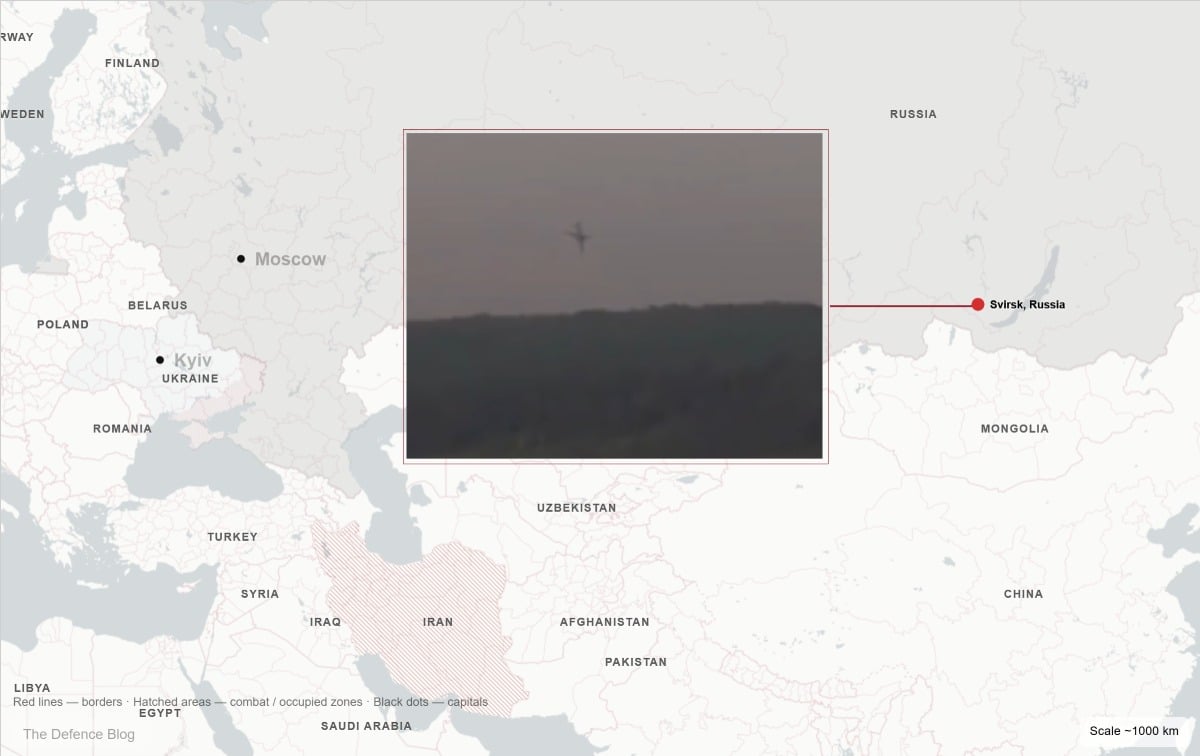
- Russia's Tu-22M3 long-range bomber crashed near Svirsk, Irkutsk region on June 15, 2026, during a training flight due to reported engine failure.
- The four-person crew ejected safely; the aircraft carried no weapons and crashed near the Angara River village of Kamenka.
A supersonic bomber that Russia uses to launch cruise missiles at Ukrainian cities came down in a field near the Siberian city of Svirsk on Monday, adding another hull to a list of losses that the Kremlin can ill afford and has no practical way to replenish.
Russia’s Aerospace Forces confirmed that a Tu-22M3 long-range bomber, a Soviet-era aircraft capable of carrying both conventional warheads and nuclear weapons, crashed in the Irkutsk region of Siberia during what the Russian Defense Ministry described as a scheduled training flight, with engine failure cited as the preliminary cause.
According to the Russian Defense Ministry, the crew successfully ejected before the crash and did not suffer life-threatening injuries, and the aircraft was not carrying any weapons at the time of the incident. Witnesses on the ground near Svirsk reported seeing crew members descending by parachute as the burning aircraft fell toward the banks of the Angara River, with a large column of smoke rising from the crash site afterward. Irkutsk’s governor, Igor Kobzev, confirmed in a statement that the plane had crashed near the village of Kamenka, and that emergency services and medical personnel were on the scene.
On board were the aircraft commander, his deputy, the navigator, and the flight engineer, and according to residents of Svirsk, all four managed to leave the plane using parachutes. Russian outlet Mash reported that the commander made radio contact after the ejection, confirming the crew had survived. The pilots steered the aircraft away from the settlement until the last moment, and the plane crashed in a field before a fire broke out. That detail, four aircrew guiding a stricken bomber away from a populated area before ejecting, is the one fact in Monday’s incident that reflects well on anyone involved.
The Tu-22M3, designated “Backfire-C” by NATO, is one of the most consequential aircraft in Russia’s military inventory, not because it is the most advanced platform in the world but because it is irreplaceable. The aircraft has variable-sweep wings, meaning the wing angle adjusts for different flight phases, and can reach speeds of around 2,300 kilometers per hour (1,430 miles per hour), approximately Mach 2.2, with an operational range estimated at up to 6,800 to 7,000 km (4,225 to 4,350 miles) and a combat radius of more than 2,400 km (1,490 miles). Designed originally during the Cold War to destroy NATO aircraft carrier groups, the aircraft evolved into one of Russia’s primary long-range strike platforms, carrying missiles such as the Kh-22 and the modernized Kh-32, both of which Russia has used extensively against Ukrainian cities and infrastructure.
The Kh-22 missile, one of the Tu-22M3’s signature weapons, can be fitted with either a conventional or nuclear warhead, which places the bomber in a category that demands careful handling even in peacetime. The Tu-22M3 is a nuclear-capable long-range bomber within Russia’s long-range aviation, but it is not usually counted alongside the Tu-95MS and Tu-160 as a strategic bomber under the New START arms control framework, a distinction that has not stopped Moscow from relying on it heavily for conventional strike missions throughout the war in Ukraine.
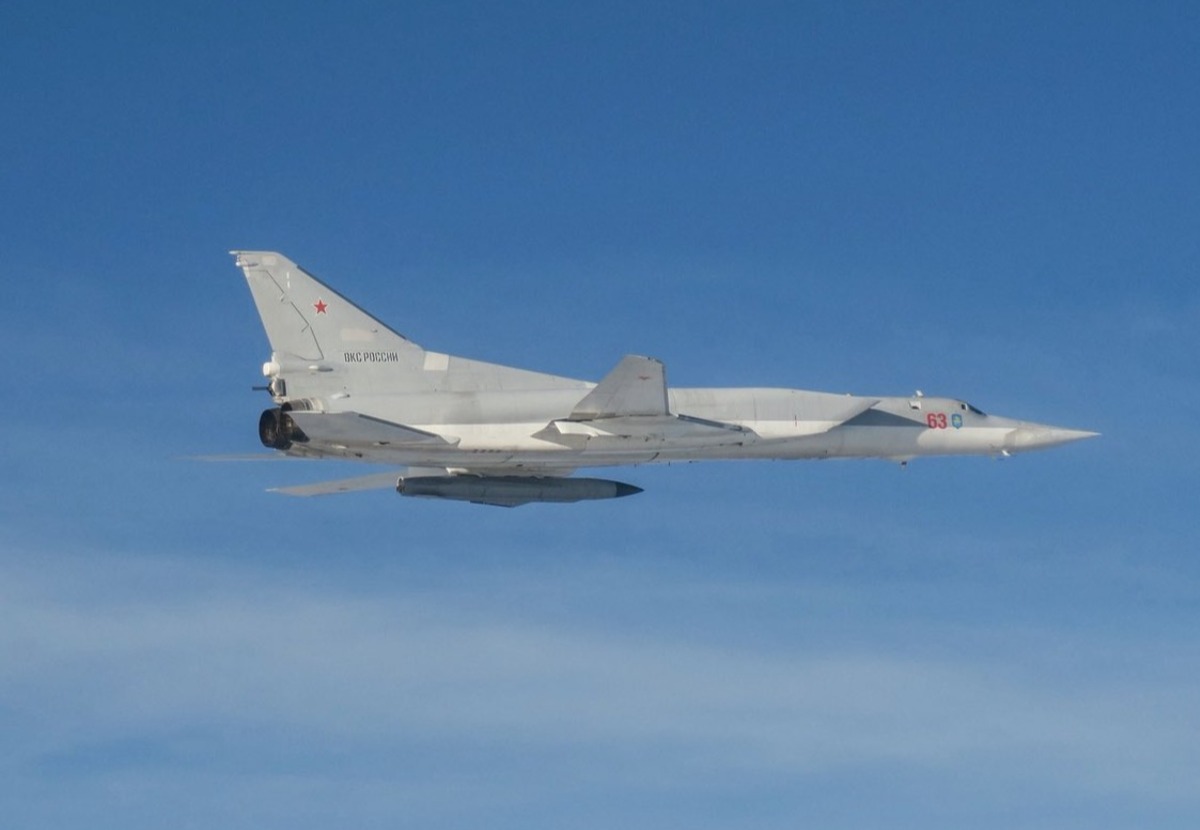
The crash occurred near the town of Svirsk, which lies around 50 km (31 miles) northwest of the Belaya air force base. Belaya hosts Tu-22M3 units, including the 200th Guards and 444th Heavy Bomber Aviation Regiments; Tu-95MS aircraft have also been observed there during wartime deployments. That base carries particular significance in the history of this war. In June 2025, Ukraine’s Security Service executed Operation Spider’s Web, a mass drone strike against Russian strategic aviation bases deep inside Russian territory, and Belaya was among the primary targets. Ukraine’s SBU claimed the operation hit 41 aircraft and caused about $7 billion in damage; independent satellite-based assessments confirmed damage to several aircraft but did not verify the full Ukrainian claim.
Fewer than 55 Tu-22M3s remain in service, with many having been destroyed on the ground or shot down, and those that survive are not all operationally ready. A modernization program exists to upgrade surviving airframes to the Tu-22M3M configuration, but progress has been slow, and the fundamental problem cannot be solved by upgrades alone. The Tu-22M3 is no longer in production, meaning none of these aircraft can be replaced. Every hull lost to enemy action, accident, or mechanical failure shrinks a fleet that Russia cannot grow and has limited ability to maintain at current operational tempo.
In April 2025, a Tu-22M3 crashed in the Usolsky district of Russia’s Irkutsk region, and in August 2024, another crash occurred in the Cheremkhovsky district of the same region. Monday’s incident makes three crashes of this aircraft type in the Irkutsk region alone within roughly two years, a pattern that points toward systemic issues with airframe age, maintenance capacity, or both. Russia has been flying its long-range bomber fleet at an elevated operational pace since the full-scale invasion of Ukraine began in February 2022, using these aircraft to launch sustained missile campaigns against Ukrainian energy infrastructure, cities, and military targets. That kind of operational pressure accelerates wear on aging airframes and strains maintenance pipelines that were already struggling before the war began.
According to open-source intelligence analysts, Russia has lost 11 Tu-22M3 aircraft since 2022, combining combat losses, aircraft destroyed in Ukrainian drone strikes, and now at least three confirmed crashes. Each loss matters more than the last. A fleet that begins a war with 60 operational bombers and loses 11 of them does not lose 18 percent of its capability in a linear sense. The aircraft that remain must fly more often, be maintained by the same overstretched crews, and absorb the operational risk that previously spread across a larger number of airframes. The math gets worse with every incident.
Russia’s strategic aviation, once among the most formidable long-range strike forces in the world, is conducting itself in a war it did not plan to last this long, flying aircraft it cannot replace, from bases it can no longer guarantee are safe from attack, and now apparently struggling to keep those aircraft in the air even during routine training.