

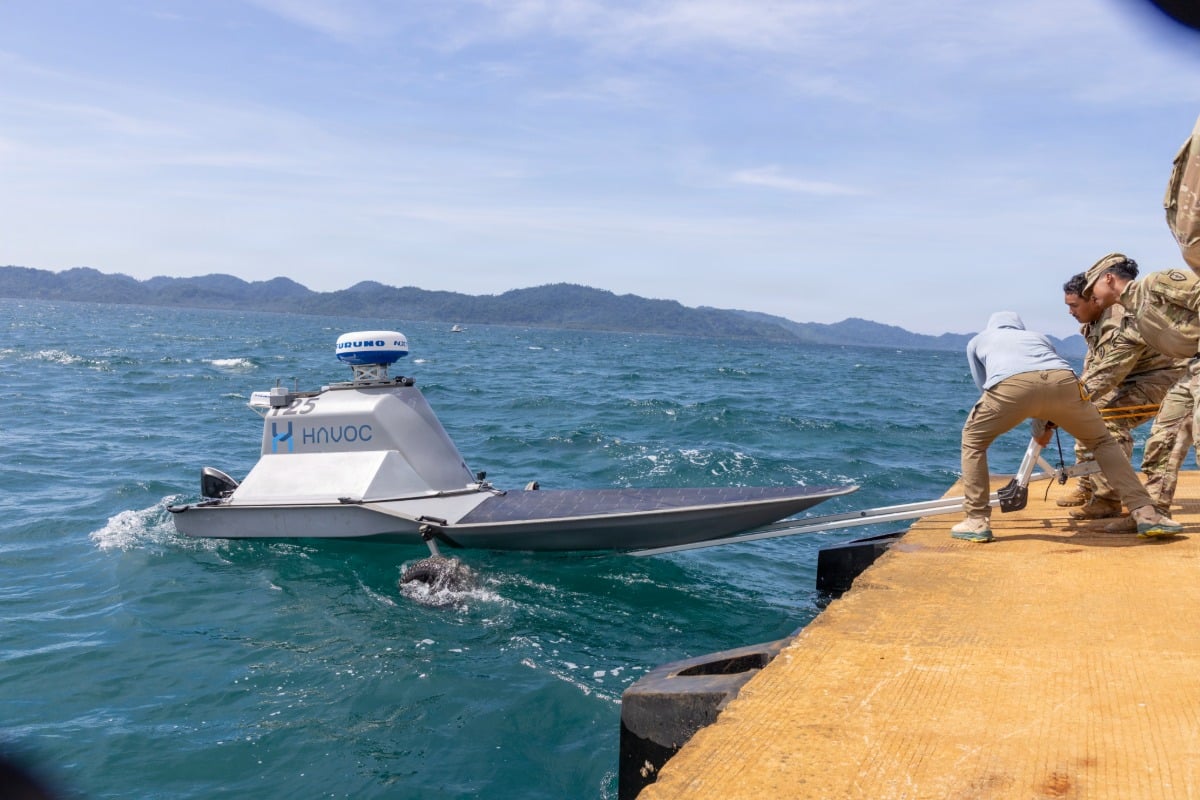
- U.S. Army soldiers from the 125th Intelligence and Electronic Warfare Battalion, 25th Infantry Division, deployed a USV swarm in Casiguran Sound during Salaknib 2026.
- The autonomous boats screened a U.S. Army Logistics Support Vessel transporting Philippine Army armored vehicles and personnel more than 418 km (260 miles) from Port Tobaco to Port Casiguran.
A swarm of autonomous boats operated by U.S. Army soldiers spread across a Philippine waterway during Exercise Salaknib 2026, screening a military cargo ship and relaying real-time surveillance data to commanders ashore as American and Philippine forces conducted a combined maritime security demonstration in Casiguran Sound in the northern Philippines.
The mission showcased how U.S. and Philippine forces can integrate autonomous maritime systems into combined operations, placing unmanned surface vessels at the center of a bilateral exercise that already covers jungle warfare, live-fire training, and air assault operations across the Philippine archipelago.
Soldiers assigned to the 125th Intelligence and Electronic Warfare Battalion, 25th Infantry Division Artillery, 25th Infantry Division, operated the autonomous boats during the exercise. The 25th Infantry Division, known as “Tropic Lightning,” is the U.S. Army’s primary Pacific-based ground combat formation headquartered at Schofield Barracks in Hawaii and the command most directly responsible for building Army interoperability with Pacific allies. Placing autonomous maritime surveillance systems in the hands of an intelligence and electronic warfare battalion reflects how the Army is embedding these capabilities in the formations that will actually use the intelligence they generate, rather than creating a separate autonomous systems unit isolated from operational context.
The mission demonstrated a maritime security scenario involving an Army Logistics Support Vessel during Exercise Salaknib 2026. The vessel was transporting Philippine Army armored personnel carriers and military personnel from Port Tobaco to Port Casiguran, a distance of more than 418 km (260 miles). As the ship transited Casiguran Sound, the autonomous boats spread across a wide perimeter around it, continuously monitoring the maritime environment with onboard sensors and transmitting what they detected to personnel ashore in near real time. Commanders on the ground received a continuously updated picture of activity throughout the operational area without needing manned aircraft, patrol boats, or observation posts positioned along the shore.
Ben Outlaw, an industry partner representative supporting the operation, described what that capability compression means for the commanders receiving the information. “These boats provide situational awareness to commanders with their ability to find, fix, target, kill, and confirm,” Outlaw said. “With the information the USV provides, the commander’s decision-making process has been compressed from hours to seconds.”
Pvt. Caleb Hannah, a soldier with the 125th Intelligence and Electronic Warfare Battalion who deployed the boats during the operation, described what the exercise looked like from the operators’ perspective. “We deployed the autonomous intelligence, surveillance, reconnaissance boats to provide security for landing craft today,” Hannah said. “They escorted the LSV to port from about six miles out, allowing Philippine vehicles to roll onto the dock.”
Exercise Salaknib, whose name translates to “shield” in the Ilocano language spoken in northern Luzon, is the primary annual bilateral exercise between the U.S. Army and the Philippine Army. The 2026 edition involved approximately 7,000 soldiers, including troops from Japan, Australia, and New Zealand, and unfolded across multiple phases between April and May, covering a wide spectrum of military operations from jungle warfare and aviation to live-fire exercises and comprehensive archipelagic defense concepts. The maritime USV demonstration was one component of the exercise’s multi-domain integration effort, applying autonomous technology to a logistics protection mission that represents one of the most operationally relevant challenges any force operating in the Philippine island chain faces.
The strategic geography of the Philippines makes this capability development particularly relevant to regional security planning. The country consists of more than 7,600 islands spread across a maritime area larger than the Mediterranean Sea, and any military force trying to move equipment, supplies, or personnel between those islands must accept significant exposure to maritime observation. Autonomous vessels that can extend surveillance coverage across those waters without requiring a corresponding number of manned ships or aircraft represent a direct answer to the problem of managing a vast maritime geography with limited resources. The South China Sea and the sea lanes connecting the Philippines’ major islands are among the most strategically contested waters in the world, making persistent maritime awareness not a convenience but a fundamental operational requirement.
The performance of the USVs during the Casiguran Sound mission illustrated both the current capability and its limitations. The boats navigated autonomously, using onboard sensors to detect and report potential threats or anomalies within the operating area, and transmitted that information in near real time to shore-based personnel.