

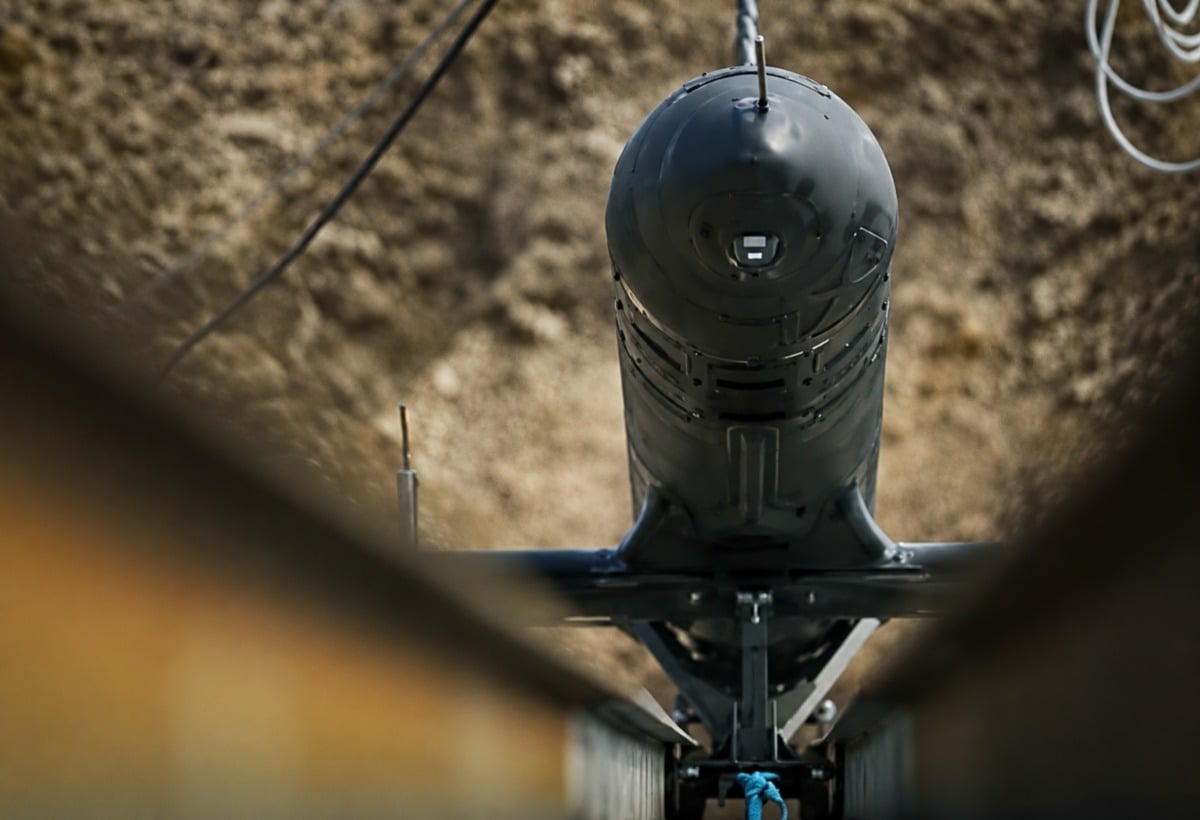
- Russia launched 1,400 jet-powered Geran drones against Ukraine in the first months of 2026, compared to 180 recorded throughout all of 2025, according to Militarnyi.
- The Geran-3 has a speed of 350 to 550 km/h (217 to 342 mph) and range of 1,500 km (932 miles); the Geran-4 carries a 50 kg (110 lb) payload with 850 km (528 mile) range.
Russia has sharply accelerated its use of jet-powered attack drones against Ukraine in 2026, with its forces already launching 1,400 such weapons since January, compared to just 180 recorded throughout all of 2025, according to Militarnyi, the Ukrainian defense outlet that reported the figures from a briefing by Colonel Alexander Zaruba, Chief Researcher at Ukraine’s State Research Institute for Testing and Certification of Weapons and Military Equipment.
The nearly eightfold increase represents a fundamental shift in how Russia is structuring its drone campaign, moving away from slower propeller-driven weapons toward faster jet-powered variants that strain Ukrainian air defenses in ways the earlier Shahed-136 model never did.
The drones driving that increase belong to the Geran family, Russia’s domestically rebranded and partially domestically produced versions of Iranian-origin designs. Three variants are currently in active use: the Geran-3, Geran-4, and Geran-5. The Geran-3 is Russia’s jet-powered Shahed-238-type derivative, the faster successor to the propeller-driven Shahed-136 that Russia has used in mass overnight strikes since 2022. As The Defence Blog reported in August 2025, the Geran-3 first appeared in large-scale operational use during combined missile and drone attacks in late July 2025, with Ukrainian Air Force spokesman Yuriy Ihnat noting at the time that the drone “appears on radar like a cruise missile based on its flight parameters” and that “its speed can exceed 500 kilometers per hour, which means not all of the systems we currently use are capable of intercepting such targets.” Colonel Zaruba’s briefing data confirms that what began as a new threat category in summer 2025 has become a dominant feature of the 2026 campaign.
The Geran-3 can reach speeds of up to about 370 km/h (230 mph) and has a reported range of up to 1,000 km (621 miles), according to Ukrainian assessments. Those numbers matter operationally because they collapse the time window Ukrainian mobile fire groups, the truck-mounted anti-aircraft units that have become one of the most effective tools for intercepting slower Shahed variants, have to detect and engage an incoming target. A drone arriving at jet speeds crosses terrain fast enough to deny ground crews the time they need to receive radar warning, reposition a launcher, acquire the target optically, and fire. The Geran-3 was built to exploit exactly that gap.
The Geran-4 is reported to reach speeds of up to 500 km/h (311 mph), with Ukrainian reporting putting its range at about 450 km (280 miles), and carries a 50 kg (110 lb) payload, making it a shorter-ranged but faster and more heavily armed platform than the Geran-3. The Geran-5 is a separate larger jet-powered design, described by Ukrainian sources as closer to an Iranian Karrar-type UAV or small missile-drone, with a fuselage measuring 6.5 m (21.3 ft) in length and powered by a TeleFly TF-Tj2000a turbojet engine. As The Defence Blog reported in May 2026, Ukraine’s Defence Intelligence Directorate assessed that the Geran-5’s design bears significant similarity to the Iranian Karrar strike drone, consistent with the broader pattern of Russian-Iranian defense cooperation that has characterized Moscow’s drone procurement since the early stages of the full-scale invasion. Ukrainian intelligence has also confirmed the use of Chinese-made TeleFly jet engines powering both the Geran-3 and Geran-5 variants, as The Defence Blog reported in April 2026, illustrating how deeply embedded third-country components are in Russia’s jet drone program.
The speed increase that makes these drones harder to intercept also changes how Russia can use them tactically. According to Colonel Zaruba’s briefing, the higher velocity allows Russian forces to more rapidly penetrate areas where Ukrainian mobile fire groups are positioned, reducing the time those units have to relocate after being spotted or to establish effective firing solutions. For some Ukrainian interceptor drone systems specifically designed to hunt incoming Shaheds, the jet variants now exceed the speed threshold at which interception is reliably achievable, creating a category of incoming threat that existing interceptor drone programs were not built to handle.
Commander-in-Chief of the Ukrainian Armed Forces General Oleksandr Syrskyi has publicly stated that Russia plans to increase the share of jet-powered drones in its overall attack mix to 50% of all strike UAVs, according to prior reporting by Militarnyi. If the 2026 launch rate continues at its current pace, that proportion will be reached not through a deliberate programmatic decision but through sheer production volume, with Russia’s manufacturing infrastructure at the Alabuga Special Economic Zone in Tatarstan, scaling output of Geran-family variants alongside continued production of the slower Geran-2 propeller models. General Syrskyi noted that a working meeting on countering enemy strike drones had taken place, at which proposals were discussed to improve Ukrainian air defense effectiveness and modernize domestic interceptors, though no specific new systems or programs were publicly announced.
The trajectory of Russia’s jet drone program reveals a deliberate strategy of technological escalation, using Iran’s design base, Chinese engine components, and domestic Russian manufacturing to produce weapons that progressively outpace the defenses arrayed against them. Each generation of Ukrainian countermeasure has prompted a Russian adaptation: when mobile fire groups became effective against slow propeller Shaheds, jet variants arrived to outrun them; when interceptor drones began catching Geran-3s, Russia added the Geran-4’s higher speed and the Geran-5’s separate design concept derived from Iranian cruise missile lineage. The 1,400 jet drone launches recorded in the first months of 2026 are not simply a production statistic. They are the pace at which a threat is growing faster than the defenses designed to stop it.