

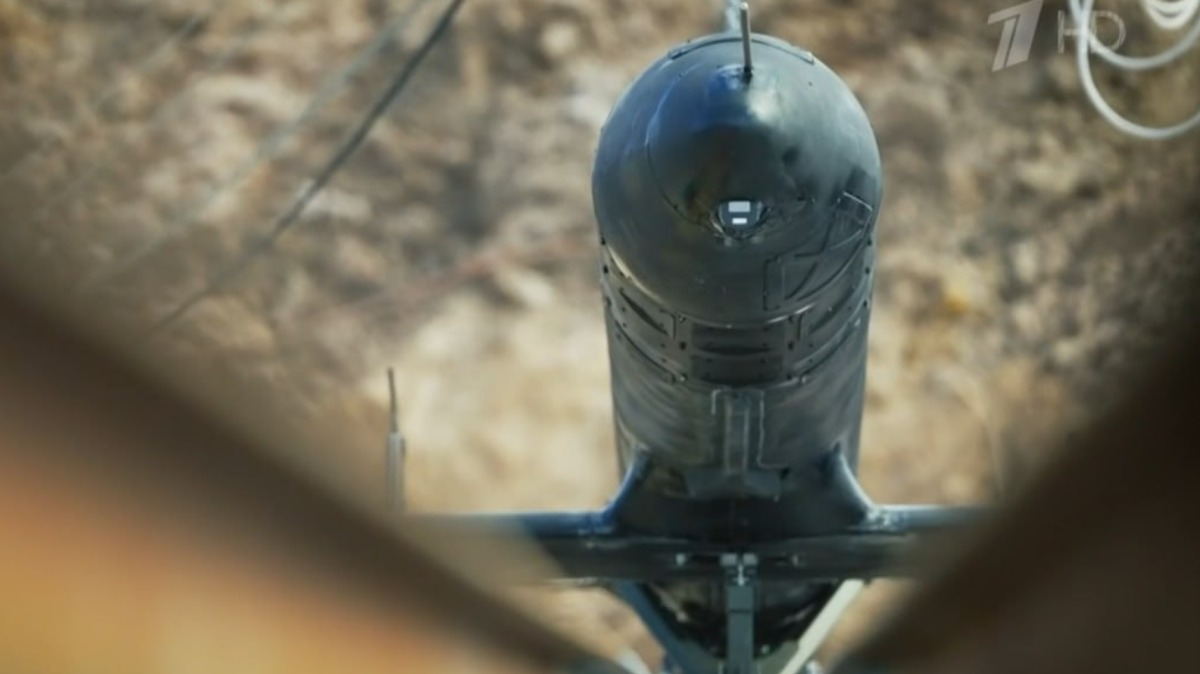
- Russia publicly revealed the jet-powered Geran-5 strike drone during the May 9 parade broadcast, measuring approximately 6 meters long with a 5.5-meter wingspan.
- Ukraine's GUR assessed the Geran-5 bears significant design similarity to Iran's Karrar drone; satellite imagery located 80-meter launch systems in Russia's Oryol region.
Russia publicly unveiled a new heavy jet-powered strike drone for the first time during the May 9 Victory Day parade broadcast on national television, revealing a one-way long-range kamikaze system designated Geran-5 that represents a significant step up in size and capability from the Shahed-derived Geran family already striking Ukrainian cities.
The Geran-5 appeared on Russian state television during the parade transmission, making its first confirmed public showing. The drone measures approximately 6 meters in length with a wingspan of up to 5.5 meters, placing it in an entirely different size class than the propeller-driven Geran-1 and Geran-2 systems that Russia has fired by the thousands against Ukraine. Where those earlier variants are subsonic, piston-engined weapons derived from Iran’s Shahed-136, the Geran-5 is jet-powered — a distinction that affects both speed and the acoustic and radar signature profile the weapon presents to air defense operators trying to detect and intercept it.
Ukraine’s Defence Intelligence Directorate, known by its Ukrainian acronym GUR, has assessed that the Geran-5’s design bears significant similarity to the Iranian Karrar strike drone, indicating the use of Iranian technologies in its development. The Karrar is a jet-powered, turbojet-propelled unmanned combat aircraft that Iran has operated and exported, and its design lineage running through the Geran-5 would be consistent with the broader pattern of Russian-Iranian defense cooperation that has characterized Moscow’s drone procurement and development since the early months of the full-scale invasion.
The guidance and control architecture recovered and analyzed from the Geran-5 reveals a navigation stack that combines multiple redundant systems in ways that complicate jamming and spoofing. Per the available technical data, the drone carries a flight controller of the type common to other Geran-series weapons alongside an inertial navigation system designated SADRA/MINSOO, a satellite navigation system called Kometa-M12 equipped with a 12-element CRP antenna, and a Tracker V3 telemetry data transmission system built around a Raspberry Pi microcomputer with 3G and LTE modems. The mesh communications layer runs through a Xingkai Tech XK-F358 modem. The electronic component base contains elements manufactured in China, the United States, and Germany — a supply chain profile that Western export control authorities have been attempting to disrupt since 2022 without fully succeeding.

The combination of inertial navigation, satellite guidance, and cellular data transmission creates a layered navigation architecture that remains partially functional even when individual layers are jammed or spoofed. Ukrainian electronic warfare units have developed considerable expertise in defeating Geran-series drones through GPS spoofing and signal jamming, but a weapon that can fall back on inertial navigation when its satellite link is disrupted, and maintain a data link through commercial cellular infrastructure, presents a harder problem than a drone dependent on any single navigation mode. The Raspberry Pi-based telemetry system is particularly notable — it reflects the same pattern of commercial off-the-shelf component integration that has characterized the entire Geran program and has proven difficult to interdict through export controls alone given the dual-use nature of the hardware involved.
Satellite imagery has already located launch infrastructure associated with the Geran-5 at a drone base in Russia’s Oryol region. The launch systems for the new drone reach approximately 80 meters in length, according to reporting on the satellite observations — three times larger than the launch rails used for Shahed-type weapons. That scale difference is consistent with a significantly heavier and faster weapon that requires more acceleration distance to reach flying speed, and it gives analysts a visible ground signature they can use to track Geran-5 deployment and basing patterns through commercial satellite coverage.
The operational implications of a jet-powered long-range kamikaze drone in Russia’s inventory extend beyond simple speed. Faster terminal approach velocities compress the engagement window available to air defense systems, requiring point defense weapons to react more quickly and reducing the probability of intercept for systems optimized against slower propeller-driven threats. Greater size typically correlates with greater warhead capacity, though the Geran-5’s payload specifications have not been confirmed in the available source material. The combination of range, speed, and the layered navigation architecture described above makes the Geran-5 a more capable and more resilient weapon than anything in the existing Geran family — which was already causing significant damage to Ukrainian infrastructure at scale.