

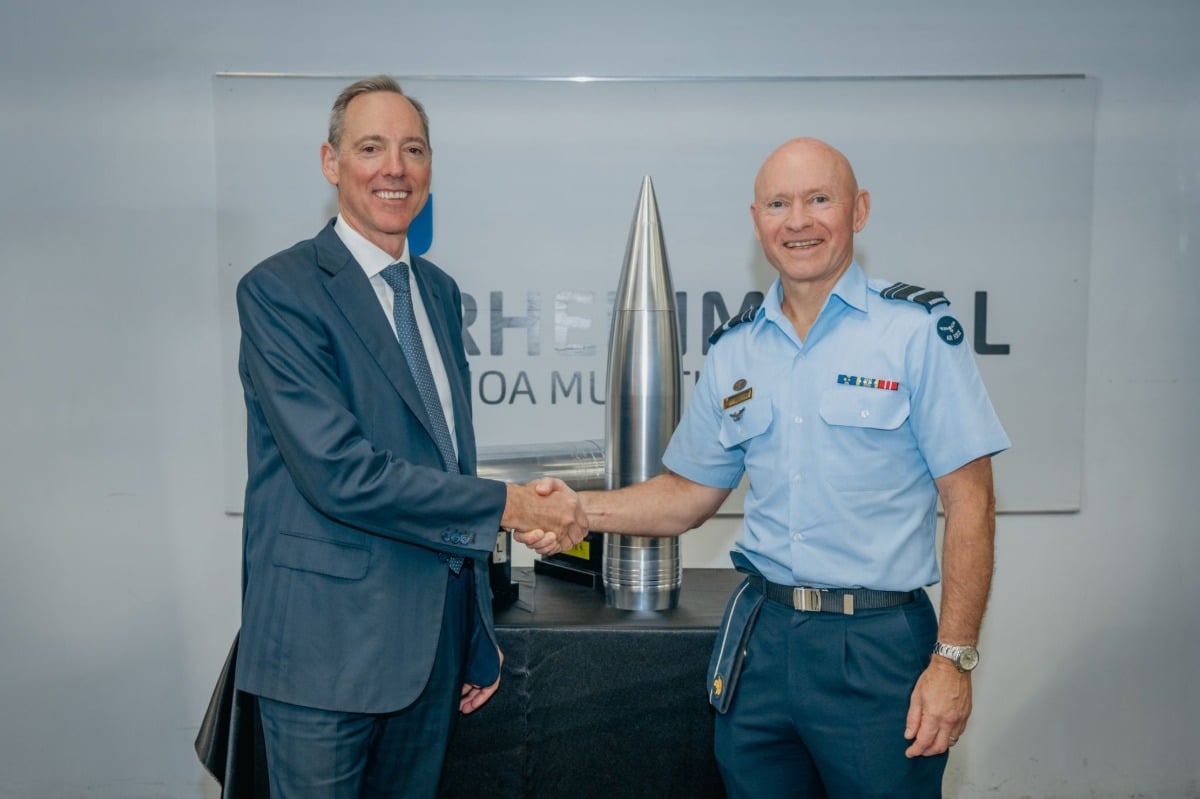
- The Albanese Government signed a $72 million contract with Rheinmetall NIOA Munitions to manufacture M795 155 mm artillery projectiles at the Maryborough facility in Queensland.
- Air Marshal Leon Phillips OAM, Chief of Guided Weapons and Explosive Ordnance at Defence Australia, attended the Maryborough facility to formalize the commitment.
Australia is investing $72 million to establish domestic production of 155 mm M795 projectiles at Maryborough, reducing the country’s dependence on foreign ammunition supply chains for a critical artillery munition used across its ground combat platforms.
The Albanese Government has signed a $72 million contract with Rheinmetall NIOA Munitions, a joint venture between German defense giant Rheinmetall and Australian defense distributor NIOA, to manufacture the M795 155 mm artillery projectile at the company’s Maryborough facility in Queensland. Air Marshal Leon Phillips OAM, Chief of Guided Weapons and Explosive Ordnance at Defence Australia, traveled to Maryborough to formalize the commitment. Deputy Prime Minister Richard Marles, Defense Industry Minister Pat Conroy, and Nathan Poyner were also referenced in connection with the announcement.
The M795 is a critical 155 mm artillery projectile for ADF platforms including the M777A2 Lightweight Towed Howitzer and the AS9 Huntsman self-propelled howitzer, and is the standard high-explosive 155 mm round used across U.S. and NATO forces. It replaced the older M107 projectile in American service and is compatible with the full range of 155 mm gun systems in allied inventories. A standard M795 round weighs approximately 47 kg (103 lb) and carries a high-explosive payload designed to detonate on impact or with a time-delay fuze, making it the workhorse munition for suppressing enemy positions, destroying light vehicles, and providing indirect fire support to infantry in contact.
The Maryborough facility, operated by Rheinmetall NIOA Munitions, is being positioned as a sovereign manufacturing capability that reduces Australia’s dependence on international ammunition supply chains that could be disrupted or prioritized away from Australian needs in a crisis affecting multiple allies simultaneously. Rheinmetall NIOA Munitions is a joint venture specifically established to build Australian munitions manufacturing capability, bringing Rheinmetall’s global expertise in ammunition production together with NIOA’s deep knowledge of the Australian defense procurement landscape and established relationships with Defence Australia.
The $72 million contract represents a meaningful commitment to establishing a production line rather than simply evaluating the concept. Building a manufacturing facility for artillery shells requires substantial capital investment in forging equipment, machining tools, quality control systems, and the workforce training required to safely handle energetic materials. The Maryborough facility’s location in regional Queensland also fits the pattern of Australian defense industrial investment that prioritizes regional economic development alongside military capability, creating employment in communities outside the major metropolitan centers.
Air Marshal Phillips’s personal presence at Maryborough to formalize the commitment reflects the seniority of the program’s government backing. As Chief of Guided Weapons and Explosive Ordnance, Phillips oversees Australia’s entire strategic munitions portfolio and is the official most directly responsible for ensuring the Australian Defence Force has the ammunition it needs across all weapon systems. His attendance signals that the M795 production program is a genuine strategic priority rather than a routine industrial development announcement.
The M795 produced at Maryborough will support Australian Defence Force use across its 155 mm artillery platforms, including the M777A2 Lightweight Towed Howitzer and the AS9 Huntsman self-propelled howitzer. Producing domestically both the projectiles and, in the case of the AS9 Huntsman, the howitzer itself gives the army a degree of self-sufficiency in its core indirect fire capability that would be critical in any extended conflict scenario where allied logistics networks were under pressure.
Domestic munitions production is one of the harder defense industrial capabilities to establish, because it requires sustained investment over years before a facility reaches the production rates and quality certifications needed to supply a military at scale. The $72 million committed at Maryborough is the beginning of that investment, not the end.