

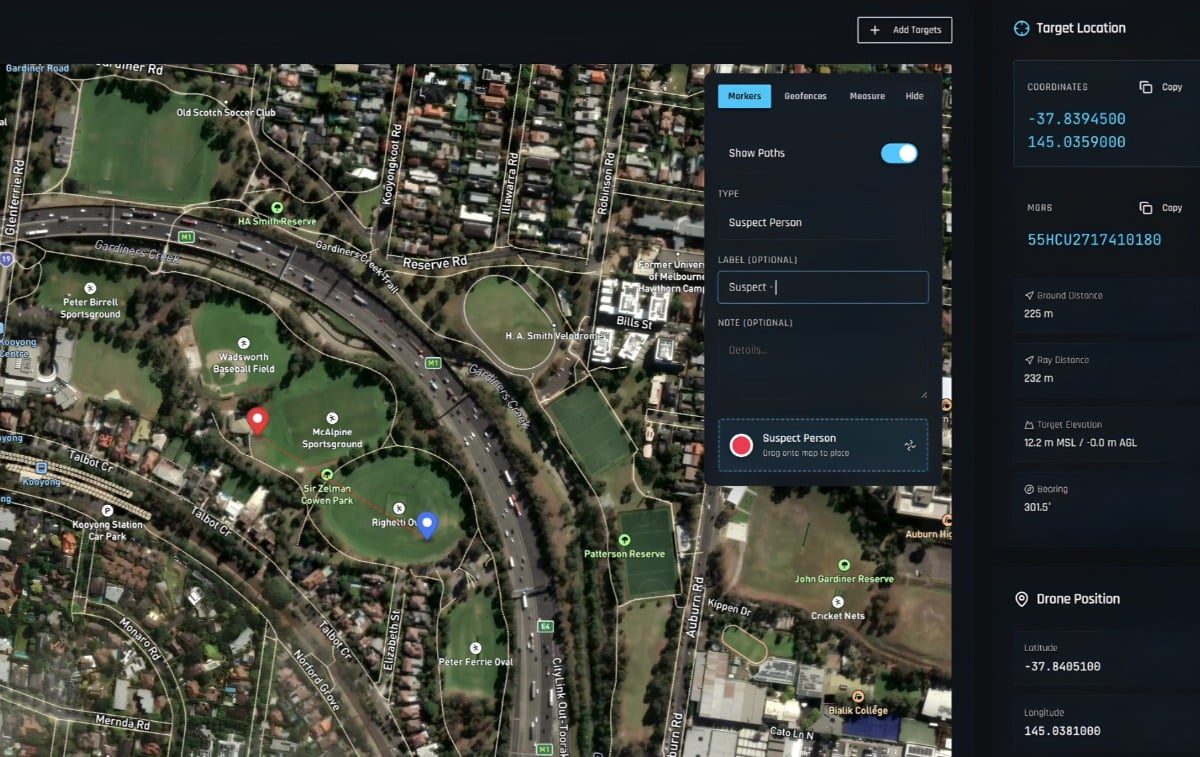
- SPARC AI completed a 43 km (27 mile) GPS-denied target acquisition test over open water in Port Phillip Bay, Australia, on June 9, 2026.
- The Overwatch platform now includes integrated image recognition and is planned for multi-drone swarm coordination in future software updates for partners in Dubai, Ukraine, and the United States.
A Canadian defense software company has demonstrated that its autonomous targeting system can acquire and track a target at a range of 43 km (27 miles) over open water without relying on GPS, a result the company is explicitly benchmarking against one of the most contested maritime chokepoints on Earth. SPARC AI Inc., a Vancouver-based defense technology developer, announced on June 9, that it completed the test in Port Phillip Bay, off the coast of Victoria, Australia, with a drone flying at 115 m (377 ft) above the water surface.
The Strait of Hormuz, the narrow passage between Iran and Oman through which approximately 20% of the world’s seaborne oil trade flows, is just 33 to 34 km (21 miles) wide at its narrowest point. SPARC AI’s 43 km (27 mile) demonstration span exceeds that width, meaning the system could, in principle, acquire and track a maritime target from one shore of that passage to the other without a single GPS signal.
That framing is not accidental; GPS signals have been jammed across the Strait of Hormuz region throughout the 2026 Iran conflict, with electronic warfare disrupting navigation systems, causing false positional data, and increasing the risk of misidentification and collision for commercial vessels transiting the area. A targeting system that functions in exactly that environment, at exactly that scale, is not an abstract capability. It is an answer to a problem that is actively happening.
SPARC AI’s Overwatch platform is a software layer, not a piece of hardware. The distinction matters because it determines how quickly the capability can reach operators and how broadly it can be deployed. Rather than requiring a new drone model, a new sensor pod, or a hardware integration contract, Overwatch runs as software on existing drone platforms across multiple manufacturers, enabling GPS-denied navigation and targeting on hardware that is already in the field. SPARC AI’s Overwatch platform enables drones to navigate and identify targets in GPS-denied environments without hardware modifications, offering a scalable, rapidly deployable alternative to hardware-dependent systems. When GPS is jammed or spoofed, standard commercial drones are forced to rely entirely on internal inertial measurement units, small sensors that track acceleration and rotation but accumulate positioning errors rapidly over time and distance. Overwatch uses onboard sensors and AI-driven processing to compensate for that drift, maintaining usable targeting accuracy without any external signal reference.
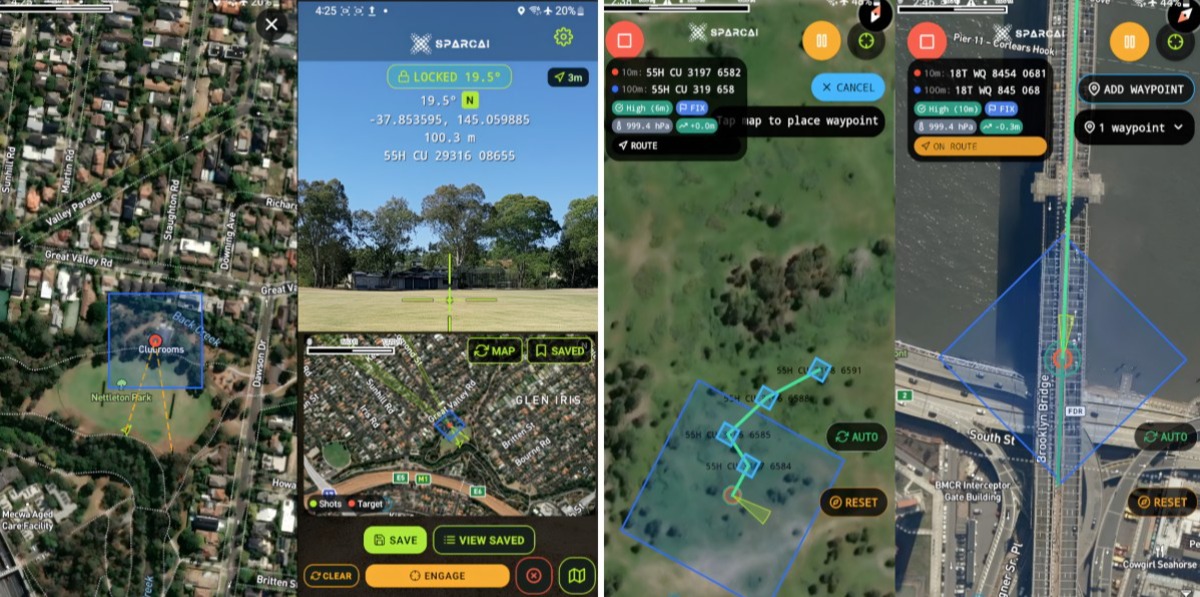
The June 9 announcement added a significant new layer to the platform’s existing capabilities. SPARC AI confirmed it has integrated image recognition directly into the Overwatch drone controller application, overlaying automated target classification onto the shared operating picture that the platform already generates. Overwatch aggregates target data recorded by multiple drones, operating from different locations and built by different manufacturers, onto a single map where operators can classify, track, collaborate, and plan missions from one common display. Adding image recognition to that picture means operators are no longer looking at raw sensor returns and making identification judgments manually. The system now contributes its own classification, accelerating the decision cycle at exactly the moment when speed matters most.
Capabilities of this kind have historically been locked inside expensive, proprietary drone platforms, meaning that GPS-denied navigation and automated targeting were features available only to operators who could afford specialized hardware built around those capabilities from the ground up. Delivering the same functionality as a software update across any manufacturer’s existing fleet changes that equation fundamentally, both for military customers managing tight procurement budgets and for allied forces operating with whatever hardware they have available in a contested environment.
The company’s development trajectory over the past several months underscores the pace at which SPARC AI has been pushing Overwatch toward operational relevance. In May 2026, SPARC AI announced a partnership with U.S. defense manufacturer Rate Manufacturing to integrate Overwatch into Rate’s Model-F multi-mission drone systems, with the collaboration announced at the SOF Week special operations exhibition in Tampa, Florida. SOF Week is where U.S. Special Operations Command and its industry partners discuss the most immediate operational requirements, and the venue of that announcement signals the customer set SPARC AI is targeting. SPARC AI also established a permanent engineering presence in Ukraine in May 2026 to drive direct integration of Overwatch with frontline drone manufacturers operating in active combat conditions, giving the company real-world feedback from the environment where GPS denial and electronic warfare are not simulated problems but daily operational realities.
The next development phase SPARC AI has outlined extends the platform from single-drone operations into coordinated multi-drone teaming and swarm deployment. The company says it is building the capability to deploy and coordinate drones from different manufacturers, operating from different locations, simultaneously, and to do so entirely within a GPS-denied environment, a feature it describes as unique to Overwatch. That capability would represent a meaningful step beyond what any single-aircraft or single-manufacturer targeting system currently offers, because it addresses the coordination problem that makes swarm operations in denied environments technically difficult. SPARC AI has said it intends to deliver these capabilities to partners in Dubai, Ukraine, and the United States through its next software update, though no specific timeline for that release has been confirmed.
The 43 km (27 mile) open-water test in Port Phillip Bay was designed to show that the underlying targeting architecture scales to the distances that real contested maritime environments demand. Whether the Strait of Hormuz ever becomes an operational theater for Overwatch-equipped drones remains unknown, but the choice of benchmark makes clear which threat environment SPARC AI’s engineers had in mind when they decided what distance to prove.