

- OSINT analyst Jompy published a satellite imagery analysis on June 9, 2026, counting 2,088 tanks across nine Russian storage bases, with usable reserves estimated at approximately 851 after accounting for degradation and cannibalization.
- At current stable production rates, Jompy estimates Russia will exhaust T-80 stocks available for upgrade at Omsktransmash within approximately 12 months.
Russia’s tank reserve, long cited by Moscow’s supporters as an inexhaustible strategic depth, is approaching exhaustion faster than official narratives suggest, according to a detailed analysis of satellite imagery published on June 9, by open-source analyst Jompy, who tracks Russian armored vehicle storage bases through publicly available satellite data.
Jompy’s thread, posted to X under the account @Jonpy99, presents a comprehensive count of tanks remaining in Russian storage facilities as of the most recent available satellite imagery. The headline figure is 2,088 tanks across nine identified storage bases, spanning T-54/55s, T-62s, T-64s, T-72 variants, T-80 variants, and 50 unidentified tanks at a transit facility. That number sounds significant until Jompy begins applying the analytical filters that reduce it, in his assessment, to something considerably less threatening.
The first and largest deduction is the T-64. Russia fields the T-64 in very limited numbers, and the variant’s Ukrainian origins, combined with chronic spare parts problems and the difficulty of integrating it with Russian logistics chains, make it effectively unusable for Moscow’s purposes. Jompy discards the entire T-64 count outright, noting that unless some dramatic and unlikely development changes the T-64 situation, those 440 tanks can be set aside. That single exclusion removes roughly one fifth of the headline total.
The 50 unknown tanks at the 904th base present a different issue. Satellite imagery of the facility, shared in Jompy’s thread, shows it functions as a transit hub between proper storage bases and the front line rather than as a storage site in the conventional sense. Those vehicles are already moving toward or through the pipeline and should not be counted as reserve capacity.

What remains after those deductions is 1,598 tanks, predominantly T-54/55s, T-62s, T-72 Ural and A/B variants, and T-80BV and T-80U/UD models. Jompy’s analysis does not stop there, because the headline count treats all 1,598 as potentially usable, which satellite imagery and visual evidence suggest is incorrect. The analyst’s imagery shows large piles of tanks at multiple bases in states that suggest severe deterioration from years of outdoor storage without proper preservation, cannibalization for spare parts, and physical damage from neglect. At the 769th base, Jompy identifies approximately 200 T-62s that have barely been touched for two years while other tanks from the same base were pulled for the front, suggesting those specific vehicles are too degraded to be prioritized even as Russia burns through its more capable types. The 349th base holds approximately 250 T-72 Urals, not the more capable T-72A variants, which were checked and moved around in 2025 but not extracted for deployment, another indicator that something about their condition is preventing their use.
The remaining T-72Bs and T-80BV/U/UD models present a different problem. These are theoretically more capable types whose operational condition should make them prioritized for extraction. Jompy’s assessment is that vehicles of these types have sat in storage while everything else around them was withdrawn, which he reads as strong evidence they have been thoroughly cannibalized for spare parts. Roughly half the remaining T-80s, he notes, appear to be T-80U/UDs based on their camouflage scheme, and there are piles of turrets alongside approximately 30 completely cannibalized and turretless T-80 hulls, which Jompy suggests are likely candidates for conversion to BREM-80 armored recovery vehicles rather than restoration as combat tanks.
Applying all these filters, Jompy arrives at a final usable reserve estimate of approximately 851 tanks. “So yeah, not a lot,” he writes at the conclusion of his thread, a characteristically understated summary given what the numbers actually mean. Those 851 tanks are, in his assessment, predominantly the most obsolete and worst-preserved examples remaining after years of extraction, specifically large numbers of T-62s, roughly 100 T-54/55s, and approximately 150 T-72As. The T-62 served in Soviet and Russian armies from the 1960s and was considered obsolete well before the Soviet Union collapsed. Its reappearance on the Ukrainian battlefield in 2022 was itself a signal of how badly Russia had burned through its more capable types.
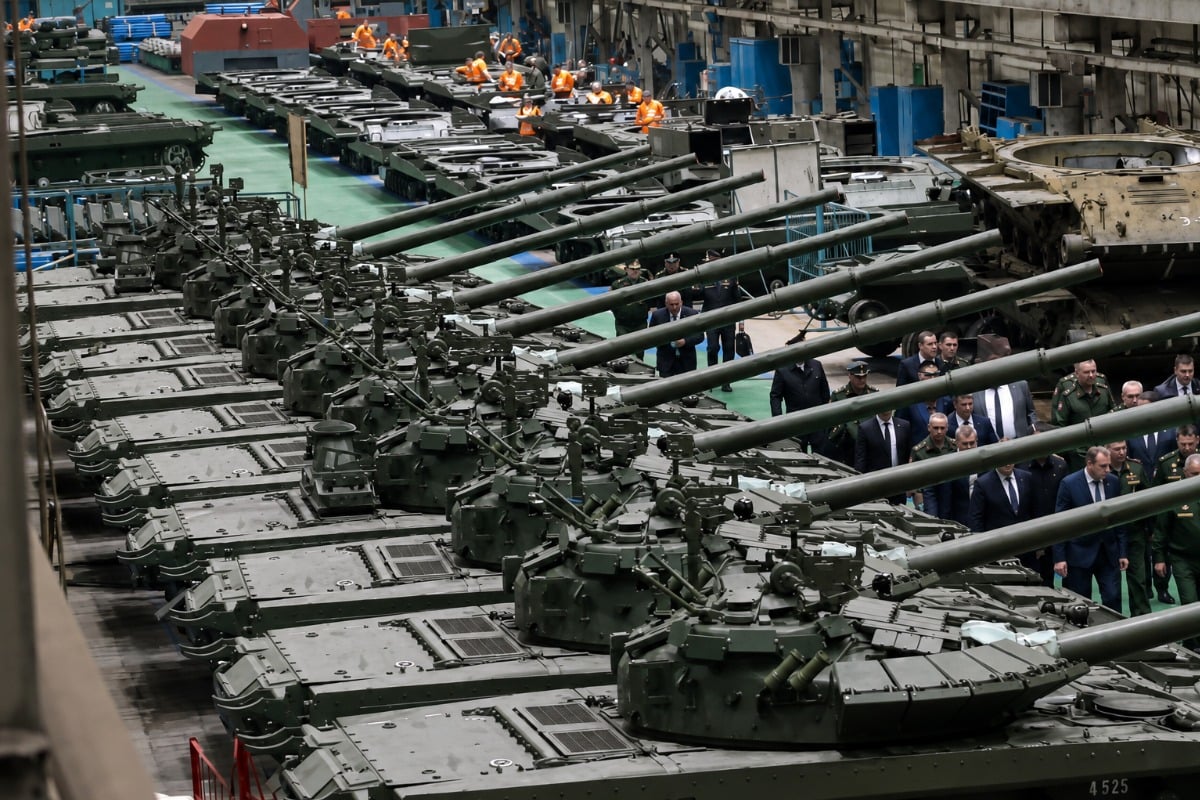
The separate observation on T-80 production at Omsktransmash, the Russian tank manufacturing and overhaul facility in Omsk, adds a time dimension to the storage analysis. At current stable production rates, Russia will exhaust its T-80 stocks available for upgrade within approximately 12 months, assuming no dramatic extraction from remaining storage and no new production beginning from scratch. This suggests that Omsktransmash could face a situation in the early part of next year where there is nothing left in storage to upgrade, forcing a choice between halting T-80 output or committing to genuinely new production, which carries significantly higher cost and time requirements than overhaul of existing hulls.
Russia began its full-scale invasion with what analysts estimated at several thousand tanks in various states of storage, a figure that Western commentators frequently cited as evidence that Western-supplied losses could always be replaced. Jompy’s analysis suggests that the practical reserve, after accounting for irreparably degraded vehicles, cannibalized hulls, unsuitable types, and transit inventory, has shrunk to a number that could be absorbed in a matter of months at current front-line loss rates.
The Oryx open-source project, which tracks Russian armor losses through visual confirmation, had documented more than 4,350 Russian tank losses since February 2022 as of mid-2026.
Russia can still manufacture new tanks, and does. But manufacturing new tanks from scratch is slower and more expensive than pulling refurbished hulls from storage, which is the model that sustained Russian armored strength through 2023 and 2024. If the storage depth is now as thin as Jompy’s analysis suggests, the production math that has kept Russian armored units supplied through four years of attrition warfare is about to change.