

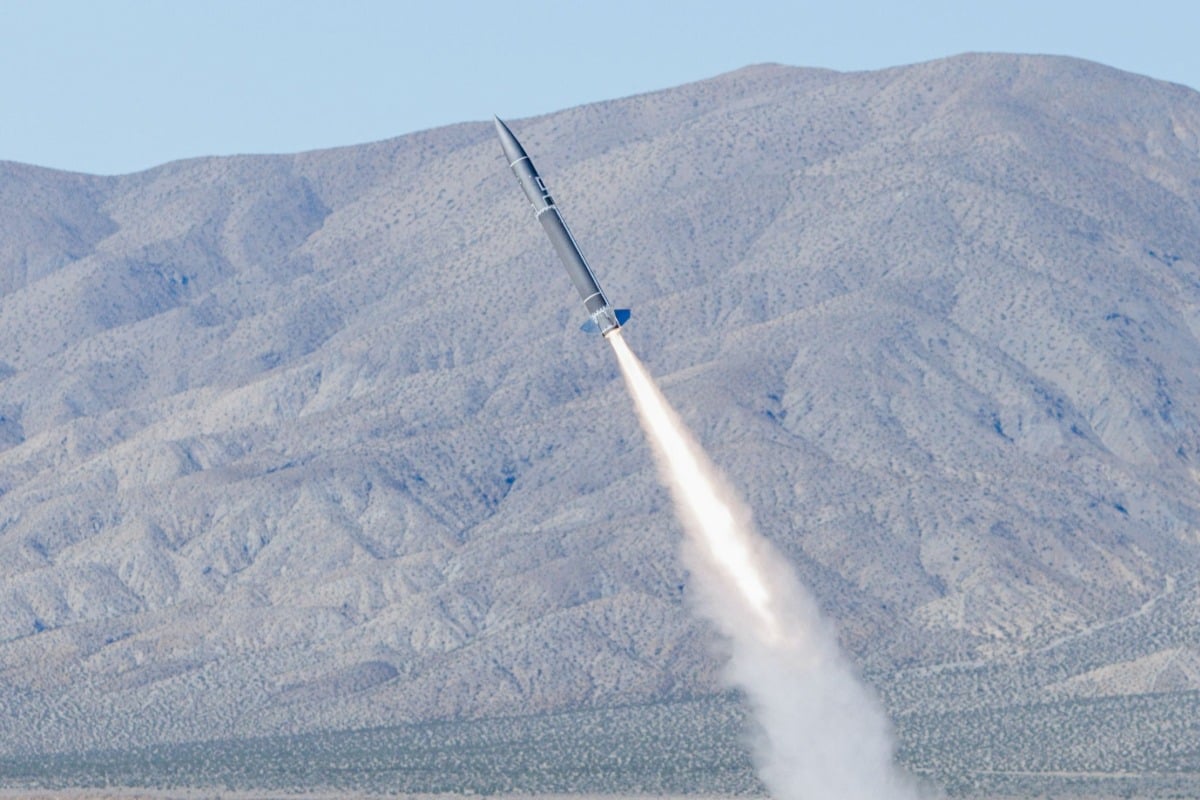
- The U.S. Navy awarded Castelion Corp. a $23.4 million contract on June 12, 2026 to produce 50 pre-production prototypes of the Blackbeard hypersonic missile, with work completing December 2027.
- Saronic and Castelion announced plans on June 11, 2026 to integrate Blackbeard onto Saronic's Marauder unmanned surface vessel, targeting a maritime launch demonstration in 2027.
Hypersonic weapons have long been the most expensive category of precision strike munitions in any military’s arsenal, costing tens of millions of dollars per round and taking decades to develop. The U.S. Navy is now betting on a different model entirely, awarding Castelion Corp., a defense technology startup based in Torrance, California, a $23.4 million contract to produce 50 early operational capability pre-production prototypes of its Blackbeard hypersonic strike missile along with 50 dedicated storage and shipping containers. The contract, awarded on June 12, 2026, is the latest step in a program explicitly designed to produce hypersonic weapons at a price point and production rate that previous programs never attempted.
Blackbeard is a low-cost hypersonic strike missile developed by Castelion, built to travel at speeds exceeding Mach 5, roughly five times the speed of sound, along trajectories that are far harder for modern air defense systems to intercept than a subsonic missile following a predictable arc. The $23.4 million prototype contract covers development-stage hardware at different economics, but the long-term production cost target is the number that defines the program’s ambition: a hypersonic weapon cheap enough to buy in the quantities that would make an adversary’s air defense planning genuinely difficult.
The contract falls under a Small Business Innovation Research Phase III effort titled “Low Cost Highly Manufacturable Long Range Strike Weapon Production,” a program designation that signals Washington’s priorities as clearly as any policy document. Work will be performed 75% in Rio Rancho, New Mexico, where Castelion is building its Project Ranger manufacturing campus, and 25% in Torrance, California, with completion expected by December 2027. The same basic ordering agreement that covers this prototype contract has funded every prior Blackbeard development order, including a $50 million order in February 2026 for full-scale prototypes and flight testing, and a $105 million modification in April 2026 to integrate Blackbeard onto the F/A-18 carrier-based fighter for live fire testing in the Indo-Pacific, as The Defence Blog previously reported.
The pace at which this program has accumulated contracts reflects a deliberate acceleration that distinguishes it from every previous hypersonic weapons effort the Pentagon has funded. Castelion went from clean-sheet design to more than 25 flight tests in under two and a half years, building the weapon for mass production from inception rather than treating manufacturability as a secondary concern. The company has committed more than $250 million in private capital to Project Ranger, a 1,000-acre hypersonic manufacturing campus in Sandoval County, New Mexico, designed for vertically integrated production of solid rocket motors, guidance systems, and final assembly, with all 21 planned structures targeted for completion by end of 2026. In May 2026, the Department of War signed a production framework agreement with Castelion for a guaranteed minimum of 500 Blackbeard missiles per year once testing and validation is complete, with a pathway to purchase thousands of additional missiles annually.
A day earlier, on June 11, Castelion and Saronic announced plans to integrate Blackbeard with Saronic’s Marauder MUSV for a 2027 maritime launch demonstration, adding a third launch domain to a weapon already being integrated onto carrier-based fighters and Army HIMARS rocket artillery. Saronic Technologies, an Austin, Texas-based autonomous vessel company founded in late 2022, built the Marauder, a medium unmanned surface vessel approximately 55 meters (180 feet) in length capable of operating without a crew. Saronic brought Marauder from design to on-water trials in under a year and is actively building three more hulls at its shipyard in Franklin, Louisiana, while executing a $300 million shipyard expansion expected to deliver production capacity for 20 Marauders annually by end of 2026.
Dino Mavrookas, Co-Founder and CEO of Saronic, described what the integration means for adversary planning. “Launching a Castelion hypersonic from a Marauder MUSV significantly changes the approach for any adversary calculating where and how the U.S. can strike,” Mavrookas said.
Bryon Hargis, Co-Founder and CEO of Castelion, framed it from the warfighter’s perspective. “Blackbeard and Marauder will give our warfighters more shots, from more places, with fewer constraints,” Hargis said.