


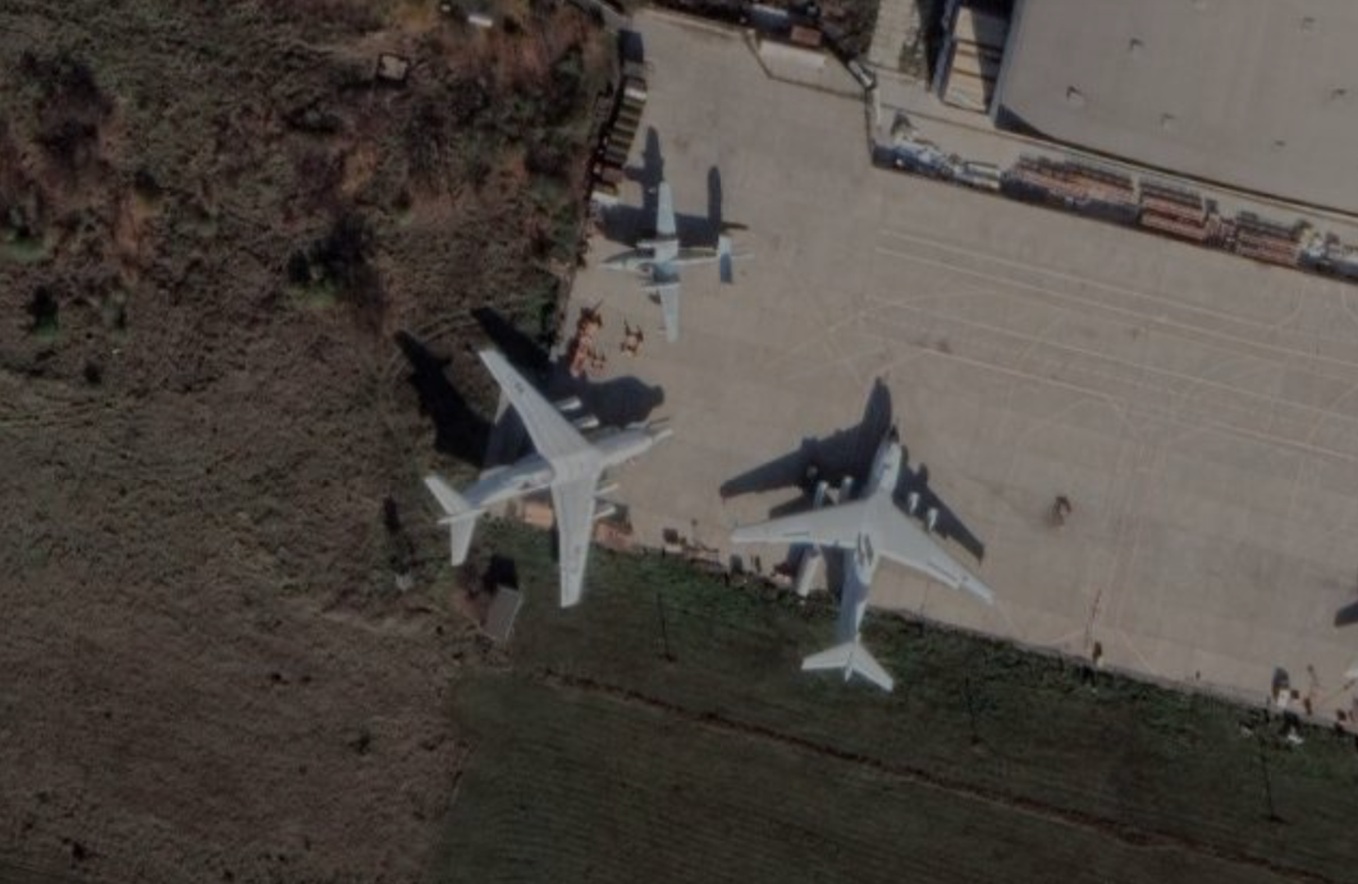
- Ukrainian forces struck the Russian A-60 laser aircraft during a November 25 attack in Taganrog, Militarnyi reported.
- The strike hit the Beriev aviation complex and the Taganrog-Yuzhny airfield, where the A-60 was undergoing work.
Ukrainian Defense Forces carried out a nighttime strike on Tuesday that hit a rare Russian Beriev A-60 airborne laser aircraft stationed in Taganrog, according to a report from the Ukrainian outlet Militarnyi.
The aircraft, a laser-armed flying laboratory built from the Il-76MD platform, was developed to test directed-energy systems for the Russian military.
Militarnyi reported that eyewitness video and photos from local residents indicated that the target of the strike was the G. M. Beriev Aviation Scientific and Technical Complex, along with the Taganrog-Yuzhny airfield, which serves as the primary test base for the enterprise. The outlet said the footage showed a fire and secondary detonations in the area used for testing and maintaining special-purpose aircraft.
The Beriev plant specializes in the development, serial production, modernization, and repair of amphibious aircraft and special-mission aviation complexes, including the A-50 airborne early warning and control aircraft. The plant also performs major repairs on Russian Navy aviation platforms and modernization work on Tu-95MSM strategic bomber-missile carriers. The enterprise is part of the United Aircraft Corporation under the state conglomerate Rostec.

In its coverage, Militarnyi wrote that an assessment of one of the strike videos led analysts to conclude that the attack hit, and possibly fully destroyed, the Soviet- and Russian-built A-60 flying laboratory with registration number RA-86879. The aircraft’s appearance at the Taganrog facility and its known role in laser-weapon trials aligns with the location struck during the attack.
The A-60 project dates back to the Soviet period, when the Beriev design bureau was tasked with converting an Il-76MD transport aircraft into a platform for airborne laser research. The gun system was housed inside the cargo hold. On the aircraft’s upper fuselage, engineers installed a large fairing that covered a mirror assembly used to direct the laser beam toward airborne targets. According to design documentation, the gun was intended to operate at a range of roughly 25 miles and deliver a firing sequence totaling 50 seconds. Reports cited by Militarnyi said the practical firing time may have been limited to approximately 11 seconds.
The strike comes at a time when Russia continues to operate specialized aviation infrastructure near the Sea of Azov, including sites for bomber maintenance and radar modernization. The A-60 is one of Russia’s few airborne laser research platforms. The aircraft had been used intermittently for trials and was considered an experimental system rather than a fielded capability.