

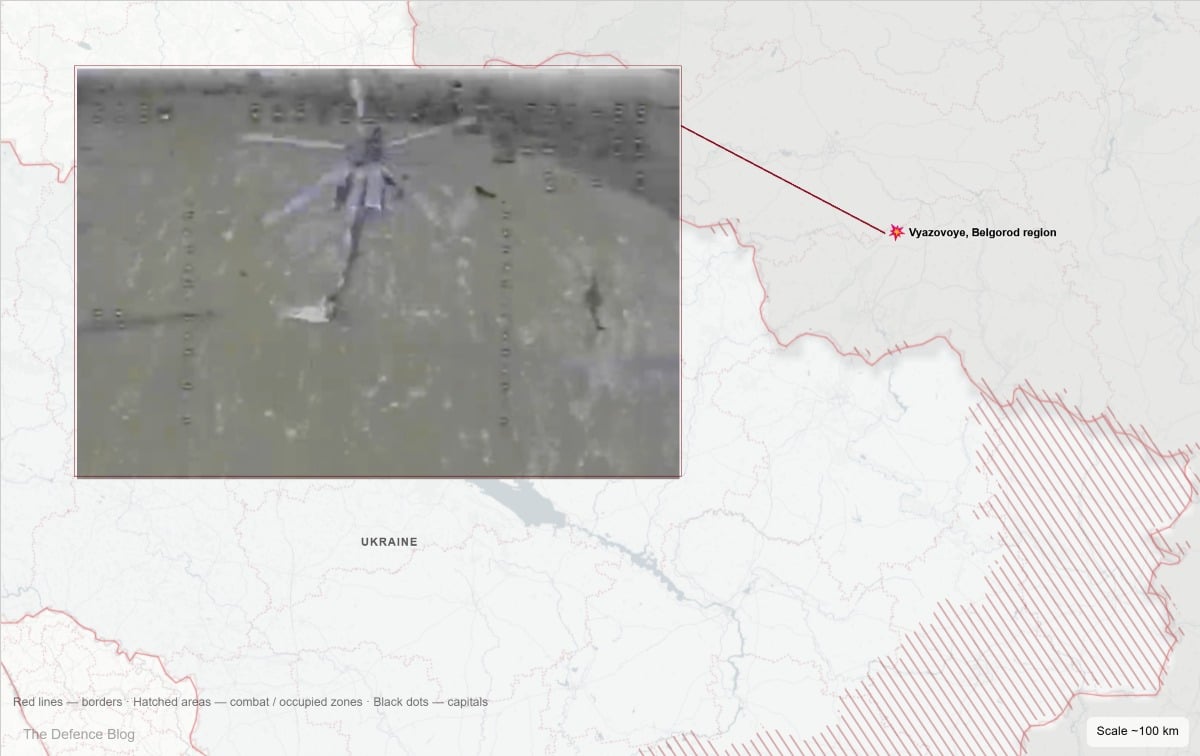
- Ukraine's Unmanned Systems Forces said Rarog unit operators struck a Russian Mi-28 attack helicopter with an FPV drone near Vyazovoye, Belgorod region, Russia.
- The strike hit the helicopter's tail boom around 10:00, and commander Robert Brovdi, known as Madyar, released video of the aircraft's final moments.
Ukraine’s Unmanned Systems Forces, the branch of the Ukrainian military built specifically around drone warfare, said operators from the Rarog unit struck a Russian Mi-28 attack helicopter with a FPV (first-person-view) drone, a small remote-controlled aircraft flown by an operator wearing video goggles that show a live feed from a camera mounted on the drone itself, guiding it directly into the target with far more precision than an unguided weapon could manage.
The strike hit the helicopter’s tail boom, the long rear section of the airframe that connects the main body to the tail rotor, and the impact happened around 10:00 near the village of Vyazovoye in Russia’s Belgorod region, a border area that sits just across the line from Ukraine’s Kharkiv and Sumy regions and has become one of the most heavily contested strips of territory on either side of the front.
Robert Brovdi, the commander of Ukraine’s Unmanned Systems Forces who goes by the call sign Madyar, released the footage himself, showing what he described as the helicopter’s last moments in the air. Brovdi has become one of the most visible faces of Ukraine’s drone war, regularly posting combat footage from units under his command and building a public profile around the argument that cheap, mass-produced drones are reshaping what modern militaries can accomplish against far more expensive equipment.
“Nose-first into the ground,” Madyar said.
That short description matches a pattern that has played out repeatedly since Russia’s full-scale invasion began. The Mi-28, known by NATO as the Havoc and by Russian pilots as the “Night Hunter,” is a dedicated attack helicopter built to destroy tanks, fortified positions, and infantry with a mix of guided missiles and cannon fire, and Russia has leaned on it heavily to strike Ukrainian ground forces throughout the war. The aircraft carries two Klimov TV3-117 turboshaft engines producing 2,200 horsepower each, can reach speeds up to 324 km/h (201 mph), and comes armored heavily enough that its cockpit can withstand hits from 12.7 to 14.5 millimeter caliber machine gun rounds, protection designed with exactly the kind of ground fire it typically faces in mind. What that armor was never built to stop is a slow, cheap drone flown directly into a weak point most of its defenses were never designed to cover.
Ukrainian forces have hit Mi-28s with FPV drones several times before, and the tactic keeps returning because it works and because it costs almost nothing compared to the aircraft it destroys. In August 2024, operators from the Security Service of Ukraine’s Special Operations Center “A” struck a Mi-28 hovering during a tactical landing in Russia’s Kursk region using a Ukrainian-made Darts fixed-wing drone that cost roughly $1,000, an operation Ukrainian officials at the time called a first of its kind. In September 2025, pilots from the Unmanned Systems Forces’ 59th Brigade destroyed another Mi-28N near the village of Kotliarivka in Russian-occupied Donetsk Oblast, and in April 2026 a combined team from Ukraine’s 429th Brigade and 43rd Artillery Brigade struck a Mi-28 and a Mi-8 transport helicopter together at a Russian airstrip in Voronezh Oblast more than 150 kilometers (93 miles) from the front line, deliberately aiming for the rear engine compartment while avoiding the main rotor blades to guarantee a kill. Each of those aircraft runs somewhere around $16 million to $18 million, according to open-source estimates cited by Ukrainian and Western outlets, which means a drone costing a tiny fraction of that price has now repeatedly taken down helicopters that represent one of the more expensive pieces of hardware in Russia’s rotary-wing fleet.
The open-source intelligence project Oryx, which tracks visually confirmed equipment losses on both sides of the war, has documented at least 20 Mi-28s destroyed or damaged since the invasion began, though the real number is likely higher since Russia routinely works to conceal its losses.