

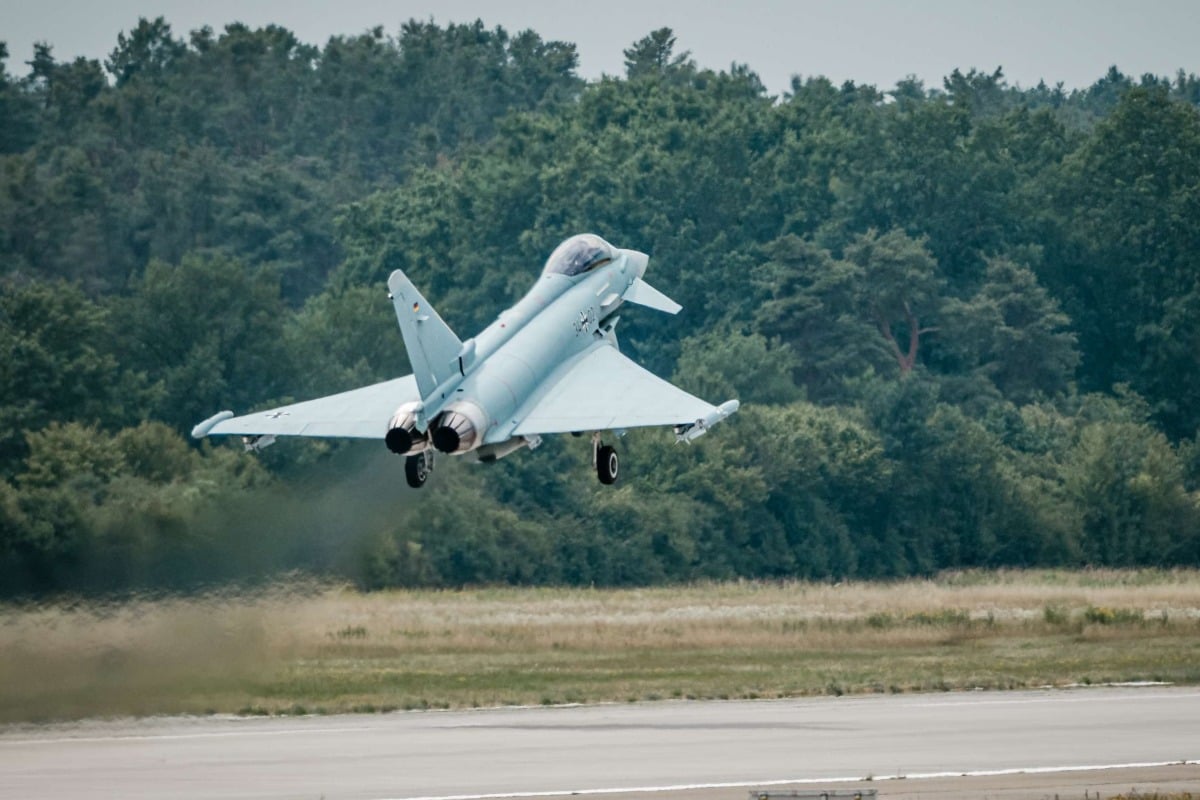
- Airbus Defence and Space confirmed the first Eurofighter Tranche 4 jet built under Germany's Project Quadriga completed its maiden flight this week.
- The aircraft, assembled at Airbus's Manching plant in Bavaria, is expected to be delivered to the Luftwaffe later this year.
A brand new fighter jet lifted off from a runway in Bavaria for the first time this week, and the small crowd watching it climb into the sky understood something the average person scrolling past a headline might not: this single flight just bought Germany’s air force another 20 to 30 years of relevance in European defense, at a moment when the continent’s next-generation replacement program is wobbling badly.
The aircraft is the first Eurofighter Typhoon built to Germany’s new “Tranche 4” standard, produced under a national procurement effort the Luftwaffe calls Project Quadriga, and its maiden flight this week marks the moment years of design work, testing, and political wrangling over money finally turned into a jet actually flying under its own power. Airbus Defence and Space, the European aerospace company that assembles the German Eurofighters at its Manching plant near Munich, confirmed the milestone in a social media post, adding that first deliveries to the Luftwaffe, Germany’s air force, remain on track for later this year.
Conceived in the 1980s and flying operationally since 2003, the Typhoon is a twin-engine, supersonic fighter jet built jointly by Germany, the United Kingdom, Italy, and Spain, and it remains the backbone of several European air forces even as newer stealth aircraft have entered service elsewhere. The jet is powered by two Eurojet EJ200 engines, each producing roughly 90 kilonewtons (20,230 pounds) of thrust in afterburner, giving it enough power to sustain supersonic flight without constantly burning through fuel in afterburner mode, a rare trait called supercruise that few fighters in the world can match. Germany currently flies around 138 Eurofighters spanning three earlier production standards, called Tranche 1 through Tranche 3, and the oldest of those, the Tranche 1 jets, have flown since the early 2000s and carry far more limited sensors and weapons than what the newer aircraft will bring.
The aircraft is fitted with a new type of radar called an Active Electronically Scanned Array, or AESA, a technology that replaces the older mechanically spinning radar dish with a fixed panel made up of hundreds of tiny transmitters, each one able to steer the radar beam electronically in microseconds rather than physically rotating a dish. That change lets the jet track multiple targets simultaneously, switch faster between scanning the sky and scanning the ground, and resist enemy jamming far more effectively than the Eurofighter’s original sensor ever could. Germany’s version of this radar is called the ECRS Mk 1, built by the German sensor company Hensoldt, and the first jets will arrive with what engineers call a Step 0 configuration, essentially the earlier export-standard radar fitted with an upgraded antenna, before a more advanced Step 1 version follows starting in mid-2027, according to Aviation Week, which has tracked the program’s testing schedule closely.
Germany placed its order for 38 of these Tranche 4 jets back in November 2020, split between roughly 30 single-seat fighters and eight two-seat trainer variants, according to Janes, and the aircraft are meant to directly replace the same number of the Luftwaffe’s oldest Tranche 1 jets on a one-for-one basis. Berlin didn’t stop there. Late last year, Germany signed a separate contract for 20 additional Tranche 5 Eurofighters, pushing the country’s total new-build orders to around 58 aircraft scheduled for delivery into the 2030s, part of a broader surge in Eurofighter demand that has also seen Spain and Italy place their own follow-on orders and Turkey sign on as a brand new export customer.
Germany had originally planned for the Eurofighter’s relevance to fade after roughly 2040, once the Future Combat Air System, a joint European program with France and Spain to build a next-generation stealth fighter, was expected to take over as the Luftwaffe’s primary combat jet. That program has run into serious funding and political disputes in recent months, and with its future genuinely uncertain, Germany’s decision to keep investing heavily in upgraded Eurofighters looks less like a bridge to something newer and more like insurance against the possibility that the bridge collapses. Officials have also confirmed that the Tranche 4 jets will eventually carry the Taurus KEPD 350, a long-range cruise missile capable of striking targets from well outside the range of most air defense systems, giving the upgraded Typhoon a strike capability that goes considerably further than the aircraft Germany has flown for the past two decades.
Airbus framed the milestone as something bigger than a single test flight, tying it directly to the continent’s broader push for what officials increasingly call European defense sovereignty, the idea that Europe should be able to design, build, and maintain its own advanced weapons systems without depending on outside suppliers.
“Airbus Defence and Space is on track for the first delivery later this year,” the company said in the social media post announcing the flight.