

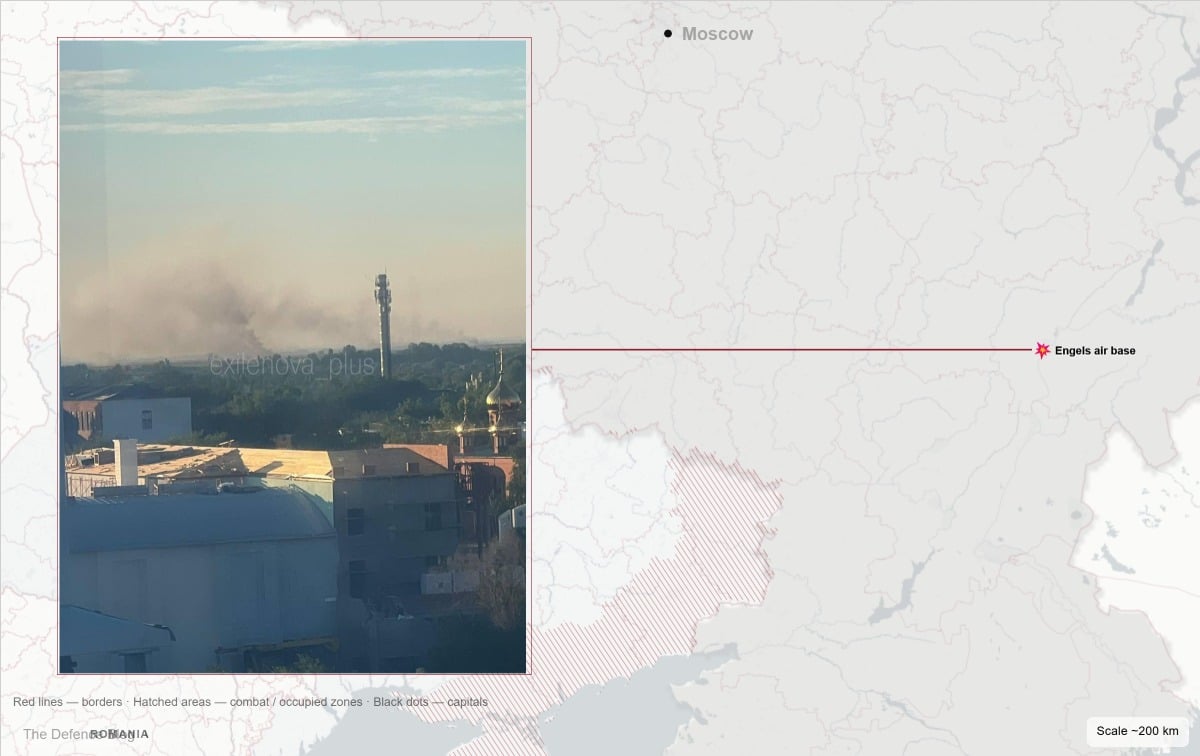
- Ukrainian drones reportedly struck Russia's Engels-2 air base in Saratov Oblast overnight into July 16, according to Russian Telegram channels and monitoring groups.
- Engels-2, located roughly 600 kilometers (370 miles) from Ukraine's front line, hosts Russia's Tu-95MS, Tu-22M3, and Tu-160 strategic bombers.
Ukrainian drones reportedly struck Russia’s Engels air base, officially known as Engels-2, in the Saratov region overnight into July 16, according to Russian Telegram channels and independent monitoring groups, with residents of both Engels and the neighboring city of Saratov reporting a barrage of low-flying drones followed by a string of powerful explosions.
Engels-2 sits roughly 600 kilometers (370 miles) from Ukraine’s front line, deep enough inside Russian territory that a successful strike there says as much about how far Ukraine’s long-range drone program has come as it does about the base itself. The airfield hosts the 184th Heavy Bomber Aviation Regiment and the 121st Guards Heavy Bomber Aviation Regiment, home to Russia’s Tu-95MS, Tu-22M3, and Tu-160 strategic bombers, the same long-range aircraft Moscow has repeatedly used to launch cruise missiles at Ukrainian cities throughout the war. Videos shared by local Telegram channels captured the distinctive drone-engine buzz overhead followed by explosions near the military airfield, footage independent journalists and open-source researchers used to geolocate the strikes to the Engels-2 grounds specifically.
The Ukrainian-linked OSINT monitoring channel Exilenova+ reported that a fire broke out on the airfield, with preliminary indications the blaze started in the aircraft parking area, though that detail has not been officially confirmed by Russian authorities. Ukrainian outlet Militarnyi, drawing on satellite fire-detection data from NASA’s FIRMS system, reported no fire outbreak had been recorded at the base as of its latest check, while separately noting that drones with an unfamiliar straight-wing, V-tail design, distinct from Ukraine’s well-known Liutyi kamikaze drones, appeared in footage of the attack, suggesting Ukraine may have used a newer platform.
The OSINT monitoring account world.militares said its geolocation analysis of strike footage placed the impacts specifically within the grounds of the Engels-2 airfield, a claim consistent with the broader cluster of videos circulating from the area, though it has not been corroborated by an independent outlet. Separately, NASA’s FIRMS satellite fire-detection system reportedly flagged a fire near an S-400 air defense battery positioned in the city of Engels, according to the same OSINT reporting, a detail that, if accurate, would suggest the strike’s effects extended beyond the airfield itself to the surface-to-air missile systems meant to protect it.
Roman Busargin, the governor of Russia’s Saratov region, confirmed only that the area faced a drone attack threat overnight without detailing any consequences, and Russian federal authorities had not issued an official statement on the strike’s outcome at the time of these reports. Beyond the airfield itself, drones also struck an electrical substation in Engels, according to Censor.NET, citing Russian media and open-source monitoring channels, triggering power outages reported by local residents in the aftermath. Russian air defenses were reportedly active over a residential area while attempting to repel the attack, though the extent of any damage to aircraft, fuel storage, ammunition depots, or other military infrastructure at Engels-2 remains unclear, and none of the competing damage assessments circulating from Russian Telegram channels have been independently verified.
Thursday’s reported strike extends a long pattern rather than breaking new ground. Ukraine has targeted Engels-2 repeatedly since the earliest months of the full-scale invasion, starting with a December 2022 drone strike that Russia said killed three servicemen with debris from a drone it claimed to have shot down, though officials at the time said no aircraft were damaged. The base’s fuel storage came under attack in January 2025, when strikes on the nearby Kristall oil depot, part of a facility that supplies jet fuel to the airfield, sparked a fire that burned for five days, an operation Ukraine’s 14th Separate UAV Regiment of the Unmanned Systems Forces carried out. A larger strike in March 2025 destroyed an ammunition depot on the base entirely, an outcome later confirmed through before-and-after satellite imagery shared by a Radio Liberty journalist, showing the complete destruction of warehouse buildings and multiple craters where stored ordnance had been kept.
None of this changes the basic calculation both sides have been running since 2022. Every successful Ukrainian strike on a base like Engels-2 forces Russia to spend money and manpower on repairs, relocations, and additional air defenses protecting facilities its military planners once considered safely out of reach, while every failed intercept adds pressure on a Russian air defense network already stretched thin defending a border that keeps proving more porous to drones than officials in Moscow would prefer to admit. Whatever burned at Engels-2 overnight, and however Russian authorities eventually choose to characterize it, the strike adds one more data point to a war in which the safest place for a strategic bomber in Russia keeps getting harder to find.