

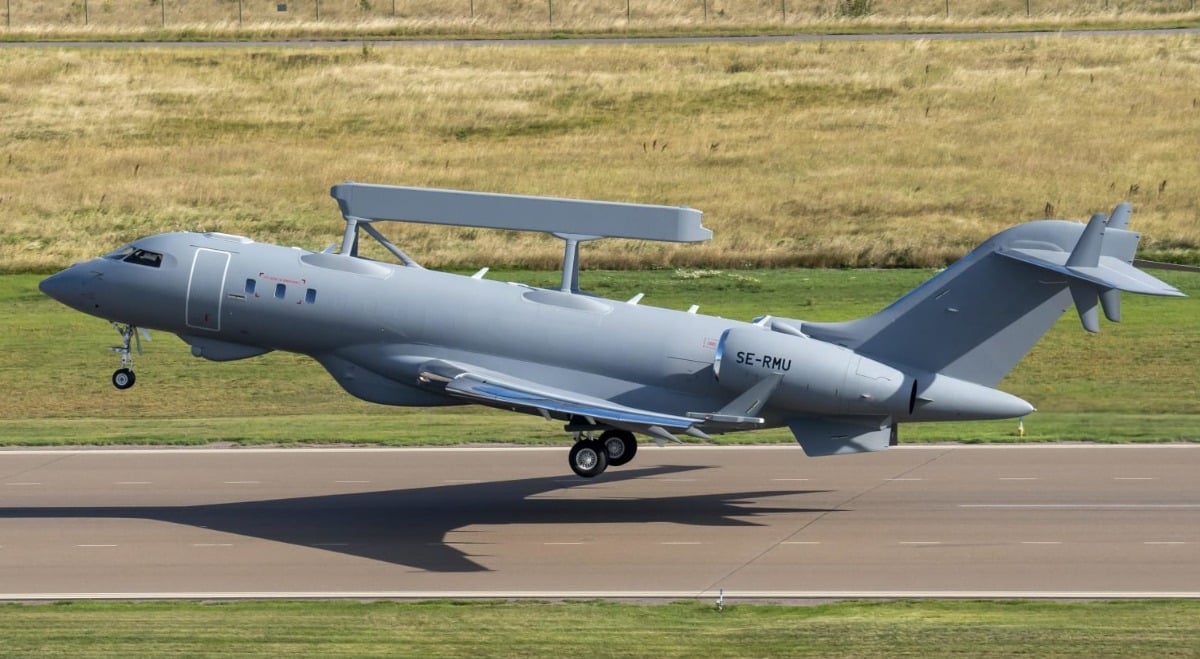
- Saab announced on July 27, 2026 an order for two GlobalEye surveillance aircraft from an undisclosed Middle Eastern country, valued around $1 billion.
- Deliveries under the new contract are scheduled for 2030, and Saab is not disclosing the buyer's identity, citing national security concerns.
The Swedish defense company announced Monday that it has received an order for two GlobalEye airborne early warning and control aircraft from an undisclosed country in the Middle East, a deal valued at roughly $1 billion. Deliveries are scheduled for 2030, and beyond that, Saab isn’t saying much. The company cited the sensitive nature of the defense industry along with national security concerns tied to the customer, declining to name the buyer or offer further detail on the contract.
That kind of confidentiality isn’t unusual in this corner of the defense world, where surveillance aircraft sales often double as intelligence-sharing arrangements between allied governments, and buyers frequently prefer to keep their acquisition of high-end reconnaissance capability out of public view. What isn’t in question is what GlobalEye actually does, and why interest in it keeps climbing. Built on a Bombardier Global 6000 business jet airframe and packed with active and passive sensors, GlobalEye is designed to track and identify targets across three domains at once, in the air, at sea and on land, feeding that picture back to friendly forces in real time so commanders can spot threats before they close the distance. According to figures Saab presented alongside its second-quarter 2026 results, the aircraft can stay airborne for up to 12 hours per mission and detect targets at ranges beyond 650 kilometers (404 miles), putting it in a class of surveillance planes that can watch an entire regional theater from a single orbit far from any border.
Micael Johansson, President and CEO of Saab, framed the sale as part of a broader pattern of demand.
“This order underscores our commitment to providing customers with mission-proven, multi-domain AEW&C capability. The increasing international interest in GlobalEye reflects its effectiveness and reliability in modern air defence operations,” said Micael Johansson, President and CEO of Saab.
That international interest goes well beyond a marketing talking point, since the United Arab Emirates was GlobalEye’s launch customer, taking delivery of five aircraft that put the platform into operational service years ago, and Saab currently holds additional GlobalEye orders from Sweden, which has three on order, and France, which has two. Canada named Saab’s system its preferred supplier for a future airborne surveillance requirement in late May, and NATO announced its intention just weeks before this latest order to acquire as many as ten heavily modified GlobalEye-based aircraft to replace the alliance’s aging AWACS fleet, a move that would make Saab’s system the backbone of NATO’s shared early warning capability for years to come. Against that backdrop of accumulating orders, an undisclosed Middle Eastern buyer joining the customer list signals that demand for the platform now stretches well past its original Gulf foothold and into a genuinely global sales pipeline.
Meeting that demand is becoming its own challenge, and Saab told investors during its second-quarter earnings presentation that supply chain constraints, not factory floor space or hiring, are now the primary bottleneck limiting how fast it can build GlobalEye aircraft, with the company working to scale annual production from two aircraft today to roughly six by 2030 through supplier partnerships rather than a major expansion of its own infrastructure. Saab is investing about 10 billion Swedish kronor annually across its business into capacity expansion generally, with new production facilities in Grayling, Michigan, and in India expected online in late 2026 and early 2027, moves that reflect a broader strategy of localizing production closer to key customers and NATO’s own defense industrial base rather than exporting everything from Sweden alone.
This latest contract lands during what has already been a record run for Saab. The company’s order backlog hit new highs in the second quarter of 2026, driven in part by a separate agreement in which Ukraine ordered 16 Gripen E fighter jets valued at roughly $2.5 billion, expected to be formally booked in the third quarter, alongside a roughly $890 million contract with Germany’s TKMS to deliver combat systems and sensors for four new German Navy frigates. Together with the new GlobalEye order, those deals paint a picture of a company whose surveillance and combat aircraft businesses are both being pulled along by the same wave of allied rearmament reshaping European and NATO defense spending this year.