

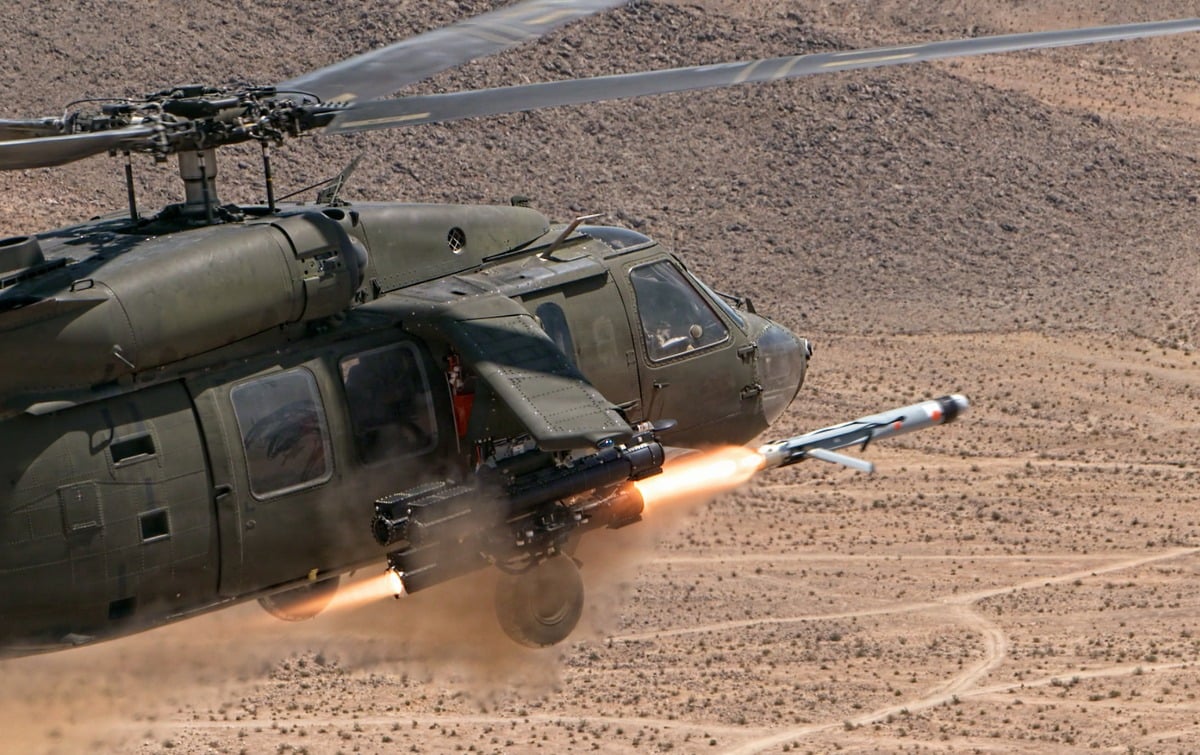
- The U.S. Army demonstrated networked Launched Effects drones at Project Convergence-Capstone 6 at Fort Irwin, California, on July 24, 2026.
- The Army validated its first production-line Long-Range Precision Munition and set a fiscal year 2027 fielding target for the weapon.
The U.S. Army reported that during Project Convergence-Capstone 6, a large-scale experimentation event hosted at Fort Irwin, California, Army Aviation demonstrated a networked strike sequence over the high desert in which two reconnaissance drones located and identified a threat before a third, weaponized drone flew in to finish it off, according to a story by Nelson Ballew of the Army’s Aviation Future Capabilities Directorate.
The exercise centered on a family of systems the Army calls Launched Effects, or LEs, air-launched drones designed to be fired from aircraft and operate at varying ranges and payloads rather than functioning as a single, one-size-fits-all system. Some variants are built purely for reconnaissance, using sensors to find and track enemy positions, while others carry electronic warfare packages meant to jam enemy communications and radar, and still others are armed outright to strike targets directly.
During the Fort Irwin demonstration, two Active/Passive Infrared Launched Effects handled what the Army calls the detect, identify, locate, and report mission, essentially scouting ahead to pinpoint a threat and beam its location back to friendly forces, before a third “lethal” Launched Effect carrying a Long-Range Precision Munition executed the actual strike.
That division of labor matters because it lets the Army keep expensive, crewed aircraft and their pilots out of the most dangerous part of the fight. Integrated Air Defense Systems, the networks of radar, surface-to-air missiles, and anti-aircraft guns that adversaries use to protect their territory from aerial attack, represent one of the most lethal threats facing military aircraft anywhere in the world, and penetrating that kind of defensive shield from a safe standoff distance has become a central goal for Army Aviation planners looking to open corridors for follow-on strikes by other joint forces and unmanned systems.
The Army has run versions of this large-scale experimentation campaign since 2020, using it as a recurring venue to test how new sensors, weapons, and command networks can work together across the joint force and with multinational allies and partners, and this year’s Capstone 6 iteration continued that mission by pushing the Launched Effects portfolio through realistic, contested scenarios rather than controlled laboratory tests.
What distinguished this particular demonstration from earlier Launched Effects testing was the networking behind it. The Army said reconnaissance assets like the medium-range Launched Effects variant used something called the Integrated Tactical Network, operating within a broader command and control system known as Next Generation Command and Control, to push real-time targeting coordinates back to corps-level commanders far from the point of contact. Treating that flow of targeting data as a weapon system in its own right allowed for faster decisions on whether and how to strike, collapsing a process that has traditionally taken far longer when human analysts and manual communications sit in the loop.
The Army also emphasized that these drones are not meant to operate as isolated, one-off assets. Multiple Launched Effects can network together and behave as what the service calls a “wolfpack,” coordinating to overwhelm an adversary’s air defenses through synchronized attacks across multiple directions and altitudes at once, a tactic that mirrors how swarming drone attacks have increasingly stressed traditional air defense systems in conflicts around the world in recent years. Because these systems are designed to be low-cost and expendable, commanders can risk losing individual units in a way they never could with a manned aircraft, giving the Army a tactically survivable way to push into contested, anti-access airspace that adversaries have built specifically to keep expensive aircraft out.
The lethal component of that ecosystem reached a genuine milestone during the exercise. The Army said it validated the first production-line Long-Range Precision Munitions when a manned aircraft, in a separate demonstration from the wolfpack sequence, successfully employed the munition against a high-priority target, with the weapon independently identifying and terminating that target inside contested airspace. That successful evaluation moves the munition past the prototype stage entirely, and the Army has now set a target of fielding it at scale by fiscal year 2027, a timeline that would put a genuinely autonomous, long-range strike weapon into the hands of Combat Aviation Brigades within roughly a year.
Making that fielding practical depends on hardware most readers will never see mentioned by name: the Launched Effects Dispenser for Ground and Rotorcraft, known as LEDGR, and a companion system called Universal Vehicle Control. Rather than building custom launch tubes and cockpit control systems for every individual drone variant the Army fields, these two systems function as a standardized, modular interface that lets aircrews plug in and control whichever Launched Effects payload a mission calls for, and the Army says both enablers are on track to support fielding at scale by fiscal year 2027 as well.
Dan Bailey, Deputy Director of the Aviation Future Capability Directorate, framed the broader strategic logic behind standardizing these systems in blunt terms.
“Launched Effects are not just stand-alone tools; they are networked combat enablers,” said Dan Bailey, Deputy Director, Aviation Future Capability Directorate. “By standardizing our launch and control systems, we’re giving the Combat Aviation Brigades the flexibility to dynamically deploy multiple capabilities, share critical targeting data on the fly, and secure a decisive overmatch against peer adversaries.”
The Army said the strategic value of this networked strike capability extends well past protecting aviation crews. By systematically dismantling an enemy’s long-range artillery, drone networks, and rocket systems deep inside contested territory, Launched Effects can help preserve the combat power of ground maneuver forces as well, creating what the Army described as a protective umbrella over its Maneuver Brigades and increasing overall force survivability during a fight.
Beyond the systems already moving toward fielding, the Army used Capstone 6 to evaluate emerging technology demonstrators within the medium-range Launched Effects category, testing platforms designed for greater speed and range that could carry either lethal or non-lethal payloads depending on the mission. Those systems remain in the technology demonstration phase rather than formal programs of record, and the Army has not specified a timeline for when, or whether, any of them might mature into fielded capabilities.
What the Army has not disclosed is the specific adversary threat systems used to represent the Integrated Air Defense System during the demonstration, the exact number of Launched Effects platforms involved in the wolfpack sequence, or the total planned procurement quantities for the Long-Range Precision Munition once fiscal year 2027 fielding begins. Those gaps leave open exactly how large a role this networked drone-and-missile combination will ultimately play in a real conflict against a technologically capable adversary.