

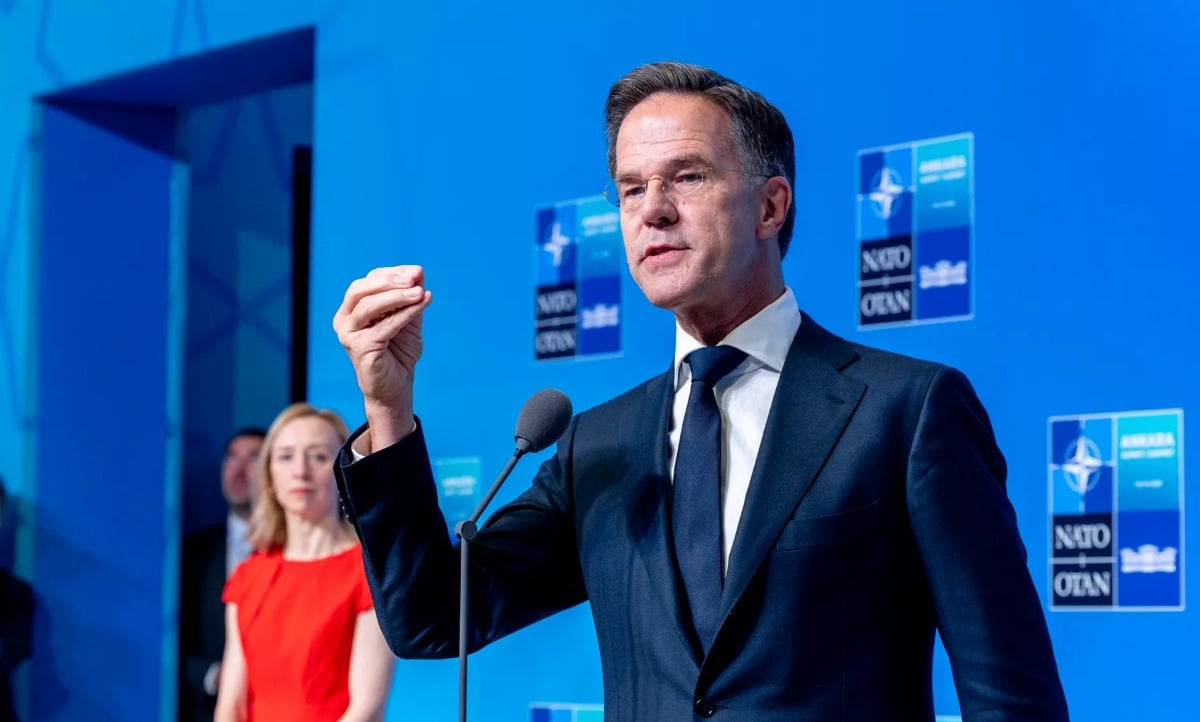
- NATO Secretary General Mark Rutte said at the Ankara summit that Canada and Europe will reach 4% of GDP in defense spending within one year.
- Rutte said the Ankara summit focuses on implementing spending and industry commitments agreed at last year's NATO summit in The Hague.
For nearly seven decades, American presidents tried and failed to get European allies to spend anywhere close to what the United States spends on its own defense, and NATO’s Secretary General says that changed on Donald Trump’s watch. Speaking to reporters ahead of the alliance’s summit in Ankara, Türkiye, Mark Rutte gave Trump direct credit for finally closing a gap that has frustrated the White House since the Eisenhower administration, framing this week’s meeting as proof that years of American pressure on European defense budgets has actually worked.
“President Trump has been able to finally get done what, since Eisenhower, American presidents tried to do, which was to equalize defense spending between Europe and the United States,” Rutte said.
Rutte’s praise for Trump did not tell the whole story on its own, since the Russian threat looming over Europe since Moscow’s full-scale invasion of Ukraine in 2022 has done at least as much as any American president to push European governments toward higher military budgets, a point Rutte acknowledged by noting that the security threat from Russia had also driven the spending shift alongside Trump’s pressure campaign. That combination of American demands and a genuine security emergency on Europe’s own doorstep has reshaped NATO’s internal economics dramatically over the past decade, with the alliance now reporting that European members and Canada have collectively added roughly $1.2 trillion in defense spending since 2016, including a 20 percent jump between 2024 and 2025 alone that Rutte has previously described as the sharpest single-year increase in the alliance’s modern history.
That spending surge builds on a target NATO leaders set just one year earlier at their 2025 summit in The Hague, Netherlands, where allies agreed to raise defense and security-related spending to 5 percent of gross domestic product by 2035, a dramatic jump from the 2 percent benchmark NATO members first adopted in 2014 after Russia’s annexation of Crimea. The new target splits that 5 percent figure into two categories, requiring 3.5 percent of GDP to go toward core military spending like troops, weapons, and equipment, with the remaining 1.5 percent covering broader security-related investments such as cybersecurity, critical infrastructure protection, and transportation networks that matter during a crisis even though they are not traditional military hardware. NATO says every member state had already reached the older 2 percent benchmark by 2025, a dramatic shift from 2014, when only three of the alliance’s members met that lower bar.
Rutte framed this year’s gathering in Ankara as fundamentally different in character from last year’s meeting in the Netherlands, arguing that The Hague summit set the targets while Ankara exists to prove allies can actually hit them.
“The last summit in The Hague was all about planning and targeting; it was about the money, it was about industry, it was about, of course, continuing our support for Ukraine,” Rutte said. “This summit, as I always said, is about implementation, getting it done.”
Rutte described the summit’s opening day as a strong start toward that implementation goal, pointing to a wave of new contracts and formal commitments signed on the sidelines as evidence that the spending pledges are translating into actual weapons and industrial capacity rather than remaining abstract budget targets on paper. That framing lines up with a broader theme NATO officials have pushed throughout the Ankara gathering, often shorthanded as “NATO 3.0,” a concept that originated within the Pentagon under the Trump administration and envisions European members taking far greater responsibility for their own conventional defense while American forces play a smaller, more supporting role on the continent going forward. Rutte has publicly embraced that framing in recent months, describing his goal as building an alliance that is less dependent on the United States while still keeping American power firmly rooted within it, a balancing act that requires convincing Washington that European capability is growing fast enough to justify any reduction in direct American military presence.
Rutte also pointed to a concrete milestone that both European members and Canada are approaching together on the path toward the full 2035 target.
“In one year, Canada and Europe are getting to 4%, and that means huge increases in core defense spending, also increases, of course, in defense-related spending,” Rutte said.
That figure represents a meaningful jump from the 2 percent benchmark that took most alliance members roughly a decade to reach after adopting it in 2014, suggesting the pace of increases has accelerated considerably as European governments respond to both American pressure and the ongoing war just beyond NATO’s eastern border. Poland currently sits well ahead of that curve as the alliance’s highest spender by percentage of GDP, at roughly 4.3 percent, giving other members a working example of what a fully implemented 5 percent target could look like across an entire military budget rather than in isolated pockets of spending.
Ukraine’s ongoing war against Russia continued to anchor much of Rutte’s remarks, with the NATO chief reiterating that continued support for Kyiv remains a central alliance priority even as attention at this year’s summit shifts toward defense-industrial capacity and the broader implementation push. That commitment carries real weight given reports that NATO allies are expected to pledge roughly $76 billion (€70 billion) in military assistance to Ukraine for 2026 alone, with a promise of at least equivalent support carrying into 2027, a level of sustained funding that would mark one of the longest continuous multiyear aid commitments any coalition has made to Ukraine since Russia’s invasion began.
Rutte closed his remarks with the alliance’s most direct message yet to Moscow, delivered in response to a question about what he wanted Russia to hear from Ankara.
“My message is that this alliance of 1 billion people living in Europe, living in Canada, living in the United States, that this alliance will defend every inch of our territory that you cannot win from NATO,” Rutte said. “We are defensive. We will never attack anyone. We will only defend our way of life, our democracies, our territory. So don’t fool with us, don’t play with us.”
Whether Rutte’s message to Moscow lands with the deterrent force he intends may ultimately depend less on the words themselves and more on whether the spending numbers he cited in Ankara keep climbing at the pace he described, because an alliance that talks tough while missing its own budget targets sends a very different signal than one that actually shows up with the checkbook to match.